
ChinaKnowledge.de -
An Encyclopaedia on Chinese History, Literature and Art
Senior Lecturer, Department of Chinese Studies, University of Tübingen, Germany
Specializing in the economic, military, and administrative history of late imperial China Dr. Theobald's research projects include an analysis of the Second Jinchuan Campaign (1771-1776): Economic, Social and Political Aspects of an Important Qing Period Border War (2013). This book is the most detailed study to date of the financing and supply arrangements of one of the great wars of the Qing dynasty. It was carried out as part of the international research project "Monies, Markets, and Finance in China and East Asia, 1600-1900", funded by the German Research Foundation.
One of his current projects investigates the impact of the sale of offices during the 18th/19th centuries on the employment structure of state examination graduates, with a shift to life-long modes of "on-the-job training". The project "Administrative Military Law in Late Imperial China: Accounting (Junxu zeli 軍需則例) and Production of Weapons and the Managing of Arsenals (Junqi zeli 軍器則例)" is one of just a few studies of zeli regulations for administrative purposes. An analysis and translation of Zheng Qiao's 鄭樵 Tongzhi jiaochou lüe 通志校讐略 (1161) and Zhang Xuecheng's 章學誠 Jiaochou tongyi 校讐通義 (1779) offers a contribution to theoretical approaches in historical Chinese bibliography. At present a project on Jiang Fangzhen's 蔣方震 (Jiang Baili 蔣百里, 1882-1938) book Caibing jihua shu 裁兵計畫書 (1923) is conducted. In this writing, published during the height of the warlord confrontations in northern China, Jiang brought forward suggestions for a regulated mode of demobilization and shortly described a federal system of autonomous "United Provinces" (liansheng zizhi 聯省自治).
Dr. Theobald is editor of the books Money in Asia (1200 -1900): Small Currencies in Social and Political Contexts (with Jane K. Leonard; Brill 2015) and Southwest China in Regional and Global Perspectives (c. 1600 - 1911): Metals, Transport, Trade and Society (with CAO Jin; Brill 2018), and author of War Finance and Logistics in Late Imperial China: A Study of the Second Jinchuan Campaign (Brill 2013) and several articles on monetary history, employment of civilians in the military, military pay and corruption, weights and measures, as well as on Chinese empresses, musical theory and the history of energy in traditional China. A book on the history of bibliography in China is in progress.
Ulrich Theobald is the editor of ChinaKnowledge.de, a widely known online encyclopaedia on Chinese history, literature and art, and author of the more than 3,000 articles found in it. Between 2014 and 2016 he was co-editor of the journal East Asian Science, Technology, and Medicine. He also developed a curriculum for the documentary Manchu language which he has been teaching since 2008.
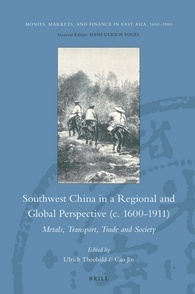 |
The book Southwest China in Regional and Global Perspectives (c. 1600-1911), edited by Ulrich Theobald and CAO Jin, is dedicated to important issues in society, trade, and local policy in the southwestern provinces of Yunnan, Guizhou and Sichuan during the late phase of the Qing period. It combines the methods of various disciplines to bring more light into the neglected history of a region that witnessed a faster population growth than any other region in China during that age. The contributions to the volume analyse conflicts and arrangements in immigrant societies, problems of environmental change, the economic significance of copper as the most important “export” product, topographical and legal obstacles in trade and transport, specific problems in inter-regional trade, and the roots of modern transnational enterprise. |
 |
The article "Space and Place in Administrative Military Regulations of Qing China: An Evaluation of the Legal Type of zeli" (in Extrême-Orient Extrême-Occident, 40/2016) analyses three sets of regulations for military administration during the high Qing period, the War Supplies and Expenditure Regulations (Junxu zeli), and the Weapons and Military Equipment Regulations (Junqi zeli) of the Ministry of War and that of the Ministry of Works. It will be shown that superficially all three provided clear and detailed rules for a wide range of aspects of military administration and organization. In practice, they allowed sufficient leeway to adapt to local conditions and permitted a great measure of autonomy. The reason was that all three codes mainly aimed at cutting expenditure, not at unifying the armament or equipment. The failure of unifying the equipment and modernizing the regulations in the early 19th century had fatal consequences. |
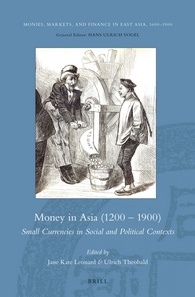 |
Money in Asia (1200-1900): Small Currencies in Social and Political Contexts (Leiden: Brill, 2015) examines two chronic problems that faced early modern monetary economies in East, South, and Southeast Asia: The inability to provide sufficient amounts of small currencies to facilitate local economic transactions and to control currency depreciation. The studies in this volume analyze the social and economic consequences of small currency scarcity and devaluation on various Asian economies and show how various regimes tried to manage these ever-present challenges. They reveal that those regimes that dealt most successfully with these two issues were those with an integrated national approach to monetary policy. |
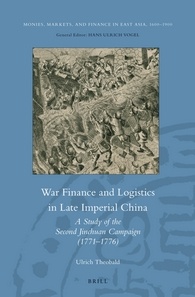 |
In his book War Finance and Logistics in Late Imperial China: A Study of the Second Jinchuan Campaign (1771–1776) (Leiden: Brill, 2013) Ulrich Theobald shows how the Qing dynasty (1644 – 1911) overcame the tyranny of logistics and successfully enlarged the territory of its empire. A detailed analysis of the long and expensive second Jinchuan war (1771 – 1776) in Eastern Tibet demonstrates that the Chinese state ordered its civilian officials as well as the common people, merchant associations, and different ethnic groups to fulfil and to foot the bill for the “common cause”. With increasing military success the state gradually withdrew from its responsibilities, believing that a War Supply and Expenditure Code (Junxu zeli) might offset the decreasing skill in and readiness to imperial leadership. |