ChinaKnowledge.de -
An Encyclopaedia on Chinese History, Literature and Art
Nanzhao 南詔 was a state in the region of modern Yunnan whose population consisted to the tribes of the Black Man (wuman 烏蠻) and the White Man (baiman 白蠻). It flourished between 649 and 902.
At the end of the 6th century the largest tribes of the region around Lake Erhai were six Black Man tribes whose chieftains were called the "six kings" (liu zhao 六詔, zhao being a native word for "chieftain"). The six tribes were called Mengshe 蒙舍 (short: Meng 蒙), Mengsui 蒙嶲, Langqiong 浪穹, Dengtan 邆賧, Shilang 施浪, and Yuexi 越析. Adding up the chieftains of the Shihe 石和 and Shiqiao 石橋 (or Shibang 時傍 ans Yichuan Luoshi 矣川羅識) Chinese sources also speak of the "eight kings" (ba zhao 八詔). The southernmost of these tribes were the Mengshe whose rulers were therefore also called the "southern kings" (nanzhao 南詔). When the family Meng took over the rulership over all tribes of the region, this designation became the name of their kingdom.
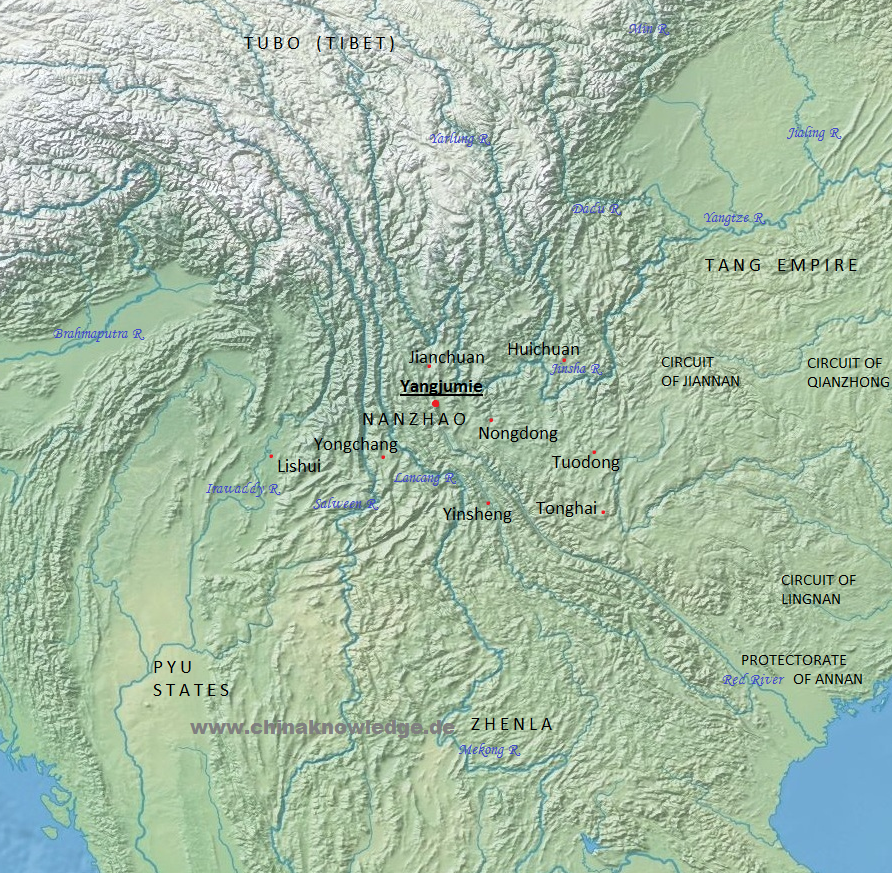 |
Southwest China and its surroundings c. 800-950. Based on Tan Qixiang 譚其驤, ed. (1995), Zhongguo lishi ditu ji 中國歷史地圖集, Vol. 5, Sui, Tang, Wudai, Shiguo shiqi 隋唐五代十國時期 (Beijing: Zhongguo ditu chubanshe, 1996). Borders, being of a considerably volatile character, are not indicated. |
In 649 the chieftain of the Mengshe tribe, Xinuluo 細奴邏 founded a kingdom, the "great land of the Meng" 大蒙國 and adopted the title of "Outstanding King" (qijiawang 奇嘉王). He nevertheless accepted the supremacy of the Tang dynasty 唐 (618-907) and delivered tributes to the Tang court. With Chinese support his descendant Piluoge 皮邏閣 was able to unite the six Man tribes and moved his capital from Mengshe (near modern Weishan 巍山, Yunnan) to Yangjumie 陽苴咩 (near modern Dali 大理). In 738 Piluoge was officially given the title of prince or king (wang 王) of Yunnan 雲南 by the Tang court and was bestowed the Chinese-style name of Meng Guiyi 蒙歸義 (literally "dedicating himself to righteousness"). Piluoge and his son Geluofeng 閣羅鳳 (r. 748-779) expanded the realm of Yunnan towards the north and west and ended the domination of the family Cuan 爨 in this region. They also occupied the territories of the tribes of the Xunchuan 尋傳, Puzi 朴子 and Wangjuzi 望苴子 in the western neighbourhood, along the River Lancangjiang 瀾滄江 (i.e. the upper course of the Mekong ). The kingdom of Nanzhao became an important state in the mountainous southwestern region of what was to become China.
The expansion of Nanzhao caused problems with the Tang empire that tried dominating this southwestern region with the founding of the prefecure of Yaozhou 姚州 (modern Tao'an 洮安, Yunnan) and the city of Anning 安寧. The military commissioner (jiedushi 節度使) of Jiannan 劍南, Xianyu Zhongtong 鮮于仲通, and the governor (taishou 太守) of the commandery of Yunnan, Zhang Qiantuo 張虔陀, tried diminishing the autonomy of the kings of Nanzhao and impeding a further expansion. In 750 therefore Geluofeng attacked Yaozhou and killed the governor. He declared his tributary relation to the Tang empire as ended and offered the king of Tubo 吐蕃 (Tibet) his alliance. Two years later he was indeed bestowed the Tibetan title of tsanpo chung 贊普鍾 "royal brother", was given an official seal of the Tibetan empire, and was even granted the title of "Eastern Emperor" (dongdi 東帝).
The chief counsellor of the Tang, Yang Guozhong 楊國忠, dispatched an army to bring Nanzhao back into subordination, but the Chinese army was defeated by Nanzhao. Shortly later the rebellion of An Lushan 安祿山 shook the Tang empire, and the imperial court had no opportunity to engage militarily in the southwestern borderlands. Nanzhao used this opportunity to expand its influence towards the north and the east and expanded into the regions of modern Sichuan and Guizhou. Under King Yimouxun 異牟尋 (r. 780-808) Nanzhao achieved its largest expansion. It was, nonetheless, a vassal state of Tibet that sometimes supported Nanzhao against the Tang empire, but also required tributes and military services.
In 787 the disturbances in the Tang empire were brought to an end, and the military commissioner of Xichuan 西川, Wei Gao 韋皋, again attacked the borders of Nanzhao. In that situation Nanzhao was weakened by the military tributes to be delivered to Tibet in the campaign against the Uyghurs 回鶻 of Beiting 北庭 in the northwest. Extremely frustrated by this kind of relationship the king of Nanzhao in 794 decided to break ties with Tibet and to revive the vassalship to the Tang empire. Yimouxun was even willing to offer his military support in a campaign against Tibet. He was rewarded with the title of King of Nanzhao. This did not impede him and his successors to pursue the belligerent actitivies common to the people of Nanzhao. In 829 the troops of Nanzhao conquered Chengdu 成都 and seized booty, women and tradesmen. At that time the central government of the Tang empire was already too weak to undertook punitive campaigns or to fend off intruding Nanzhao troops.
Like many neighbouring states of China, the kingdom of Nanzhao adopted some patterns of the Chinese administratorial system, like the six ministries (in Nanzhao called liucao 六曹), namely that of war (bingcao 兵曹), revenue (hucao 戶曹), rites (kecao 客曹), justice (facao 法曹), personnel (shicao 士曹), and granaries (cangcao 倉曹). Later on these were divided into three agencies (santuo 三托) and nine courts (jiushuang 九爽). The three agencies were that of horses (qituo 乞托), cattle (lutuo 祿托) and that of grain (jutuo 巨托). The nine courts were that of military (mushuang 幕爽), household registers (congshuang 琮爽), rituals (cishuang 慈爽), punishment (fashuang 罰爽), officials (quanshuang 勸爽), works (jueshuang 厥爽), finance (wanshuang 萬爽), guests (yinshuang 引爽), and trade (heshuang 禾爽). The highest minister was the counsellor (qingpingguan 清平官). The kingdom was administered territorially by military commissioners (jiedushi 節度使) and commanders-in-chief (dudu 都督) that controlled the prefectures (jian 瞼).
| military commissions (jiedu 節度) | |
|---|---|
| Jianchuan 劍川 | Jianchuan, Yunnan |
| Lishui 麗水 | 10 km south of Myitkyina, Myanmar |
| Nongdong 弄棟 | Yao'an 姚安, Yunnan |
| Tuodong 拓東 (prefecture of Shanchan 善闡府) | Kunming 昆明, Yunnan |
| Yinsheng 銀生 | Jingdong 景東, Yunnan |
| Yongchang 永昌 | Baoshan 保山, Yunnan |
| commanderies (dudu 都督) | |
| Huichuan 會川 | Huili 會理, Yunnan |
| Tonghai 通海 | Tonghai, Yunnan |
Sons of the Nanzhao aristocracy visited Chengdu and the Tang capital Chang'an 長安 (modern Xi'an 西安, Shaanxi) to obtain a Chinese education, and the Chinese Zheng Hui 鄭回, once caputured during a campaign, acted as royal mentor and even as counsellor-in-chief of Nanzhao. Poems of the Nanzhao aristocracy and courtiers are included into the collection Quantangshi 全唐詩, for instance, poems by King Longshun 隆舜 (r. 878-897) and counsellor Yang Qikun 楊奇鯤. Chinese artisans and craftsmen were employed at the Nanzhao court, and Buddhism found many believers among the Nanzhao population. Chongsheng Monastery 崇聖寺 in Dali and the famous three pagodas at Dali were constructed during the Nanzhao period.
The royal court of Nanzhao lost its initial impetus during the end of the 9th century. King Longshun was in 897 assassinated by Yang Deng 楊登. In 902 Zheng Maisi 鄭買嗣, a descendant of Zheng Hui, usurped the throne and ended the rule of the Meng family of Nanzhao. He founded the second dynasty of Nanzhao and changed the name of the country to Da Changhe 大長和. The Zheng family ruled until 927 and was then replaced by 趙善政 (r. 928-929), ruler of Da Tianxing 大天興, who was again followed by Yang Ganzhen 楊干真 (r. 930-937), who gave the country the name Da Yining 大義寧. In 937 Duan Siping 段思平, military commissioner of Tonghai 通海, conquered Dali and founded the state with the same name, see Dali 大理.
| name | reign | reign motto |
| Kingdom of Da Meng 大蒙國 617-902 | ||
|---|---|---|
| Meng Xi-nu-luo 蒙細奴邏 (Du-luo 獨羅) | (r. 617-674) | |
| Meng Luo-sheng 蒙邏盛 | ||
| Meng Sheng-luo-pi 蒙盛邏皮 | ||
| Meng Pi-luo-ge 蒙皮邏閣 | (r. 697-748) | |
| Meng Ge-luo-feng 蒙閣羅鳳 | (r. 748-779) | Changshou 長壽 (769-779) |
| Meng Yi-mou-xun 蒙異牟尋 | (r. 779-808) | Shangyuan 上元 (784-?) Yuanfeng 元封 (?-?) |
| Meng Xun-ge-quan 蒙尋閣勸 | (r. 808-809) | |
| Meng Quan-long-cheng 蒙勸隆晟 | (r. 810-816) | Longxing 龍興 (810-816) |
| Meng Quan-li-(sheng) 蒙勸利(晟) | (r. 816-823) | Quanyi 全義 (817-819) Dafeng 大豐 (820-823) |
| Meng Quan-feng-you 蒙勸豐祐 | (r. 823-859) | Baohe 保和 (824-839?) Tianqi 天啟 (?-?) |
| Meng Shilong 蒙世隆 | (r. 859-877) | Jianji 建極 (860-872?) Fayao 法堯 (?-?) |
| Meng Da-feng-min 蒙大封民 (Longshun 隆舜) | (r. 877-897) | Zhenming 貞明 (878-?) Chengzhi 承智 (?-?) Datong 大同 (?-?) Cuoye 嵯耶 (?-?) |
| Meng Shun-hua-zhen 蒙舜化貞 | (r. 897-902) | Zhongxing 中興 (898-902) |
| Kingdom of Da Changhe 大長和 (903-927) | ||
| Zheng Maisi 鄭買嗣 (Emperor Huan 桓帝) | (r. 903-909) | Anguo 安國 (903-909) |
| Zheng Renmin 鄭仁旻 (Emperor Taishang 太上帝) | (r. 909-926) | Shiyuan 始元 (910-912?) Tianrui jingxing 天瑞景星 (?-?) Anhe 安和 (?-?) Zhenyou 貞祐 (?-?) Chuli 初曆 (?-?) Xiaozhi 孝治 (?-?) |
| Zheng Longtan 鄭隆亶 (Emperor Gonghui 恭惠帝) | (r. 926-927) | Tianying 天應 (927) |
| Kingdom of Da Tianxing 大天興 (928-929) | ||
| Zhao Shanzheng 趙善政 | (r. 928-929) | Zunsheng 尊聖 (928-929) |
| Kingdom of Da Yining 大義寧 (930-937) | ||
| Yang Ganzhen 楊干真 | (r. 930-937) | Xingsheng 興聖 930 Daming 大明 (931-937) |