ChinaKnowledge.de -
An Encyclopaedia on Chinese History and Literature
Longkan shoujing 龍龕手鏡, also called Longkan shoujian 龍龕手鍳 (龍龕手鑑) "Hand mirror of the dragon niche", is a dictionary with words arranged in mixed system of character radicals and phonetic value. It was written during the Liao period 遼 (907-1125) by the Buddhist monk Xingjun 行均. The preface, written by Zhiguang 智光, dates from 997.
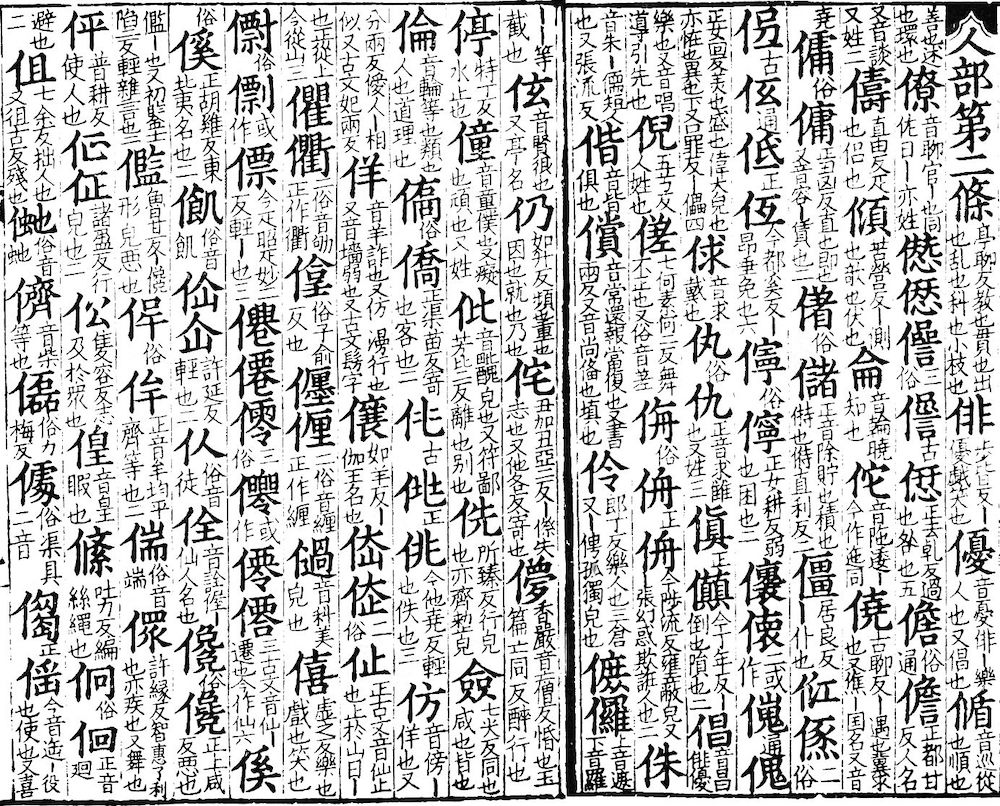 |
Example from the Longkan shoujian 龍龕手鑑, beginning of the radical 人 "man", Sibu congkan xubian 四部叢刊續編 edition, reproducing a Song-period 宋 (960-1279) print from the collection of the family Fu 傅氏 from Jiang'an 江安, Sichuan (Shuangjian Studio 雙鑑樓). |
The radicals are arranged according to 240 rhyme groups, divided into the four tone pitches level tone rhymes (pingsheng 平聲) with 97 rhyme groups, falling-rising tone rhymes (shangsheng 上聲) with 60 rhyme groups, falling tone rhymes (qusheng 去聲), with 26 rhyme groups and entering tone rhymes (rusheng 入聲) with 59 rhyme groups. This arrangement is unique among all traditional Chinese dictionaries.
Under the radical level, the characters are likewise arranged according to the four tone pitch system. The dictionary contains 26,430 characters, among them not only the standard script types (zhengti 正體), but also alternative characters (huoti 或體 or yiti 異體), abbreviated characters of daily use (suti 俗體), as well as a vast amount of character variants used in Buddhist writings.
The compilation of the Longkan shoujian was not done very well, and therefore many writing errors, as well as inconsistencies decrease the value of it. For example, the radical 亠 includes the characters 高 and 亭, which are radicals by themselves; the character 處 is listed under the radical 几, and it is a radical by itself; the character 其 is used as a radical for the characters 基, 碁, or 纂, although it is clear that 其 is a phonetic part of these characters, and not a radical.
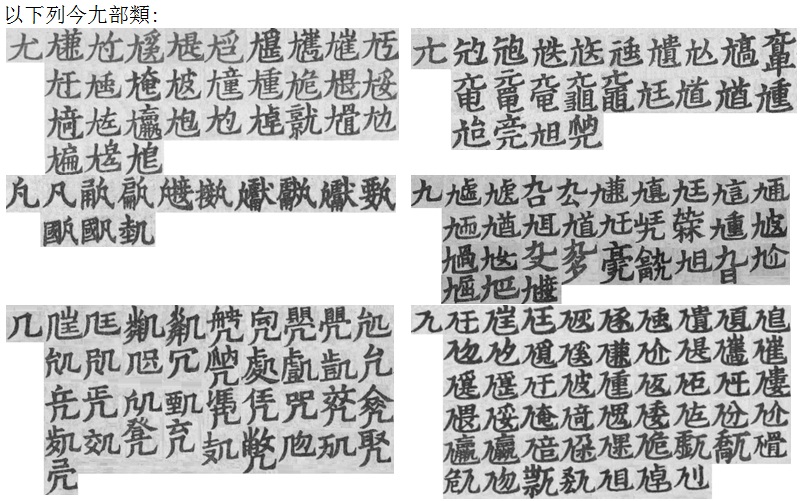 |
Characters distributed over the radicals 尢, 亣, 凡, 九, 几, and 兀. In modern dictionaries, all words are assembled under the (graphical, not semantic) radical 尢. The word 尰 is listed thrice, the words 尲, 𡯾 and 𡯺 (and others) twice. |
This is the case in a large number of the Longkan radicals, so that the peculiar radical system of the Longkan shoujian is not not only geared to the meaning of the characters, but also to oft-used graphemes as a part of the characters (e. g. 歲, 益, 寧, 卑, 興, and many more). Some radicals are also doubled, like 攴 and 攵, 罓 and 罒, 示 and 礻, or even several times, like 尢, 元, 凡, 九, 几, and 兀 (there are several variants of 尫 listed under the radicals 元, 九, 几 and 兀). Many characters appear under several radicals, like 冗, under 冖 and 几, or 黿, under 黽 and 元. In many cases, the radicals themselves are not explained.
From this fact alone it can be seen that the Longkan shoujian is not a general dictionary, but a handbook that specializes on characters used outside the common world of literates, concretely, Buddhist writings.
| 【條】亭聊反。敎也。貫也。出也。亂也。斜也。小枝也。 | /dʰ-ĭɛu˥˩/. To teach. To pass through. To go out. To bring into disorder. To provide. A small twig. |
| 【俳】歩皆反。俳優。戲笑也。 | /bʰ-ɐi˩/. Artist. A comedy sketch. |
| 【優】音憂。俳優樂人也。又倡也。 | /ʔ-ĭəu˥˩/. A comedian. To entertain. |
| 【偱】音廵。從也。順也。善也。述也。環也。 | /zĭuĕn˩/. To follow. To obey. Good. To describe. To circumvene. |
| 【僚】音聊。官僚也。同佐曰僚。亦姓。 | /lieu˩/. A state official. How an assistant is called. Also a surname. |
| 【𠎝】【𠍴】【𠐨】三俗。【諐】古【愆】正。去乾反。過也。咎也。五。 | All three vulgar. 諐 is ancient for correct 愆. /kʰĭɛn˥˩/. A fault. A mistake. 5 alternative characters. |
| 【■】俗通【儋】正。都甘反。人名。又音談。又姓。二。 | ■ is vulgar for correct 儋. /t-ɑm˥˩/. A common personal name. Also read /dɑm/. A surname. 2 alternative characters. |
| 【儔】直由反。疋也。侶也。 | /ɖʰ-ĭəu˩/. A companion. A friend. |
| 【傾】苦營反。傾側也。欹也。伏也。 | /kʰ-ĭwɛŋ˩/. To incline. To rely on. To recline. |
| 【侖】音輪。曉知也。 | /lĭuĕn˩/. To know clearly. |
| 【佗】音陀。逶佗。今作迤同。 | /tʰɑ˥˩/. To wind. Now commonly written 迤. |
| 【僥】古聊反。僥遇也。冀求也。又僬僥國名。又音堯。/td> | /ŋ-ieu˩/. To encounter. To long for. Also: the country of 僬僥. Also read /ŋieu˩/. |
| 【■】俗。傭正。丑凶反。直也。即也。又音容。賃也。二。 | ■ is vulgar for correct 傭. /ȶʰ-ĭwoŋ˥˩/. Direct. Immediate. Also read /jĭwoŋ˩/. To lend. 2 alternative characters. |
| 【㒂】俗【儲】正。音除。貯也。積也。備也。偫。直利反。二。 | 㒂 is vulgar for correct 儲. /ɖʰĭo˩/. To store. To accumulate. To treat. To assemble ([the latter is read] /ɖʰ-i˩˥/. 2 alternative characters. |
| 【僵】居良反。僵仆也。 | /k-ĭaŋ˥˩/. Coarse. |
| 【■】【𠍪】二俗。【■】古。【𠇓】通。【低】正【仾】今。都奚反。低昂垂免也。六。 | Both vulgar, ■ old, ■ commonly used for correct 低, or currently used 仾. /t-iei˥˩/. To press down. To hang down. 6 alternative characters. |
| 【■】俗。【儜】正。女耕反。弱也。用也。二。 | ■ is vulgar for correct 儜. /ɳ-æŋ˩/. Weak. In distress. 2 alternative characters. |
| 【𠐤】【■】二或作【𠎺】通。【傀】正。女回反。美也。盛也。偉大貌也。亦怪也。異也。下又口罪反。傀儡。四。 | Both also commonly written ■ or correctly 傀. /ɳ-uɒi˥˩/. Beautiful. Abundant. Impressive. Also, to feel strange, different. The last two variants also read /kʰ-uɒi˥/. A puppet. 4 alternative characters. |
| 【俅】音求。戴也。【■】俗【仇】正。音求。雔也。又姓。三。 | /gʰĭəu˩/. To wear. ■ is vulgar for 仇. /gʰĭəu˩/. A spouse. Also a surname. 3 alternative characters. |
| 【傎】正。【■】今。丁年反。例也。隕也。二。 | 傎 it correct for presently used ■. /t-ien˩/. Upside down. To fall down. 2 alternative characters. |
| 【倡】音昌。俳優樂也。又音唱。導引聲也。 | /tɕʰĭaŋ˥˩/. To entertain with music. Also read /tɕʰĭaŋ˩˥/. To lead a group. |
| 【倪】丑兮反。人姓也。 | /ŋ-iei˩/. A surname. |
| 【傞】七何。素何二反。舞不正也。又俗音差。 | /tsʰ-ɑ˥˩/ or /s-ɑ˥˩/. To dance not correctly. Also commonly read /tʃʰa˩˥/. |
| 【■】俗【侜】正【■】今。陟流反。壅蔽貌。又侜張幻惑欺誑人也。二。 | ■ is vulgar for correct 侜 or commonly used ■. [ȶ-ĭəu˥˩]. To conceal. Or to betray someone and lie at him. 2 altnative characters. |
| 【侏】音朱。侏儒短人也。又張流反。 | /tɕĭu˥˩/. A short person. Also read /ȶ-ĭəu˥˩/. |
| 【偕】音皆。俱也。 | /kɐi˥˩/. Complete. |
| 【償】音常。還報。當復也。又書兩反。又音尚。備也。填也。 | /ʑĭaŋ˩/. To give back. To retribute. Also read /ɕ-ĭaŋ˥/ or /ʑĭaŋ˩˥/. To prepare. To provide. |
| 【伶】郎丁反。樂人也。《三倉》又伶俜。孤獨貌也。 | /l-ieŋ˩/. A musician. The book Sancang also says, orphaned. |
In spite of all these inconsistencies, the Longkan shoujian is remarkable for its simplification of the radical system, and it must be seen as a first step in the direction to the 214 radical system. It has 241 radicals (including the redundant radicals) and one category of miscellaneous characters which Xingjun could not attribute to a radical of his system, like 雜, 凹, 囪, 壺, 夊, 乇, 丰, and many more. The Longkan shoujian is mainly a collection of characters, with an indication of the pronunciations. Explanations of the meaning are very short, if provided at all. There are very few references to other dictionaries.
A Song-period print of the Longkan shoujing is included in the series Sibu congkan 四部叢刊 and Hanhai 函海. It is also included in the imperial series Siku quanshu 四庫全書.
Numbers in brackets are counts on the fascicle level. Based on the Hanhai 函海 edition. Note that the radicals are not used in the proper sense as carriers of meaning, but in many cases just graphically. |
||
| 卷一平聲韻 Level-tone radicals | ||
| 1 | 金 | metal |
| 2 | 人 | man |
| 3 | 言 | speech |
| 4 | 心 | feeling |
| 5 | 山 | mountain |
| 6 | 車 | carriage |
| 7 | 長(髟) | hair, long |
| 8 | 門 | gate |
| 9 | 刀 | knife |
| 10 | 衣 | clothes |
| 11 | 礻[在左] | to signify, spiritual matters (=168) |
| 12 | 牛 | ox |
| 13 | 爿 | bed |
| 14 | 文(攵) | graph, ornament, pattern; whip (=217) |
| 15 | 支 | branch |
| 16 | 皮 | skin |
| 17 | 方 | direction |
| 18 | 風 | wind |
| 19 | 𠘨[在上] | graphical cover (=132) |
| 20 | 亠 | head, above |
| 21 | 舟 | boat |
| 22 | 毛 | hair |
| 23 | 斤 | axe, weight |
| 24 | 巾 | silk, cloth (=232) |
| 25 | 勹 | to embrace, to hold |
| 26 | 矛 | spear |
| 27 | 禾 | grain plant |
| 28 | 隹 | small bird |
| 29 | 弓 | bow |
| 30 | 田 | field |
| 31 | 宀 | roof |
| 32 | 羊 | sheep, goat |
| 33 | 身 | body, self |
| 34 | 尸 | corpse, body |
| 35 | 魚 | fish |
| 36 | 戈 | halberd |
| 37 | 囗 | enclosure |
| 38 | 韋 | both sides of leather |
| 39 | 音 | sound |
| 40 | 多 | many |
| 41 | 尢 | curved leg (=61, 73, 131, 132, 209) |
| 42 | 光 | brilliance |
| 43 | 香 | perfume |
| 44 | 䜌 | confusion |
| 45 | 殸 | soundstone |
| 46 | 黃 | yellow |
| 47 | 辛 | spicy, eighth of the Celestial Stems |
| 48 | 厶 | self |
| 49 | 高 | high |
| 50 | 其 | basket, his, this |
| 51 | 章 | stanza, rule |
| 52 | 生 | produce, birth |
| 53 | 冫 | ice |
| 54 | 彡 | hair, decoration |
| 55 | 來 | grain, come |
| 56 | 兒 | son |
| 57 | 而 | beard, and, but |
| 58 | 臣 | subject, civil servant |
| 59 | 羸 | weak, exhausted |
| 60 | 龜 | tortoise |
| 61 | 亣(元) | great, large (origin) (=41, 73, 131, 132, 209) |
| 62 | 云(𠫓) | movement of air (disobedience) |
| 63 | 雲 | cloud |
| 64 | 匚 | container |
| 65 | 殳 | club |
| 66 | 瓜 | melon, gourd |
| 67 | 龍 | dragon |
| 68 | 畨(番) | round, turn |
| 69 | 僉 | many, together |
| 70 | 天 | Heaven, sky |
| 71 | 西(襾) | west, cover |
| 72 | 旡 | burp |
| 73 | 凡 | all, together, normal (=41, 61, 131, 132, 209) |
| 74 | 名 | name, designation |
| 75 | 亭 | pavillion |
| 76 | 牙 | molar teeth |
| 77 | 卑 | low, unworthy |
| 78 | 寧 | tranquil, peaceful |
| 79 | 男 | man |
| 80 | 孚 | confidence, breed |
| 81 | 雁 | goose |
| 82 | 申 | to reach out, ninth of the Terrestrial Branches |
| 83 | 虍 | tiger pattern |
| 84 | 歺 | bad, evil (=205) |
| 85 | 甘 | sweet |
| 86 | 么(幺) | small, young |
| 87 | 巛 | stream, river |
| 88 | 甾 | calamity, cultivated field |
| 89 | 由 | because, origin |
| 90 | 尼 | nun, approach from behind |
| 91 | 冂 | vast, wide |
| 92 | 單 | single, solitary |
| 93 | 圭 | jade tablet |
| 94 | 㓙(凶) | unfortunate |
| 95 | 興 | rise, flourish |
| 96 | 丹 | cinnabar |
| 97 | 知 | wise, to know |
| 卷二上聲韻 rising-tone radicals | ||
|---|---|---|
| (1)98 | 手 | hand |
| (2)99 | 虫 | vermin, insect |
| (3)100 | 水 | water |
| (4)101 | 火 | fire |
| (5)102 | 土 | earth |
| (6)103 | 艸 | grass, herb |
| (7)104 | 口 | mouth |
| (8)105 | 女 | female |
| (9)106 | 鳥 | bird |
| (10)107 | 馬 | horse |
| (11)108 | 阜 | raised structure |
| (12)109 | 广 | roof, great |
| (13)110 | 厂 | cliff |
| (14)111 | 戶 | house |
| (15)112 | 米 | rice, millet grains |
| (16)113 | 雨 | rain |
| (17)114 | 酉 | jug |
| (18)115 | 齒 | teeth |
| (19)116 | 耳 | ear |
| (20)117 | 瓦 | tile, brick |
| (21)118 | 犬 | dog |
| (22)119 | 豕 | pig |
| (23)120 | 豸 | cat, small carnivore |
| (24)121 | 虎 | tiger |
| (25)122 | 鬼 | ghost, demon |
| (26)123 | 走 | to walk |
| (27)124 | 羽 | wings |
| (28)125 | 皿 | dish |
| (29)126 | 𠕀(冈,网) | net (=166) |
| (30)127 | 爪 | claw, grip |
| (31)128 | 矢 | arrow |
| (32)129 | 黍 | glutinous millet |
| (33)130 | 𠧸(鹵) | salt |
| (34)131 | 九 | nine (=41, 61, 73, 132, 209) |
| (35)132 | 几[在下] | low table (=19) |
| (36)133 | 斗 | a volume measure |
| (37)134 | 鼠 | rat, mouse |
| (38)135 | 亨 | long-lasting, comprehensive |
| (39)136 | 此 | this |
| (40)137 | 止 | stop |
| (41)138 | 枲 | (male) hemp plant |
| (42)139 | 子 | child |
| (43)140 | 鼓 | drum |
| (44)141 | 小 | little, small, young |
| (45)142 | 𦈢(缶) | mug |
| (46)143 | 老 | old, aged |
| (47)144 | 井 | well |
| (48)145 | 喜 | joy |
| (49)146 | 古 | ancient |
| (50)147 | 乃 | breast, speak with difficulty |
| (51)148 | 里 | hamlet, mile |
| (52)149 | 尒(𠇍) | you |
| (53)150 | 凵 | box |
| (54)151 | 黽 | amphibium |
| (55)152 | 臼 | mortar |
| (56)153 | 也 | is, stress particle |
| (57)154 | 比 | compare |
| (58)155 | 是 | right, correct, is |
| (59)156 | 首 | head |
| (60)157 | 果 | fruit, outcome |
| 卷三去聲韻 falling-tone radicals | ||
| (1)158 | 見 | to see |
| (2)159 | 面 | face |
| (3)160 | 又 | hand, also, again |
| (4)161 | 貝 | cowry shell, valuables |
| (5)162 | 欠 | lack |
| (6)163 | 大 | large |
| (7)164 | 壴 | vessel, one |
| (8)165 | 豆 | beaker |
| (9)166 | 罒(网) | net (=126) |
| (10)167 | 片 | piece, slip |
| (11)168 | 示[在下] | to signify, spiritual matters (=11) |
| (12)169 | 鼻 | nose |
| (13)170 | 自 | self |
| (14)171 | 耒 | plow |
| (15)172 | 歲 | year, age |
| (16)173 | 更 | to change |
| (17)174 | 夜 | night |
| (18)175 | 去 | to discard |
| (19)176 | 二 | two |
| (20)177 | 寸 | inch |
| (21)178 | 令 | order, command |
| (22)179 | 𠁅(處) | place, to treat |
| (23)180 | 彐 | pig's head |
| (24)181 | 氣 | air, breeze, energy |
| (25)182 | 倝 | banner |
| (26)183 | 句 | hook |
| 卷四入聲韻 entering-tone radicals | ||
| (1)184 | 木 | tree |
| (2)185 | 竹 | bamboo |
| (3)186 | 系(糸) | thread, textile |
| (4)187 | 肉 | meat |
| (5)188 | 目 | eye |
| (6)189 | 日 | sun |
| (7)190 | 白 | white, self |
| (8)191 | 玉 | jade |
| (9)192 | 石 | stone |
| (10)193 | 革 | tanned leather |
| (11)194 | 邑 | village, settlement |
| (12)195 | 足 | foot |
| (13)196 | 疒 | sickbed |
| (14)197 | 骨 | bone |
| (15)198 | 頁 | side, face |
| (16)199 | 辵 | to go |
| (17)200 | 彳 | pace |
| (18)201 | 食 | food, to eat |
| (19)202 | 麥 | grain, wheat |
| (20)203 | 穴 | hole, cavity |
| (21)204 | 角 | horn, corner, angle |
| (22)205 | 歹 | bad, evil (=84) |
| (23)206 | 力 | force, power |
| (24)207 | 立 | to stand, to erect |
| (25)208 | 鹿 | stag, deer |
| (26)209 | 兀 | high and flat (=41, 61, 73, 131, 132) |
| (27)210 | 色 | colour, facial expression |
| (28)211 | 赤 | red |
| (29)212 | 一 | one, unity |
| (30)213 | 谷 | valley |
| (31)214 | 弋 | plug |
| (32)215 | 廾 | two hands |
| (33)216 | 入 | to enter |
| (34)217 | 攴 | whip, to beat (=14) |
| (35)218 | 黑 | black, soot |
| (36)219 | 舌 | tongue |
| (37)220 |  |
tripod, same as 221 |
| (38)221 | 鬲 | tripod |
| (39)222 | 學 | to learn |
| (40)223 | 冖 | cover |
| (41)224 | 出 | to exit, to emerge |
| (42)225 | 十 | ten |
| (43)226 | 卩 | seal |
| (44)227 | 血 | blood |
| (45)228 | 卜 | oracle |
| (46)229 | 癶 | blocked hands or feet |
| (47)230 | 卓 | lofty, brilliang |
| (48)231 | 弗 | not |
| (49)232 | 巾 | silk, cloth (=24) |
| (50)233 | 疋 | bolt of cloth |
| (51)234 | 益 | abundant, to overflow |
| (52)235 | 壹 | can, one |
| (53)236 | 乙 | two, second of the Celestial Stems |
| (54)237 | 甲 | armour, first of the Celestial Stems |
| (55)238 | 聿 | brush |
| (56)239 | 束 | to bind, to wrap |
| (57)240 | 必 | necessary, must |
| (58)241 | 不 | not |
| (59)242 | 雜部 | miscellaneous radicals |