Jul 6, 2010 © Ulrich Theobald
Shanhaijing 山海經 "Classic of mountains and seas" is an early geography of China. The modern version has a length of 18 juan and consists of four parts describing "mountains" (Shanjing 山經), "seas" (Haijing 海經), "the great wilderness" (Dahuangjing 大荒經), and China herself (Haineijing 海內經). Another arrangement divides the book into two parts, namely, the Shanjing 山經 or Wucang shanjing 五藏山經, which consists of five geographical chapters, and the Haijing 海經, which is constituted by the parts Haiwaijing 海外經, Haineijing 海內經 (four chapters each), and Dahuangjing 大荒經 (five chapters).
Authorship of the Shanhaijing is traditionally attributed to Emperor Yu 禹, the mythological founder of the Xia dynasty 夏 (17th to 15th cent. BCE), or Bo Yi 伯益, one of his ministers. Alternatively, it was said to have, in its original form of a geographical map, been a chart of the ding 鼎 cauldrons that Yu the Great had erected in the provinces of China. Modern scholars believe that the book was compiled between the late Warring States 戰國 (5th cent. - 221 BCE) and the Han 漢 (206 BCE-220 CE) periods and is the product of a long period of compilation.
The first two parts of the book can be seen as Daoist writings. The first part, dealing with mountains, their nature and character, plants, animals, and ores - all features relevant to the ideal performance of Daoist shamans working there. It was probably compiled during the 4th and 3rd centuries BCE.
The second part deals with foreign countries and their inhabitants. it contains numerous mythological stories and tales about strange persons and animals. It was probably written during the late 3rd or the 2nd centuries BCE.
The last two parts were originally supplements compiled during the Former Han period 漢 (206 BC-8 AD) by Liu Xiang 劉向 (77-6 BCE) or Liu Xin 劉歆 (50 BCE-23 CE). Only from the time when Guo Pu 郭璞 (276-324) started compiling his commentary were the supplements treated as proper parts of the classic.
Figure 1. Bizarre animals in the southern mountains
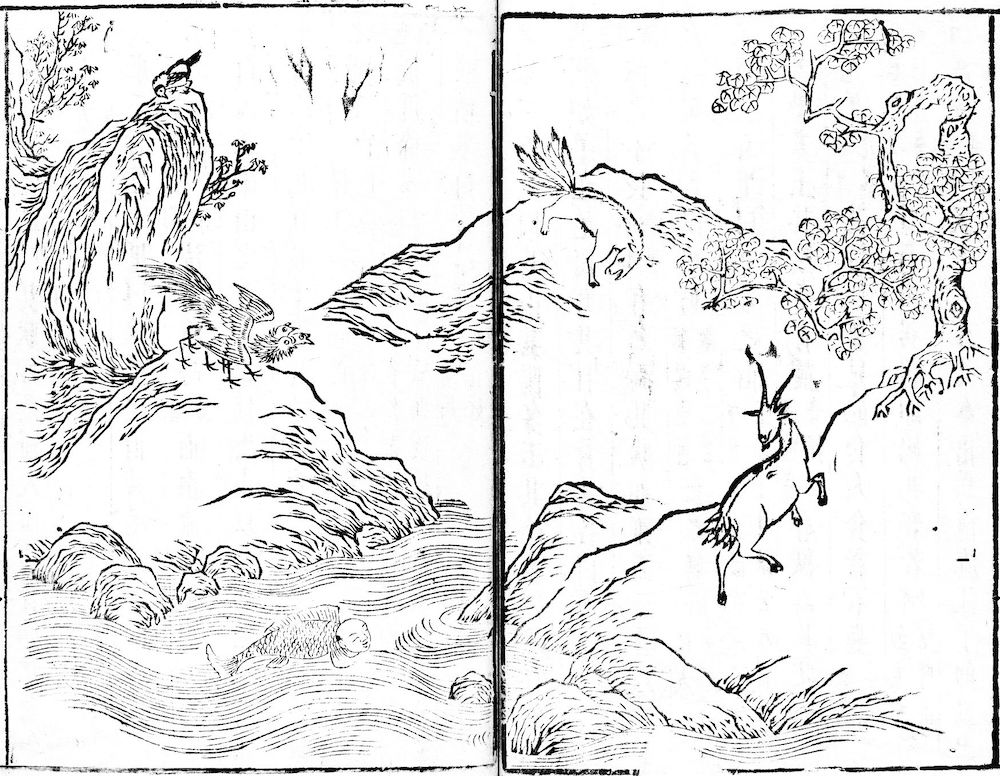 |
This compound image shows a nine-tailed goat called bodan 猼訑 with four ears and eyes on the back, a cock called shangfu {尚鳥}{付鳥} with three heads, six eyes, six feet, and three wings, a nine-tailed, man-eating fox, a dove called guanguan 灌灌, and a man-headed fish with a voice like a duck. From Jiang Yinggao's 蔣應鎬 illustrated edition of the Shanhaijing, printed during the Chongzhen reign-period 崇禎 (1628-1644). Copy of the Harvard Yenching Institute, from Guangming zhi Men / 光明之門. |
Although the stories in the Shanhaijing are historically unreliable, they are valuable sources for the study of early Chinese mythology and, eventually, for the origins of certain parts of Chinese popular religion. The Yellow Emperor 黃帝, for example, was a deity venerated mainly in western China. The Shanhaijing is thus a rich source of information on early Chinese history, geography, astronomy, climate, religion, customs and habits, animals and plants, minerals, medicine, rivers and marine sciences.
In the earliest book catalogue, Qilüe 七略, the Shanhaijing was classified as a writing of divinatory (shushu 數術) character, yet from the Tang period 唐 (618-907) on, it was seen as a geographical book. During the Song period 宋 (960-1279), the many superstitious and fictional accounts were the reason for its categorisation as a book of cosmological character (wuxing 五行). In later ages, the Shanhaijing was seen as a collection of fantastic stories and is considered the ancestor of Chinese novellas and fiction (xiaoshuo 小說).
Guo Pu's commentary on the Shanhaijing is the oldest. During the Qing period 清 (1644-1911), Hao Yixing 郝懿行 (1757-1825) wrote a commentary, the Shanhaijing jianshu 山海經箋疏. Less important commentaries were written by Yang Shen 楊慎 (1488-1559), Wang Chongqing 王崇慶 (1483-1565), Wang Niansun 王念孫 (1744-1832), He Zhuo 何焯 (1661-1722), Wu Renchen 吳任臣 (1628-1689) and Bi Yuan 畢沅 (1730-1797). The most recent commentary is Yuan Ke's 袁珂 (1916-2001) Shanhaijing jishi 山海經集釋 from 1980.
The Shanhaijing is to be found in the Daoist Canon Daozang 道藏 and the series Gujin yishi 古今逸史, Siku quanshu 四庫全書, Gezhi congshu 格致叢書, Ershi'er zi 二十二子, Baizi quanshu 百子全書, Mishu ershiyi zhong 秘書二十一種, Sibu congkan 四部叢刊, Sibu beiyao 四部備要 and Longxi jingshe congshu 龍溪精舍叢書.
There are translations by Schiffeler (only partial), Thern, Yuan K'o, Mathieu, and Anne Birrell. 1999. The Classic of Mountains and Seas. London: Penguin.
Table 1. Contents of the Shanhaijing 山海經
| Shanjing 山經 The classic of mountains
|
| 1. |
南山經 |
The classic of the southern mountains |
| 2. |
西山經 |
The classic of the western mountains< |
| 3. |
北山經 |
The classic of the northern mountains |
| 4. |
東山經 |
The classic of the eastern mountains |
| 5. |
中山經 |
The classic of the central mountains |
| Haijing 海經 The classic of the seas
|
| Haiwaijing 海外經 The classic of the regions beyond the seas |
| 6. |
海外南經 |
The classic of regions beyond the seas: The south |
| 7. |
海外西經 |
The classic of regions beyond the seas: The west |
| 8. |
海外北經 |
The classic of regions beyond the seas: The north |
| 9. |
海外東經 |
The classic of regions beyond the seas: The east |
| Haineijing 海內經 The classic of the regions within seas |
| 10. |
海內南經 |
The classic of regions within the seas: The south |
| 11. |
海內西經 |
The classic of regions within the seas: The west |
| 12. |
海內北經 |
The classic of regions within the seas: The north |
| 13. |
海內東經 |
The classic of regions within the seas: The east |
| Dahuangjing 大荒經 The classic of the great wilderness |
| 14. |
大荒東經 |
The classic of the great wilderness: The east |
| 15. |
大荒南經 |
The classic of the great wilderness: The south |
| 16. |
大荒西經 |
The classic of the great wilderness: The west |
| 17. |
大荒北經 |
The classic of the great wilderness: The north |
| 18. |
海內經 |
The classic of regions within the seas |
Sources:
Chang Jincang 常金倉. 2000. "Shanhaijing yu Zhanguo shiqi de zaoshen yundong 《山海經》與戰國時期的造神運動." Zhongguo shehui kexue 中國社會科學 2000 (6): 191-201+209.
Chao Fulin 晁福林. 2016. "Shanhaijing yu shanggu shidai de di guannian 《山海經》與上古時代的“帝”觀念." Zhongguo shi yanjiu 中國史研究 2016 (2): 43-61.
Chen Shuai 陳帥. 2013. "Shanhaijing shenhua yanjiu zongshu 《山海經》神話研究綜述." Xue lilun 學理論 2013 (11): 209-211.
Chong Gou 重構. 2009. "Genju Zhongguo guji Shanhaijinmg fuyuen huizhi de Zhongguo 4200 nian qian de gu ditu 根据中國古籍《山海經》復原繪制的中國4200年前的古地圖." Fujian Shida Fuqing Fenxiao xuebao 福建師大福清分校學報 2009 (1): 1-3+20.
Ding Yonghui 丁永輝. 1993. "Shanhaijing yu gudai zhiwu fenlei 《山海經》與古代植物分類." Ziran kexue shi yanjiu 自然科學史研究 1993 (3): 268-276.
Durrant, Stephen. 1986. "Shan-hai ching 山海經." In The Indiana Companion to Traditional Chinese Literature, edited by William H. Nienhauser, 671-672. Bloomington/Indianapolis: Indiana University Press.
Fracasso, Riccardo. 1993. "Shan hai ching." In Early Chinese Texts: A Bibliographical Guide, edited by Michael Loewe, 357-367. Berkeley: Society for the Study of Early China/Institute of East Asian Studies.
Gao Wangfei 高王飛. 2022. "Shanhaijing zhong de long ji qi wenhua neihan 《山海經》中的龍及其文化內涵." Puyang Zhiye Jishu Xueyuan xuebao 濮陽職業技術學院學報 35 (1): 1-4+13.
Gao Ju 郜菊, and Yang Liu 楊柳. 2016. "Bile'er [Anne Birell] fanyi sixiang yanjiu. Yi Shanhaijing Yingyi wei li 比勒爾翻譯思想研究——以《山海經》英譯為例." Waiyu jiaoxue lilun yu shijian 外語教學理論與實踐 2016 (3): 72-77.
Gong Shengsheng 龔勝生, and Luo Bibo 羅碧波. 2012. "Shanhaijing de yixue dilixue jiazhi 《山海經》的醫學地理學價值." Huazhogn Shifan Daxue xuebao (Ziran kexue ban) 華中師範大學學報(自然科學版) 46 (3): 351-357.
Gu Jiegang 顧頡剛. 1982. "Shanhaijing zhong de Kunlun qu 《山海經》中的昆侖區." Zhongguo shehui kexue中國社會科學 1982 (1): 3-30.
He Shengdi 賀聖迪. 1996. "Shanhaijing 山海經." In Zhongguo xueshu mingzhu tiyao 中國學術名著提要, vol. Keji 科技卷, edited by Zhou Gucheng 周谷城, 243. Shanghai: Fudan daxue chubanshe.
He Shengdi 賀聖迪. 1997. "Shanhaijing 山海經." In Zhongguo xueshu mingzhu da cidian 中國學術名著提要, vol. Zongjiao 宗教卷, edited by Zhou Gucheng 周谷城, 679. Shanghai: Fudan daxue chubanshe.
Hu Yuanpeng 胡遠鵬. 2003. "Zongguan hainei-wei Shanhaijing yanjiu wushi nian 縱觀海內外《山海經》研究五十年." Fujian Shida Fuqing Fenxiao xuebao 福建師大福清分校學報 2003 (1): 45-52.
Ji Xiaojian 紀曉建. 2006. "Chuci yu Shanhaijing shenshui shumu shenhua de huzheng 《楚辭》與《山海經》山水樹木神話之互證." Lilun yuekan 理論月刊 2006 (11): 118-120+129.
Ji Xiaojian 紀曉建. 2011. "Chuci, Shanhaijing shenhua qutong de wenhuaxue yiyi 《楚辭》《山海經》神話趨同的文化學意義." Nanjing Shifan Daxue Wenxue Yuan xuebao 南京師範大學文學院學報 2011 (2): 6-14.
Jia Chuantang 賈傳棠, ed. 1997. Duojie da cidian 多解大辭典, 529. Zhengzhou: Zhongzhou guji chubanshe.
Jiang Linchang 江林昌. 2008. "Tu yu shu: Xian-Qin Liang-Han shiqi youguan shanchuan shenguai lei wenxian de fenxi: Yi Shanhaijing. Chuci, Huainanzi wei li 圖與書。先秦兩漢時期有關山川神怪類文獻的分析——以《山海經》、《楚辭》、《淮南子》為例." Wenxue yichan 文學遺產 2008 (6): 15-29.
Jin Rongquan 金荣權. 2000. "Shanhaijing yanjiu liang qian nian shuping 《山海經》研究兩千年述評." Xinyang Shifan Xueyuan xuebao (Zhexue shehui kexue ban) 信陽師範學院學報(哲學社會科學版) 2000 (4): 101-104.
Kim Moon-kee. 김문기. 2017. "Kŭnse Tongasia ŭi ŏdo wa ŏryu pangmulhak: Sigyŏng [Shijing]-gwa Sanhaegyŏng [Shanhaijing]-ŭl chungsimŭro 근세 동아시아의 魚圖와 어류박물학 : 『詩經』과 『山海經』을 중심으로." Yŏksa wa kyŏnggye 역사와경계 105: 385-452.
Li Bingzhong 李秉忠, Wei Canjin 衛燦金, and Lin Conglong 林從龍, eds. 1990. Jianming wenshi zhishi cidian 簡明文史知識詞典, 581. Xi'an: Shaanxi renmin chubanshe.
Li Shuihai 李水海, ed. 1994. Zhongguo xiaoshuo da cidian 中國小說大辭典, vol. Xian-Qin zhi Nanbeichao 先秦至南北朝卷, 3. Xi'an: Shaanxi renmin chubanshe.
Li Xueqin 李學勤, and Lü Wenyu 呂文郁, eds. 1996. Siku da cidian 四庫大辭典, vol. 2, 2168. Changchun: Jilin daxue chubanshe.
Li Zhengquan 李正栓, and Cheng Gang 程剛. 2022. "Zou chu chu beijing xia Zohngguo keji dianji shuyu Yingyi tanwei: Yi Shanhaijing Da Zhonghua Wenku yiben wei li “走出去”背景下中國科技典籍術語英譯探微——以《山海經》大中華文庫譯本為例." Shanghai fanyi 上海翻譯 2022 (1): 75-81.
Liang Qi 梁奇. 2011. "Shanhaijing zhong ren-shou heti lei shenren xingxiang guankui: Shanhaijing zhogn shenren xingxiang yanjiu 《山海經》中人獸合体類神人形象管窺——《山海經》中神人形象研究." Minzuo xinshang 名作欣賞 2011 (2): 163-166.
Liang Qi 梁奇, and Chen Yulin 陈鈺琳. 2022. "Iteng Qingsi [Itō Seiji] dui Shanhaijing shenguai de minsu quanshi 伊藤清司對《山海經》神怪的民俗詮釋." Minsu yanjiu 民俗研究 2022 (2): 84-94+159-160.
Liao Qun 廖群. 2006. "Shanhaijing zhong de yuanshi zhengzhao xinyang ji qi minsuxue jiazhi 《山海經》中的原始征兆信仰及其民俗學價值." Minsu yanjiu 民俗研究 2006 (2): 146-154.
Liu Yingjie 劉英傑, and Chen Baihan 陈柏寒. 2022. "Jiyu Shanhaijing Zhong Shenhua gushi de xushixing chahua chuangzuo 基於《山海經》中神話故事的敘事性插畫創作." Yishu yu sheji (Lilun) 藝術與設計(理論) 2 (6): 54-56.
Liu Zhao 劉釗. 2021. "Chutu wenxian yu Shanhaijing xinzheng 出土文獻與《山海經》新證." Zhongguo shehui kexue 中國社會科學 2021 (1): 83-103+205-206.
Liu Zongdi 劉宗迪. 2020. "Yaoguai de dansheng: Shanhaijing zhong de lingyi dongwu 妖怪的誕生——《山海經》中的靈異動物." Kaifang shidai 開放時代 2020 (4): 102-113+8.
Liu Zongdi 劉宗迪. 2002. "Taiyang shenhua, Shanhaijing yu shanggu lifa: Shanhaijing yanjiu zhi san 太陽神話、《山海經》與上古曆法——《山海經》研究之三." Minzu yishu 民族藝術 2002 (4): 59-64+66-71.
Luo Yunyun 羅筠筠, and Li Jieqiong 李潔瓊. 2019. "Shanhaijing yongsheng shenmei yixiang yanjiu 《山海經》永生審美意象研究." Jinan xuebao (Zhexue shehui kexue ban) 暨南學報(哲學社會科學版) 41 (9): 82-95.
Luo Zhitian 羅志田. 2001. "Shanhaijing yu jindai Zhongguo shixue 《山海經》與近代中國史學." Zhongguo shehui kexue 中國社會科學 2001 (1): 181-192+209.
Ma Changyi 馬昌儀. 2003. "Cong Zhanguo tuhua zhong xunzhao shiluo le de Shanhaijing gutu 從戰國圖畫中尋找失落了的《山海經》古圖." Minzu yishu 民族藝術 2003 (4): 46-58.
Ma Changyi 馬昌儀. 2005. "Ming-Qing Shanhaijing tu banben shulüe 明清《山海經》圖版本述略." Xibei minzu yanjiu 西北民族研究 2005 (3): 81-91+152.
Meng Yuting 孟愉亭. 2021. "Chuantong shenshou wenhua zai xianhia chahua sheji zhong de yingyong: Shanhaijing shenshou chahua sheji 傳統神獸文化在現代插畫設計中的應用——《山海經》神獸插畫設計." Jingu wenchuang 今古文創 2021 (43): 100-101.
Ning Jiayu 寧稼雨. 1994. "Shanhaijing yu Zhongguo qihuan siwei 《山海經》與中國奇幻思維." Nankai xuebao 南開學報 1994 (3): 20-28.
Oh Yi-hwan. 오이환. 2024. "Ch’oin-gwa sinsŏn: Sanhaegyŏng [Shanghaijing], Ch’osa [Chuci], Changja [Zhuangzi]-rŭl chungsimŭro 超人과 神仙 - 『山海經』, 『楚辭』, 『莊子』를 중심으로." Ch’ŏrhak yŏn’gu 철학연구 169: 221-247.
Pu Fengjiao 濮鳳嬌, and Ren Xiaofei 任曉霏. 2022. "Shanhaijing zai Riben de chuanbo ji qi yingxiang yanjiu 《山海經》在日本的傳播及其影響研究." Hanzi wenhua 漢字文化 2022 (6): 94-96.
Qi Tinggui 戚廷貴, Liu Xiaoyan 劉孝嚴, and Tang Shufan 唐樹凡, eds. 1992. Dong-Xifang yishu cidian 東西方藝術辭典, 1275. Changchun: Jilin jiaoyu chubanshe.
Qin Jian 秦儉. 2021. "Shanhaijing zhong xianhua siwei yu Xiyouji de shenxian tixi jiangou 《山海經》中仙話思維與《西遊記》的神仙體系建構." Jingu wenchuang 今古文創 2021 (34): 39-41.
Qing Wei 卿蔚. 1993. "Shanhaijing 山海經." In Shijie baike zhuzuo cidian 世界百科著作辭典, edited by Ru Xin 汝信, 409. Beijing: Zhongguo gongren chubanshe.
Shan Youfang 單有方. 2002. "Jinghuayuan yinyong Shanhaijing shenhua shoufa qianxi 《鏡花緣》引用《山海經》神話手法淺析." Yindu xuekan 殷都學刊 2002 (2): 71-73.
Schipper, Kristofer. 2004. "Shanhai jing." In The Taoist Canon: A Historical Companion to the Daozang, edited by Kristofer Schipper, and Franciscus Verellen, vol. 1, 112. Chicago and London: University of Chicago Press.
Song Zhima 宋志瑪. 2009. "Tan Shanhaijing zhong de she xingxiang 談《山海經》中的蛇形象." Hengshui Xueyuan xuebao 衡水學院學報 11 (2): 33-35.
Sun Yuzhen 孫玉珍. 2003. "Shanhaijing yanjiu zongshu 《山海經》研究綜述." Shandong Ligong Daxue xuebao (Shehui kexue ban) 山東理工大學學報(社會科學版) 2003 (1): 109-112.
Tochio Takeshi 杤尾武, and Aida Mitsuru 相田満. 2004. "Sankaikyō to ruisho ni okeru enkō 『山海經』と類書における猿猴." Kokubungaku kenkyū shiryōkan kiyō 国文学研究資料館紀要,2004.
Tu Minhua 涂敏華. 2009. "Shanhaijing taiyang niao shenhua de kaogu yinzheng ji qi wenhua neihan 《山海經》太陽鳥神話的考古印證及其文化內涵." Zhangzhou Shifan Xueyuan xuebao (Zhexue shehui kexue ban) 漳州師範學院學報(哲學社會科學版) 23 (2): 57-60.
Wan Qun 萬群. 2013. "Cong Hanyu shi jiaodu kan Shanhaijing de chengshu niandai 從漢語史角度看《山海經》的成書年代." Zhongguo dianji yu wenhua 中國典籍與文化 2013 (2): 4-11.
Wang Yuguang 王余光, and Xu Yan 徐雁, eds. 1999. Zhongguo dushu da cidian 中國讀書大辭典, 1147. Nanjing: Nanjing daxue chubanshe.
Wang Zijin 王子今. 2022. "Shanhaijing yu shanggu haiyangxue zhishi 《山海經》與上古海洋學知識." Qinghua Daxue xuebao (Zhexue shehui kexue ban) 清華大學學報(哲學社會科學版) 37 (2): 103-112+215.
Wu Feng 吳楓, ed. 1987. Jianming Zhongguo guji cidian 簡明中國古籍辭典, 48. Changchun: Jilin wenshi chubanshe.
u Feng 吳楓, ed. 1994. Zhongguo gudai wenxian da cidian 中華古文獻大辭典, vol. Wenxue 文學卷, 30. Changchun: Jilin wenshi chubanshe.
Wu Kang 吳康. 2007. "Shanhaijing: Zhongguo shenhua de jiangou 《山海經》——中國神話的建構." Zhongguo wenxue yanjiu 中國文學研究 2007 (1): 43-46.
Wu Xiaodong 吳曉東. 2007. "Zhanxing guji: Cong Shanhaijing zhong de ershiba zuo shan yu tiankong zhong de ershiba xingxiu duiying lai jiedu Shanhaijing 占星古籍——從《大荒經》中的二十八座山與天空中的二十八星宿對應來解讀《山海經》." Minzu yishu 民族藝術 2007 (3): 77-86.
Wu Yifei 吳弋斐, and Yu Yangfei 于仰飛. 2020. "Zhongguo Shanhaijing yu Riben dongman yaoguai wenhua yanjiu 中國《山海經》與日本動漫妖怪文化研究." Shiting 視聽 2020 (12): 223-224.
Xiang Wei 項薇. 2021. "Qianxi Shanhaijing shehua xingxiang dui houshi xiaoshuo wenxue de yingxiang 淺析《山海經》神話形象對後世小說文學的影響." Jingu wenchuang 今古文創 2021 (12): 25-26.
Xibei Shifan Xueyuan Zhongwen Xi Wenyi Lilun Jiaoyan Shi 西北師范學院中文系文藝理論教研室, ed. 1985. Jianming wenxue zhishi cidian 簡明文學知識辭典, 280. Lanzhou: Gansu renmin chubanshe.
Xinjiang baike quanshu bianzuan weiyuanhui 《新疆百科全書》編纂委員會, ed. 2002. Xinjiang baike quanshu 新疆百科全書, 83. Beijing: Zhongguo da baike quanshu chubanshe.
Xu Lihui 徐麗慧. 2019. "Sanhaijing zhong de yishou xingxiang kaoxi 《山海經》中的異獸形象考析." Nanjing Yishu Xueyuan xuebao (Meishu yu sheji ban) 南京藝術學院學報(美術與設計版) 2019 (4): 104-110.
Yang Yi 楊義. 2003. "Shanhaijing de shenhua siwei 《山海經》的神話思維." Zhongshan Daxue xuebao (Shehui kexue ban) 中山大學學報(社會科學版) 2003 (3): 1-10+122.
Yang Qing 陽清, and Li He 李賀. 2015. "Cong Shanhaijing dao Shenyijing, Hainei shizhou ji: Bowu zhiguai xiang Daojiao xianhua de xushi pibian 從《山海經》到《神異經》《海內十洲記》——博物志怪走向道教仙話的敘事丕變." Guangxi shehui kexue 廣西社會科學 2015 (1): 169-175.
Yang Wenheng 楊文衡. 1997. "Shanghaijing 山海經." In Zhonghua guocui da cidian 中華國粹大辭典, edited by Men Kui 門巋, and Zhang Yanjin 張燕瑾, 393. Xianggang: Guoji wenhua chuban gongsi.
Ye Shuxian 葉舒憲. 2000. "Dahuang yixiang de wenhua fenxi: Shanhaijing Huangjing de gaijian beijing “大荒”意象的文化分析——《山海經·荒經》的觀念背景." Bejing Daxue xuebao (Zhexue shehui kexue ban) 北京大學學報(哲學社會科學版) 2000 (4): 94-101.
Ye Shuxian 葉舒憲. 2012. "Cong wenxue zhong tanxun lishi xinxi: Shanhaijing yu shiluo de wenhua da chuantong 從文學中探尋歷史信息——《山海經》與失落的文化大傳統." Wenyi lilun yanjiu 文藝理論研究 32 (2): 24-31.
Yuan Ke 袁珂. 1985. "Shanhaijing gai gu zhi wu shu shitan 《山海經》蓋“古之巫書”試探." Shehui kexue yanjiu 社會科學研究 1985 (6): 61-67.
Yuan Ke 袁珂. 1986. "Shanhaijing 山海經." In Zhongguo da baike quanshu 中國大百科全書, part Zhongguo wenxue 中國文學, vol. 2, 691. Beijing and Shanghai: Zhongguo da baike quanshu chubanshe.
Yuan Shishuo 袁世碩. 2004. "Jinghuayuan he Shanhaijing 《鏡花緣》和《山海經》." Dongyue luncong 東嶽論叢 2004 (3): 66-70.
Yuan Xingpei 袁行霈. 1992. "Shanhaijing 山海經." In Zhongguo da baike quanshu 中國大百科全書. part Zhongguo lishi 中國歷史, vol. 2, 887. Beijing and Shanghai: Zhongguo da baike quanshu chubanshe.
Zhang Rui 張銳, and Wang Kailun 王凱倫. 2016. "Wenchuang chanpin zhong de wenhua yuansu: Yi Shanhaijiing zhong de yu yuansu suo zuo de wenchuang chanpin sheji yanjiu 文創產品中的文化元素——以《山海經》中的魚元素所做的文創產品設計研究." Dazhong wenyi 大眾文藝 2016 (10): 114-115.
Zhang Liming 張黎明. 2021. "Wushu siwei yu Shanhaijing de zhiwu wenhua 巫術思維與《山海經》的植物文化." Nongye kaogu 農業考古 2021 (3): 231-236.
Zhang Zhiyao 張志堯. 1990. "Renshou shesen Fu Xi, Nü Wa yu she tuteng chongbai: Jian lun Shanhaijing zhong renshou sheshen zhi shen de youlai 人首蛇身的伏羲、女媧與蛇圖騰崇拜——兼論《山海經》中人首蛇身之神的由來." Xibei minzu yanjiu 西北民族研究 1990 (2): 31-45.
Zhao Chuan 趙川. 2010. "Shanhaijing tuteng chongbai sixiang 《山海經》圖騰崇拜思想." Hebei Ligong Daxue xuebao (Shehui kexue ban) 河北理工大學學報(社會科學版) 10 (3): 18-20+24.
Zhao Peilin 趙沛霖. 1997. "Zhongguo shenhua de fenlei yu Shanhaijing de wenxia jiazhi 中國神話的分類與《山海經》的文獻價值." Wenyi yanjiu 文藝研究 1997 (1): 95-104.
Zheng Yunbo 鄭雲波, ed. 1992. Zhongguo gudai xiaoshuo cidian 中國古代小說辭典, 1, 15. Nanjing: Nanjing daxue chubanshe.
Zhou Jintai 周金泰. 2021. "Wuxing xueshuo yu bowu zhiguai bianzuan: Cong Shanhaijing dao Shenyijing de wenben jiegou yanbian 五行學說與博物志怪編纂——從《山海經》到《神異經》的文本結構演變." Zhejiang xuekan 浙江學刊 2021 (6): 206-215.
Zhu Ling 朱玲. 2002. "Lun Shanhaijing de xushu jiegou ji qi wenhua chengyin 論《山海經》的敘述結構及其文化成因." Qinghua Daxue xuebao (Zhexue shehui kexue ban) 清華大學學報(哲學社會科學版) 2002 (1): 51-54+67.
Zhu Shunlong 朱順龍. 1994. "Shanhaijing 山海經." In Zhongguo xueshu mingzhu tiyao 中國學術名著提要, vol. Lishi 歷史卷, edited by Zhou Gucheng 周谷城, 638. Shanghai: Fudan daxue chubanshe.