ChinaKnowledge.de -
An Encyclopaedia on Chinese History, Literature and Art
Guishuang 貴霜 was the Chinese name for the kingdom of Kushana (Kuṣāṇa) that was located in modern Afghanistan and northwestern Pakistan and India. In the 2nd century BCE the Tokharians (by the Chinese called Yuezhi 月氏) migrated into the region of the Rivers Amu Darya and Syr Darya (the so-called Soghdiana), where they established five kingdoms. If the rulers of these kingdoms were Tokharians, is not known.
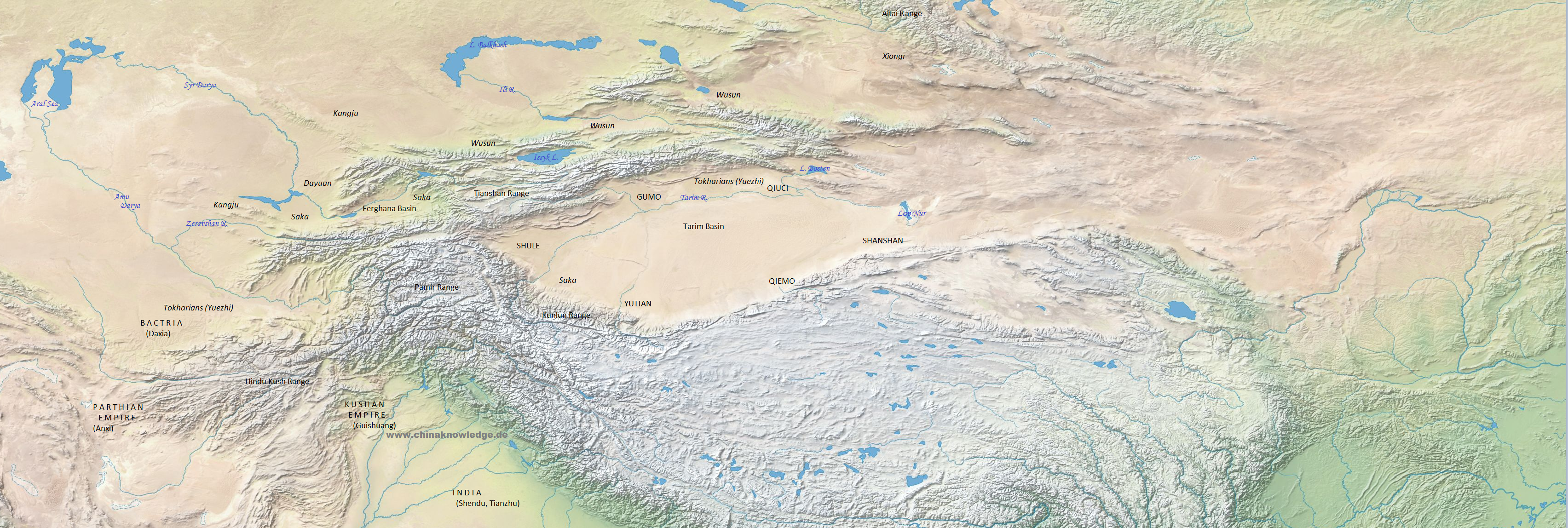 |
Based on Tan Qixiang 譚其驤, ed. (1995), Zhongguo lishi ditu ji 中國歷史地圖集, Vol. 2, Qin, Xihan, Donghan shiqi 秦西漢東漢時期 (Beijing: Zhongguo ditu chubanshe, 1996). Tribes and peoples in italics, states in normal letters. |
In the late 1st century BCE king Kujula Kadphises of Kusa (i.e. Guishuang) united the whole territory and so founded the Kushan kingdom. With the help of the neighbouring kingdom of Jibin 罽賓 his armies crossed the Hindukush Range and invaded Kabul, Parthia (by the Chinese called Anxi 安息) and northwestern India (Chinese name Shendu 身毒 or Tianzhu 天竺). The Kushan empire reached its zenith under the rule of Kaniṣka. At that time Buddhism spread from India to Central Asia, and the people of the Kushana became fervent adherents of Buddhism, supporting missionaries travelling towards China.