ChinaKnowledge.de -
An Encyclopaedia on Chinese History, Literature and Art
The Yuezhi 月氏 (-zhī, also written 月支 and in some manuals read "Rouzhi") were a nomad people romaning Central Asia between the 2nd cent. BCE and the 1st cent. CE. The Chinese called this people commonly Da Yuezhi 大月氏 "the Great Yuezhi". According to the history Shiji 史記, the Yuezhi first dwelled in the region of Dunhuang 敦煌 (modern province of Gansu) and the Qilian Range 祁連山. It might be that ancient terms like Yushi 禺氏 or Heshi 和氏 point at this people.
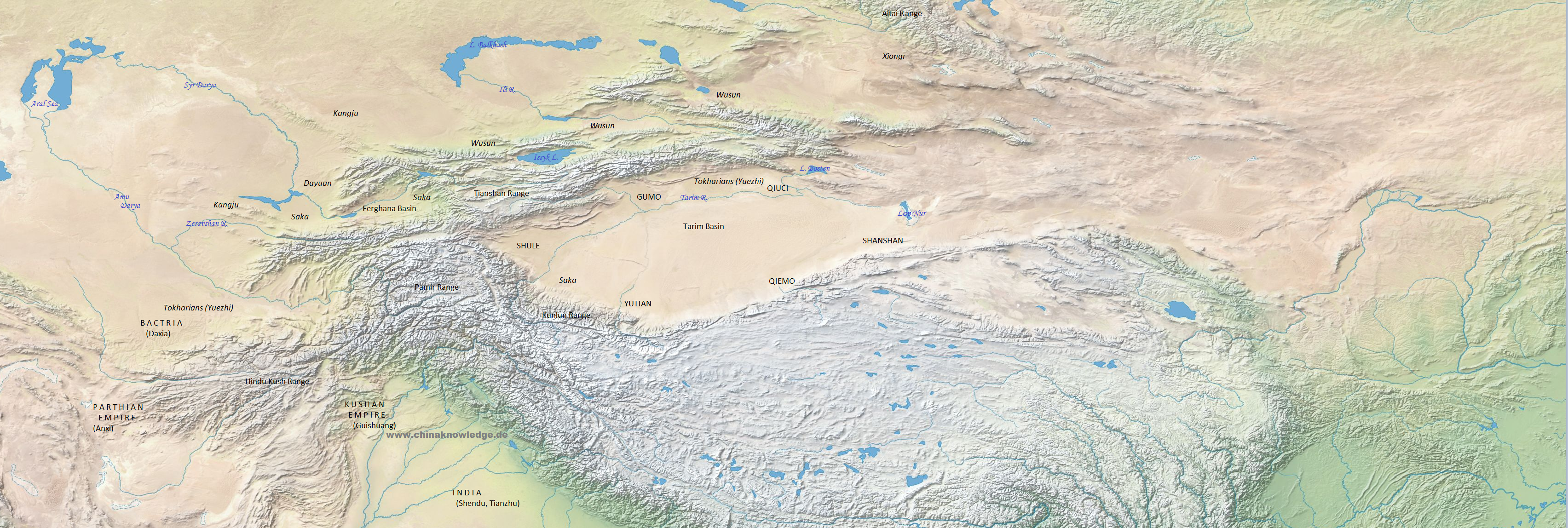 |
Based on Tan Qixiang 譚其驤, ed. (1995), Zhongguo lishi ditu ji 中國歷史地圖集, Vol. 2, Qin, Xihan, Donghan shiqi 秦西漢東漢時期 (Beijing: Zhongguo ditu chubanshe, 1996). Tribes and peoples in italics, states in normal letters. |
European historians in vain tried to identify any people in Greek sources with the Yuezhi. Around 220 BCE the Yuezhi were so strong that even the steppe federation of the Xiongnu 匈奴 sent a prince as hostage to the Yuezhi. This prince was nobody else than Modu 冒頓, the eventual khan (chanyu 單于) of the Xiongnu. It was also he who destroyed the armies of the Yuezhi around 202 BCE and forced them to migrate farther to the west. He defeated the Yuezhi a second time around 177 and incorporated part of them into the Xiongnu federation. The others escaped the pressure of the Xiongnu by migrating to the west, into the Dzunghar Basin and the region of modern Yining 伊寧, Xinjiang. This part of the Yuezhi people was then called "Greater Yuezhi" (Da Yuezhi 大月氏), while a small rest that had remained at the Qinlin Range was called the "Lesser Yuezhi" (Xiao Yuezhi 小月氏). Forced by the Xiongnu to migrate to the west, the Yuezhi themselves exerted pressure on the people of the Sakas (Chinese name Sai 塞) that had lived in the Dzunghar Basin. The Sakas left to the southwest and settled down in the Soghdiana.
The Yuezhi themselves were expelled from the Dzunghar Basin by the Wusun 烏孫 another steppe people. While the Wusun settled down in this region, the Yuezhi migrated into the plain of the River Syr Darya in modern Uzbekistan around 130 BCE. They were able to destroy the Bactrian kingdom (by the Chinese called Daxia 大夏). Around 128 the Chinese traveller Zhang Qian 張騫 dwelled at the court of the Yuezhi ruler and transmitted news of them to the court of the Han dynasty 漢 (206 BCE-220 CE). In the 1st century BCE the Yuezhi fell apart into five tribes (in the native language yabghu, a term later used by the Türks) or xihou 翕侯: Xiumi 休密 (capital Hemo 都和墨), Shuangmi 雙靡 (capital Shuangmi), Guishuang 貴霜 (capital Huzao 護澡), Bidun 肸頓 (capital Baomao 薄茅), and Gaofu 高附 (capital Gaofu). The king of Guishuang proved to be the strongest, and Guishuang (known as Kushana) swallowed the other kingdoms during the 1st century CE. Kushana became a very strong empire that even controlled parts of India.
Greek sources call the people that destroyed Bactria and founded Kushana the "Tokharians", and the region Tokhara or Tokharistan. According to most scholars concerned, the Tokharians were an Indo-Iranian people. A recent phonological reconstruction by Christopher Beckwith identifes the archaic Chinese pronunciation of 月氏 as *togwar in a border dialect, and therefore equates the Yuezhi also linguistically with the Tokharians.
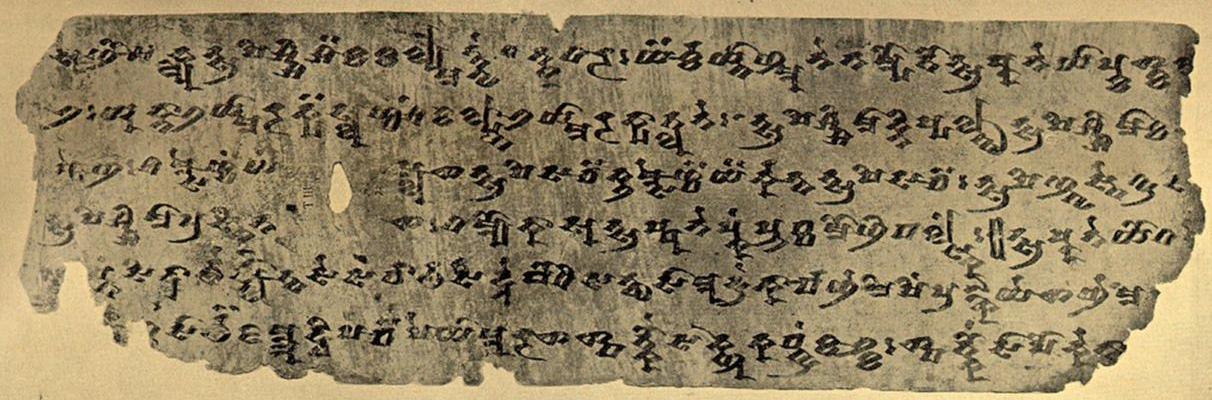 |
Source: Corpus of Tocharian (A) texts, Collection: THT, Berlin Collection, On the basis of the edition by E. Sieg and W. Siegling, Tocharische Sprachreste, I. Band: Die Texte, A. Transcription, Berlin und Leipzig 1921. Retrieved from the database http://titus.uni-frankfurt.de/texte/etcs/toch/tocha/tocha.htm. Manuscript: 634, No._1 = T_III_Š_72.1. THT 0634, Trägt auf der Rückseite die Blattzahl 65 (no. of folio indicated on the reverse side). |
Transcription: Line 1: (kā)su1 ñoM\ klyu tsraṣiśśi śäK\ KAlymentwaṃ SAtkaTAR\ : yärK\ ynāñmune nam poto tsraṣṣuneyā PùKAṢ KAl(pnā)- Line 2: L\ : yuknāL\ ymāRAk yäsluñcäS\ KAlpnāL\ ymāRAk yātlune : 1 tsraṣiśśi māk niṣpalntu tsraṣiśśi māK\ Line 3: ṣṣeñÄ\ : NAmseñcÄ\ yäsluṢ\ tsraṣisacÄ\ kumseñcÄ\ yärkanT\ tsraṣisacÄ\: tsraṣiñ waste wrasa(śśi) Line 4: tsraṣiśśi mā praski naṢ\ : TAmyo kāsu tsraṣṣune pùkaṃ pruccamo ñi PAlskaṃ : | tsraṣṣuneyo TAm(.)e Line 5: ṣ..ṣtaṃ siddʰārtʰes lānT\ se sarvārtʰasiddʰe bodʰisattu sāmudraṃ kārP\ ñemiṣiṃ praṅkā yeṢ\ ñemi Line 6: l.i_ sārtʰÄ\ jambudvipacÄ\ pe yāmuRAṢ\ ṢPAt koṃsā kñukac wraṃ KALK\ : ṢPAt koṃsā pokenā |