ChinaKnowledge.de -
An Encyclopaedia on Chinese History and Literature
The historical Mongols were a federation of heterogenous groups of different nomad peoples of "Tartar" and also Türkish origin. The word "Mongol" is derived from the name of a tribe called Mongɣol or Manqol. Even if the cultural levels of these ethnic groups were different, they had a common language and a common culture which made their unification under the hand of a strong leader easier. In 1206, Temüjin (1155 or 1167-1227) of the Borjigid line of the Mongɣol adopted the title of Great Khan (qaɣan, in Chinese kèhán! 可汗). He is known as Činggis Qaɣan (Genghis Khan). Under his leadership the Mongols destroyed the Western Xia 西夏 (1038-1227) and Jin 金 (1115-1234) empires and conquered central Asia. The successors of Činggis Qaɣan created the largest empire that ever existed in premodern history. Yet this empire soon disintegrated into several states (ulus), one of which was China, ruled by the Yuan dynasty 元 (1279-1368) that was founded by Qubilai Qaɣan (Emperor Shizu 元世祖, r. 1260-1294), a grandson of Činggis.
In 1368, the Mongols withdrew to the northern steppe, but then and when, a great leader unifed them - Esen Qaɣan (1407-1455), Dayan Qaɣan (1464-1543), and Altan Qaɣan (1507-1582). The Mongols (also known as Dada 韃靼 in Chinese) were fierce enemies of the Chinese Ming empire 明 (1368-1644).
The Manchus, founders of the Qing dynasty 清 (1644-1911), integrated the Eastern Mongols into their empire and colonized the territory of the Western Mongols, the Oyirad under Galdan Qaɣan (1632/1644-1697), by force. The Mongol tribes were organized in the leagues and banners of Inner and Outer Mongolia, a distinction which still exists today.
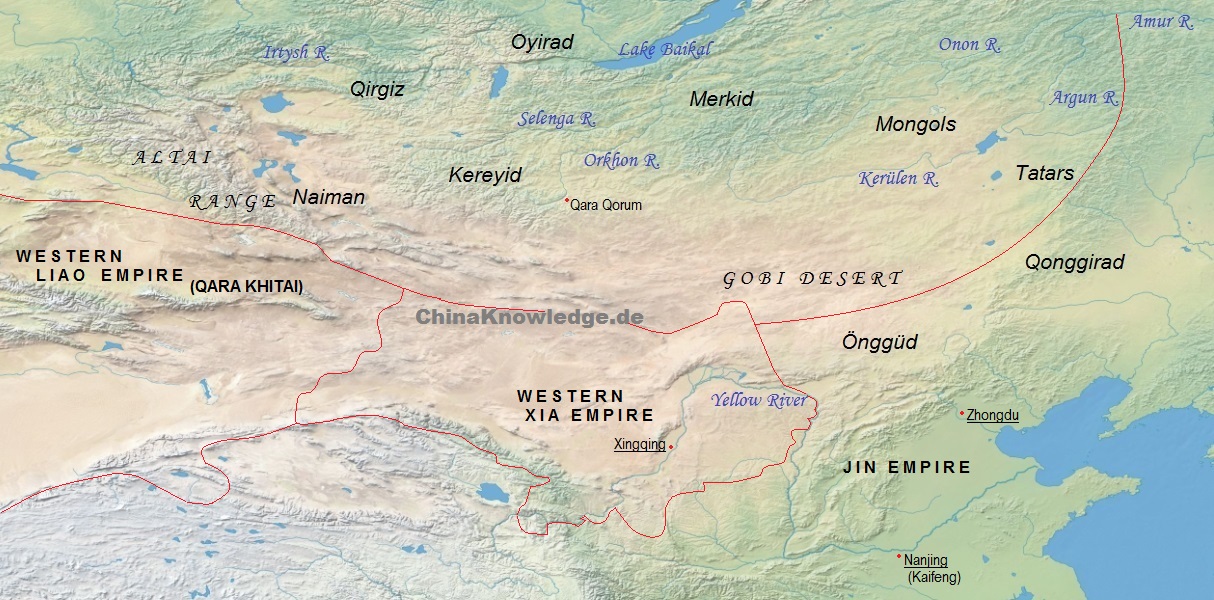 |
The northern steppe around 1200. The original grounds of the Mongols were located in the eastern parts of the steppe. Click to enlarge. |
The most important source for the history of Činggis Qaɣan is the "Secret History of the Mongols" (Mongɣol-un niɣuča tobčiyan, Menggu mishi 蒙古秘史), written in Mongolian language, but noted down phonetically with Chinese characters. According to this chronicle, the ancestors of the Mongol people were Börte-Čino "Blue-Gray Wolf" and his spouse Qo'ai-Maral "Fallow Doe". Their descendant Yisügei Baɣatur was the head of the Borjigid family. He was married to Ögelen from the Olqonoɣud family. Temüjin was born in 1155, 1162 or 1167 somewhere in the grazing grounds of the Mongɣol between the rivers Onon and Kerülen (northeast of today's Mongolia). At that time, the Mongɣol were part of a federation with the Kereyid (Kelie 克烈, living in what is today southern Mongolia) and the Tatar which had been created by Qabul Qan in the early 12th century.
Temüjin was engaged with Börte from the tribe of the Qonggirad (Hongjila 弘吉剌). Around that time, Yisügei Baɣatur was killed by the Tatar, and the federation disintegrated, making way to bloody fights between the tribes. Temüjin experienced bitter humilation by his capture by the foes of his late father, the treason by his own fellows, and during his escape and the period as a destitute "outlaw". Yet in the course of time Temüjin won a reputation as an intelligent and brave daredevil, and achieved the cooperation of some tribesleaders, like Toɣril Wang of the Kereyid, or Jamuqa (d. 1204) of the Qamaɣ Mongɣol. He helped Temüjin to liberate Börte, which had been abducted by the Merkid (Mierqi 蔑兒乞), who lived south of Lake Baikal. Around 1197, the three companions and their supporters defeated the Merkid.
Yet Jamuqa competed with Temüjin for leadership, and sought for support by the Nayiman (Naiman 乃蠻), which roamed the southwestern parts of today's Mongolia, and adopted the title of Gur Qaɣan. In 1202, Temüjin defeated the Tatar, but a year later, Toɣril Wang decided to support Jamuqa. Temüjin attacked and first vanquished the traitor Toɣril Wang and the Kereyid, and launched in 1204 a campaign against Jamuqa and the Nayiman. A year later, he subjected also the Merkid.
In 1206, Temüjin invited the tribesleaders to convene to the military council (quriltai, Chinese huliletai 忽里勒台) at the source of River Onon and adopted the title of Great Khan (qaɣan). What exactly the word Činggis means, is still debated. His "capital" was Qara Qorum on River Orkhon (in present-day Övörkhangai Province in the centre of Mongolia)
The most important step of Činggis Qaɣan to prevent future rebellions was the destruction of the traditional social system which was based on genealogical grounds. He replaced it by a military organization of the tribes, with divisions (tümen) headed by his most trusted supporters, like Boɣurči, Jelme, Jürčidei, Jebe (d. 1225) or Sübegedei. Some of these units served as the bodyguard (qišig) of Činggis Qaɣan. It had also the function of elite troops (see Yuan military).
Činggis Qaɣan immediately decided to expand the territory of his "empire", with the aim to attack the empires in north China. For this enterprise, he ordered his generals to secure the western flank and forced the Oyirad (Elute 厄魯特) and the Türkic Kirghiz (Xiajiasi 黠戛斯) into submission. The Uyghurs (Huihu 回鶻) in the city states of the Tarim Basin thereupon declared their submission to Mongol suzerainty. The Great Khan himself prepared his assault of the Tangutan state of Western Xia. In 1209, Emperor Xiangzong 西夏襄宗 (r. 1206-1210) decided to cooperate with the Mongols. In the same year, Činggis Qaɣan decided to stop paying tributes to the Jin empire, and two years later began the assault of some northern garrisons of the Jin.
In 1213, the Mongols advanced in three columns, one commanded by the Great Khan himself. His contingent besieged the "Central Capital" Zhongdu 中都 (today's Beijing), which was also at that time the imperial seat of the Jin. The Jurchen concluded a peace treaty with the invaders, paid a bounty ransom to the Mongols, and presented Činggis Qaɣan Princess Qiguo 歧國公主 as a peace tribute (see heqin policy 和親).
The Jin court thereupon decided to shift the central government to the "Southern Capital" Nanjing 南京 (Kaifeng 開封, today in Henan), yet this decision provoked a new invasion by the Mongols. Zhongdu was conquered in 1214, and Činggis Qaɣan entrusted in 1217 the supreme command to Muquli (Muhuali 木華黎). Muquli was able to attract the support of collaborators of Chinese and Kitan origin, among them many specialists in modern military technology, particularly in poliorcetis (the art of siege). Yet the war against the Jin empire proved to be more difficult than expected, all the more as the Western Xia resigned from further support.
In the meantime, Činggis Qaɣan himself was occupied with a western campaign that was initiated as a revenge after the ruler of Khwārezmia, ʿAla ad-Dīn Muhammad (r. 1200-1220), had a Monglian diplomatic mission murdered. In 1218, Činggis Qaɣan destroyed the empire of Kara Qitai (Western Liao 西遼, 1124-1211/1218); in 1219, the city of Otrar (Kazakhstan, today devastated) was conquered, and in early 1220, the Mongols massacred the populations of the wealthy cities of Bukhara and Samarkand. In 1221, Činggis Qaɣan conquered Balkh. His youngest son Tolui (Tuolei 拖雷, c. 1191-1232) conquered the Persian province of Khorasan (today in the borderlands of Afghanistan, Iran, Turkmenistan, and Uzbekistan) and the cities of Herat, Merv, and Nishapur. Far in the west, Jebe and Sübedei (Subutai 速不台, 1175–1248) crossed the Caucasus Range and advanced far into the Kipchak Steppe (in Russia known as Polovtsian Steppe), which was inhabited by the Türkish Kipchaks (Qinchai 欽察, in the contemporary West known as Cumans) and extended from north of the Black Sea to Lake Balkhash. In the battle of River Kalka (in Russian Kal'chik) in 1223, the Mongols defeated a united army of Kipchaks and some Rus' principalities.
The deadlock situation in north China forced Činggis Qaɣan to return to the east, where he began a revenge campaign against the Western Xia empire, which he extinghuished in 1227.
In the same year, Činggis Qaɣan died from a wound received by a hunting accident. His tomb is unknown, but he is venerated in a mauseoleum in Xinjie 新街, Ejin Horo Banner (Yijin Huoluo Qi 伊金霍洛旗) in Inner Mongolia.
| Temüjin (Činggis Qaɣan, r. 1206-1227) | |||||||
| Joči | Čaɣatai | Ögödei (r. 1229-1241) | Tolui | ||||
| Orda, Batu and Berke | Mutukan | Güyük (r. 1246-1248) | Möngke (r. 1251-1259) | Qubilai (Sečen Qaɣan, r. 1260-1294) | Hülegü | Ariɣ Buqa (Anti-Khan 1260-1264) | |
| Golden Horde | Mogulistan | ... | Yuan Dynasty | Il-Khanate | ... | ||
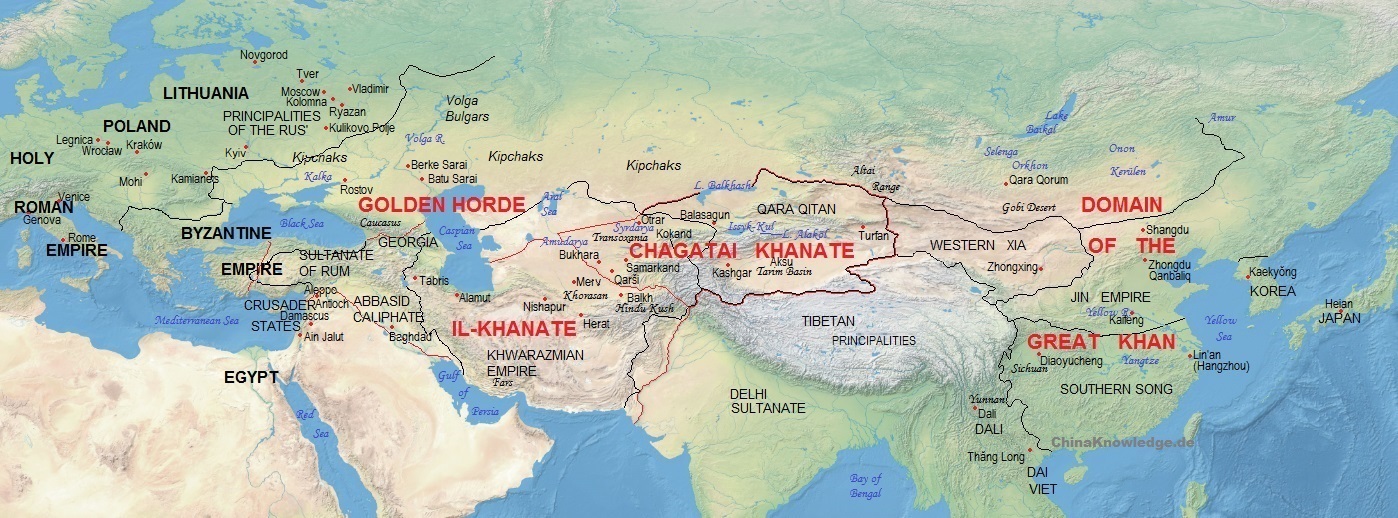 |
The maps shows important states before and after the Mongol conquest in the mid-13th century. Black lines of frontiers are states which vanished (e.g. Western Xia, the Jin empire, the Southern Song, the kingdom of Dali, the Qara Qitan empire, the Khwarazmian empire, the Abbasid Caliphate, the Seljuk Sultanate of Rum), red lines are borders between the four khanates (ulus, hordes). Place names appear as mentioned in the text. Click to enlarge. |
Among Činggis Qaɣan's four legitimate sons, Joči (Zhuchi 朮赤, 1183-1227), Čaɣatai (Chahetai 察合台, 1183-1242), Ögödei (Wokuotai 窩闊台, 1185-1241), and Tolui (c. 1191-1232), it was Ögödei who had been promised the title of Great Khan as early as 1218. Between Činggis Qaɣan's death and the quriltai of 1228 (or 1229?), Tolui as the youngest formally administered, according to a traditional rule, the Great Khanate. It might be that Ögödei was the first person who was in fact bearing the title of Great Khan, while its use for Činggis is only a posthumous conferral. The other sons of Činggis Qaɣan were given the commands over parts of the empire, with the oldest sons receiving the most distant territories. Joči therefore received the far west, and Čaɣatai Central Asia (Transoxania from the Western perspective, i.e. modern Uzbekistan, Turmenistan and Kazakhstan). Ögödei himself received Mongolia proper and Eastern Turkestan (approx. modern Xinjiang). The borders between the "hordes" (ulus) of Ögodei and Čaɣatai were not clearly defined. This circumstance eventually led to constant quarrels about territorial matters.
Ögödei immediately continued with the expansive politics of his father. He sent Joči's son Batu (Badu 拔都, 1205-1255) to the west, supported by his own son Güyük (1206-1248) and his nephew Möngke (1209–1259), a son of Tolui. They fought against Persia (Khwarazmian Empire, 1077–1231), the Cumans, the principalities of the Rus', and the Volga Bulgars. In 1230, the war against the Jin empire was resumed and finalized in 1234 with the conquest of Kaifeng. In 1232 and 1234, respectively, the Mongols conquered Georgia and Armenia in the Caucasus region.
On the quriltai in 1235, the Mongol nobles decided to launch a new large-scale campaign against the west. The Mongolian war machine defeated in 1237 the Volga Bulgars, conquered the cities of Ryazan, Kolomna, Moscow, Vladimir, Rostov, and Tver. In 1240, Möngke brought down Kyiv. Orda (c. 1204-1251), the oldest son of Joči, advanced to Kamianets (in Podolia), Kraków and Wrocław, and annihilated on 9 April, 1241, the army of the Teutonic Order in the battle of Legnica. Two days later, Batu and Qadan, another son of Ögödei, annihilated the Hungarian army of King Bela IV (r. 1235-1270) at the banks of River Sajó (Battle of Mohi).
In the meantime, a punitive expedition against Korea was carried out in 1231-1232, but the war against the Southern Song empire 南宋 (1127-1279) was not continued, even if Sübedei and Tolui took care for preparations. In 1237, some Chinese cities were conquered by Qöčö, a son of Ögödei, and Qutuɣtu, a son of Tolui.
Ögödei's internal policy differed remarkably from that of his father. From the beginning he made use of advisors that had already worked for the Jin empire, like Yelü Chucai 耶律楚材 (1190-1244), who suggested to create a Central Secretariat. The supreme judge Šigi Qutuqu (Shiqi Hutuhu 失吉忽禿忽, d. 1250) initiated the first household register in the north China domains in order to have a base for tax registers. In 1234, Ögödei promulgated a series of civilian and military laws, and in 1236 decreed the issuing of paper money. The large empire was administered with the help of a network of courier stations (jamči, Chinese yizhan 驛站).
In December 1241, Ögödei died, and the Mongol armies in the west immediately withdrew. The regency was taken over by the Great Khan's widow Töregene Qatun (regent 1242-1246) because the oldest son of Činggis Qaɣan, Batu, relinquished his right of succession. During the regency of Töregene, the prince of Novgorod, Alexandr Nevskij (1221-1263), visited the Mongolian court in Sarai on the Volga, and delivered tributes. In 1244, military campaigns against the Song empire were resumed. Rivalries at the court, the growing independence of Batu in Sarai, and success in the war against Song China staying away urged the Qatun (female form of qaɣan) to convoke the quriltai in 1246, during which her son Güyük was invested as the new Great Khan.
Ögödei's courier stations were an important instrument for the cultural and diplomatic traffic that flourished during the 13th century on the Eurasian continent. Pope Innocent IV (papacy 1243-1254) hoped to use diplomatic ties with the Mongols not just to fight against the Eastern Church in Russia, but also to liberate Jerusalem from Muslim occupation. In 1245, he dispatched a diplomatic mission led by the Franciscan Friar Giovanni dal Piano del Carpine (c. 1182-1252) which arrived at the Mongol court and attended the inthronisation of Güyük. Piano del Carpine was the first Western European who reported directly from the centre of the Mongolian empire. Yet the new Great Khan refused to cooperate with the Pope - not of religious, but of political reasons.
The first interal quarrel among the Mongols occurred in 1247. Güyük was upset that his uncle Batu, residing far away in Sarai, acted like a deputy of the Great Khan instead of sending tributary missions from the Rus' principalities further on to Qara Qorum. Yet Güyük died on the long way to the west, and so no military clashes occurred. Batu therefore continued to act on his own behalf and established intensive diplomatic relations with the European states. He also proposed to have the next quriltai convene at Lake Alaköl in Central Asia (at the border between Kazakhstan and Xinjiang) rather than in "Mongolia". Regency was laid into the hands of Güyük's widow Oɣul Qaimiš Qatun (regent 1248-1251). She travelled to Central Asia, not without Güyük's two sons Naqu and Qoja, two possible candidates against the favourite of Batu and his brother Berke (Bie'erge 別兒哥, 1205?–1267), namely Möngke, a son of the youngest brother Tolui. With the help of Möngke's mother, Sorɣoɣtani Beqi (c. 1190-1252), Möngke was elected Great Khan in 1251 during a quriltai at River Kerülen and was invested shortly after either in Qara Qorum or at the banks of River Onon. The Ögödei line had not been able to present a worthy candidate who would be supported by the majority of nobles and leaders.
The new Great Khan had Oɣul Qaimiš executed and took precautions against the supporters of the Ögödei line. He also destroyed those members of the house of Borjigid who had not attended the quriltai. He also rearranged the administration of he empire. His younger brother Qubilai was appointed ruler of north China, and Hülegü (Xuliehu 旭烈兀, 1218-1265) was entrusted with the conquest of Western Asia. Möngke furthermore tried to restrict the power of the many Mongol princes, punished delinquents harshly, and cut down the sizes of princely appanages.
In terms of military affairs, Möngke made a fresh attempt at conquering Korea, and envisaged a conquest of the Southern Song empire. In 1252, he ordered some Chinese cities to surrender, and two years later, an army of 40,000 recruits thrusted deep into Chinese territory. In 1254, the Mongols began with a blockade of important waterways. After a military council, Möngke ordered in 1257 the beginning of a large-scale assault. The Mongols conquered Sichuan, then Yunnan (kingdom of Dali 大理), and even invaded northern Vietnam. In autumn 1259, Möngke died during the siege of the fortress of Diaoyucheng 釣魚城 (close to Hechuan 合川, Chongqing) which he personally commanded.
Batu was during that time considerably loyal to the Great Khan, and sent information about and diplomatic notes with his "subjects" on to the capital Qara Qorum, for instance, the investiture of Alexandr Nevskij as Grand Prince of Vladimir, or a request of King Hethum I (r. 1226-1270) of Armenia. In Western Europe, it was believed that Batu's son Sartaq (d. 1256) had converted to the Christian creed, and the French king therefore sent the Franciscan friar William of Rubruck (c. 1220–c. 1293) to the court of Sarai with the request to be allowed to preach the Gospel. Rubruck was sent forth to the Great Khan, at whose court the missionary dwelled in early 1254. Quite interestingly, Möngke did not require any more tributes from the Western rulers, as had Ögödei before.
Hülegü, entrusted with further conquests, had been promised that the conquered territories would fall to his line, and not to the Mongol empire as a whole, and therefore did not hesitate to push forward. From 1255 on he quickly received the submissions of the Seljuk Sultans of Rūm (today's Anatolia), the princes of Fars, Herat (today's Afghanistan), Iraq, Azerbaijan, Arran, and Shirvan (Caucasus). The greatest resistance was offered by the Assassins, a Muslim secret society based in the fortress of Alamut (northern Persia). In 1257 Hülegü conquered Tabris, a year later Baghdad, and so ended the Abbasid Caliphate (750–1258). In 1260 the Mongols conquered Aleppo and Damascus.
After Batu's death, the dignity of the Khan of the Golden Horde, as the western ulus was called, fell to Saraq (r. 1256), then Ulaɣči (r. 1256-1257), and then to Berke, Batu's brother. Berke was very critical towards the privileges of Hülegü, not just that he would own all territories conquered, but also that troops from the Golden Horde had to participate in his campaigns, without Berke being rewarded. In order to tame Berke's hatred, Möngke changed the territorial jurisdiction and added the Caucasus - hitherto part of Batu's territory, to the realm of Hülegü. The Great Khan's death in 1259 rendered any further reconciliation between the house of Hülegü (Činggisid line of Tolui) and that of Berke (line of Joči) impossible.
Before his death Möngke had rendered the seal of the Great Khan to his youngest brother Ariɣ Buqa (1219?–1266), yet as soon as Qubilai learned of his brother's death, he left the front, hastened to Zhongdu (today's Beijing), and convoked a quriltai in the "Supreme Capital" Shangdu 上都 (Kaiping 開平, today in Zhenglan Banner 正藍旗, Xilingol League 錫林郭勒盟, Inner Mongolia) on his own behalf, where he was proclaimed Great Khan, without the consent of the other Činggisid lines. Qubilai was happy enough that Ariɣ Buqa was involved in a struggle with the Čaɣatai line, and forced in 1264 Ariɣ Buqa into submission.
The future development of the Mongolian empire showed that some of the ulus remained loyal to the new Great Khan, while others went their own ways. The latter were the Golden Horde, and the Čaɣatai Khanate.
Historical sources for the history of the Mongol empires are Jāmiʿ at-Tawārīkh (in Chinese called Shiji 史集) by Rašīd ad-Dīn (1247-1318), Masālik al-abṣār fī mamālik al-amṣār by Shihāb al-ʿUmarī (1300-1349), and Tarikh-i-Rashidi by Mirza Muhammad Haidar (c. 1500–1551).
| Ögödei Qaɣan (Wokuotai 窩闊台) Third son of Činggis Qaɣan. |
1229-1241 |
| Töregene Qatun (Tuoliegena 脫列哥那) Widow of Ögödei Qaɣan. |
regent 1241-1246 |
| Güyük Qaɣan (Guiyou 貴由) Son of Ögödei Qaɣan. |
1246-1248 |
| Oγul Qaimiš Qatun (Wowuli Haimishi 斡兀立海迷失) Widow of Güyük Qaɣan. |
regent 1248-1251 |
| Möngke Qaɣan (Mengge 蒙哥) Oldest son of Tolui (Tuolei 拖雷), the younger brother of Ögödei Qaɣan. |
1251-1259 |
| Qubilai Qaɣan (Hubilie 忽必烈) Younger brother of Möngke Qaɣan. Founder of the Yuan Dynasty 元 (1279-1368) |
1260-1294 |
| Qaidu Qaɣan (Haidu 海都) Son of Qašin (Heshi 合失), the fifth son of Ögödei Qaɣan. |
1264-1301 |
| Čapar (Chabar 察八兒) | 1301-1309 |
The ulus of Batu and his descendants (the Jočid line of the Činggids) was called the "Golden Horde" (a term of Russian origin, zolotaya orda), or Qibčaq Ulus (Qincha hanguo 欽察汗國), because the territory was inhabited by the Türkic tribe of the Qibčaq (Kipchaks). The seat of Batu was Batu-Sarai (north of today's Astrakhan) on the Volga River. The khan shifted it in 1320 to Berke-Sarai (near Volgograd). The name is derived from the Persian word for "palace, court" (sarāi) which is also used for Ottoman palaces (e.g. Topkapı Sarayı). Joči's Golden Horde was divided into two wings, the eastern White Horde under Orda Qan (Wo'erda 斡兒答, Woluduo 斡魯朵), and the western Blue Horde under Batu Qan.
Berke, a younger brother of Batu, was the first Mongol ruler who converted to the Islamic creed. This might be one reason why he criticized Hülegü's campaings in the Near East which was directed against Muslim states. Berke's enmity towards the Great Khan and Hülegü was fanned by the latter's exclusive rights not just over newly conquered territory, but also over the Caucasian states. After Möngke Qaɣan's death, Berke decided to opt against Qubilai and to side with Ariɣ Buqa, but Qubilai prevailed in the struggle for the throne. In addition to political quarrels, the geographical distance to Qara Qorum, the Great Khan's seat, was the main reason for the growing independence of the Golden Horde. Not much is known about the fate of the White Horde, and even less of the small khanate (the Grey Horde) of another Jočid brother, Šiban (Xiban 昔班, d. 1266), in the early phase. His descendants were the Šibanids, a dynasty ruling in Bukhara, Uzbekistan. Far in the north was the Khanate of Sibir, controlled by the Taibugids, descendants of the Šibanid scion Taibuga.
With military and diplomatic means, Berke tried to gain territory under the control of Hülegü and his son Abaqa (r. 1265-1282), for instance, by opening contacts to Byzantine, the Seljuks, and the Mamlūks (1250–1517) in Egypt. The cultures of these states influenced the Mongols of the Golden Horde, and they adopted Islamic administrative structures and invited teachers to come to Sarai. Türkish became the lingua franca of the Qibčaq Ulus. The cultural and political superiority and the religious difference to the principalities of the Rus' preserved the autonomy of the Golden Horde for centuries, in contrast to Persia, where the ruling class of the Mongols soon merged with the local population. Berke's only military achievement against Hülegü was the victory in the battle of ʿAin Ǧālūt (Ain Jalut, today's Ein Harod, Israel) in 1260, during which a unified army of the Mamlūks and Golden Horde Türks defeated the Il-Khan army. The popes tried several times to establish contacts with the Golden Horde, but to no avail.
The Golden Horde suppressed the Rus' principalities by governors (daruɣači, daluhuachi 達魯花赤, by the Russians called with the Türkic term baskak) which collected taxes and recruited labourers and soldiers. Then and when the oppressed Eastern European peoples rebelled against the domination of the Mongols ("Tartars"), but the latter actively fostered the political fragmentation of the principalities. Yet the princes of the Rus' also used "Tartar" support to fight against each other. In 1340, Moscow obtained the title of Grand Principality and was given the right to collect tributes for the Golden Horde.
The rule of Möngke Temür (r. 1266-1282) was too passive to react on the requirements of foreign policy. One of his brethren, Prince Noqai (d. 1299), informally took over the regency of the Golden Khanate. He reconfirmed ties with Egypt, cared for the benevolence of Byzantium, and established contacts with merchant states like Genova, which possessed trade ports on the Crimea. Noqai also instrumentalized cities of the Rus' for the containment of Lithuania and Poland. Noqai even was the father-in-law of the Il-Khan Abaqa, and son-in-law of the Byzantine emperor, and Russian chronicles called him the "Tsar". In 1299, the "real" khan, Toqtoɣa, challenged Noqai and defeated him. His descendants founded the Nogai Horde that occupied the Pontic-Caspian steppe until the 17th century.
The most important khan of the Golden Horde was Öz Bek (r. 1313-1341), whose name was used for the country of Uzbekistan. After his death, the disintegration of the Golden Horde advanced. Some Tartar princes allied with Poland or Lithuania, and the succession to the throne was characterized by bloody infights. In the south, the Ottoman Empire came into being and brought contacts to the Levant to an end. Mentally, the "Tartar yoke" began to dwindle with the battle of Kulikovo Polje in 1380, during whith Prince Dmitrij II (r. 1359-1389, dubbed "Donskoj") defeated the Tartar Emir Mamay (1335-1380).
By 1400, the Mongolian element in the territory of the Golden Horde was pushed back in favour to (original) Türkish elements. The language of the successor khanates is therefore called Turco-Tatar.
In the 15th century the empire disintegrated into the khanates of the Crimea (1443-1783), Kazan (1445-1552), Astrakhan (1460-1556), Sibir, Uzbek, and Kazakh. From 1480 on Moscow began to conquer territories formerly controlled by the Tatars. The Qibčaq Khanate itself was ended in 1502.
| Batu Son of Joči, the oldest son of Činggis Qaɣan. |
1243-1255 |
| Sartaq Son of Batu. |
1256-1257 |
| Ulaɣči | 1257 |
| Berke Brother of Batu. |
1257-1266 |
| Möngke Temür | 1266-1282 |
| Töde Möngke | 1282-1287 |
| Tola Buqa | 1287-1291 |
| Toqtoɣa | 1291-1313 |
| Muḥammad Öz Bek Qan | 1313-1341 |
| Tīnī Bēk | 1341-1342 |
| Ǧānī Bēk (I) | 1342-1357 |
| Berdī Bēk | 1357-1359 |
| Qulpa Ḫān | 1359-1360 |
| Nawrūz Bēk | 1360-1361 |
| Ḫiḍr Ḫān | 1361 |
| Tīmūr Ḫwāǧa | 1361 |
| Urdū Malik Shaiḫ | 1361 |
| Kildi Bēk | 1361 |
| Murād Ḫān | 1362-1364 |
| Amir Pulad Ḫan | 1354-1365 |
| Azīz Ḫān | 1365-1367 |
| ʿAbdullah Ḫān | 1367-1368 |
| Ḥassan Ḫān | 1368-1369 |
| ʿAbdullah Ḫān (again) | 1369-1370 |
| Ǧānī Bēk (II) | 1369-1370 |
| Muḥammad Būlāq | 1370-1372 |
| ʿUrūs Ḫān Ruler of the White Horde. |
1372-1374/1377 |
| Ḥāǧǧī Čirkas | 1374-1375 |
| Muḥammad Būlāq (again) | 1375 |
| Ġiyat ad-Dīn Ḫaqān Bēk | 1375-1377 |
| ʿArab Shāh Muẓaffar | 1377-1380 |
| Toḫtāmiš Ḫān Re-unified the Golden Horde. |
1378-1397 |
| Tēmūr Qutluġ | 1397-1399 |
| Šādī Bēk | 1399-1407 |
| Polad Ḫān | 1407-1410 |
| Tēmūr Ḫān | 1410-1412 |
| Ǧalāl al-Dīn Ḫān | 1411-1412 |
| Karīm Bardī | 1412-1414 |
| Qabaq Ḫān | 1414 |
| Čukra Ḫān | 1414-1417 |
| Ǧabbār Bardī Ḫān | 1417-1419 |
| Darwīš Ḫān | 1419 |
| Qadīr Bardī Ḫān | 1419 |
| Ḥāǧǧī Muḥammad Ḫān | 1419 |
| Uluġ Muḥammad vs. Dawlat Bardī | 1419-1421 |
| Barāq Ḫān bin Kūyiričak | 1421-1427 |
| Uluġ Muḥammad (again) Founder of the khanate of Kazan. |
1428-1433 |
| Sīd Aḥmad I | 1433-1435 |
| Kūčuk Muḥammad | 1435-1459 |
| Maḥmūd bin Kūčuk Founder of the khanate of Astrakhan. |
1459-1465 |
| Aḥmed Ḫān | 1465-1481 |
| Sīd Aḥmad II vs. Shaiḫ Aḥmad | 1481 |
| Murtaḍā Ḫān | 1481-1502 |
The basic problem of the Čaɣatai ulus in Central Asia was that its borders were not clearly defined, mainly the eastern ones, towards the ulus of his younger brother Ögödei, who was made the second Great Khan. The khanate reached from Turfan (today's Xinjiang) to the Amu-Darya River in the west and from the Altai Mountains to the Hindu Kush Range.
Čaɣatai (d. 1241) was the second son of Činggis Qaɣan and was given, according to Mongol custom, a territory in some distance of the Great Khan's seat in Qara Qorum. Another problem was that there was never a political centre from which the ulus was administered. The only regular "capital" was the city of Kokand which was made the cultural centre of Transoxania (Soghdia) by Maḥmūd Yalawāč (d. 1255) and his son Masʿūd Bēk (d. 1289).
In the question of electing a Great Khan in 1251, the Čaɣatai family sided with the line of Ögödei, and so challenged the suzerainty of Möngke, as well as in 1260 that of Qubilai. Möngke punished tge Čaɣataïd ruler Yesü Möngke (r. 1246-1251), a son of Čaɣatai, and deposed him, giving the administration of the ulus into the hands of Ergene Qatun (d. c. 1271), the widow of Qara Hülegü (r. 1242-1246), a grandson of Čaɣatai. In contrast to the khans, Masʿūd Bēk declared his loyalty to Möngke and was rewarded by an aggrandizement of his territory. The position of this governor foreshadowed the disintegration of the Čaɣatai Khanate.
Mönkge designated his youngest brother Ariɣ Buqa as successor, yet when he died, Qubilai usurped the title of Great Khan and so challenged some lines of the house of Činggis Qaɣan. Ariɣ Buqa, residing in Qara Qorum in Mongolia, ordered Čaɣatai's grandson Alɣu (r. 1260–1266, a son of Baidar) to send military provisions to Mongolia because Qubilai had cut off the regular supplies from China. Instead, Alɣu occupied large parts of the Čaɣatai ulus and became the khan of this territory. Yet Alɣu, too, did not define any new boundaries between his domain and that of the Great Khan in Mongolia, even after he had defeated Ariɣ Buqa. Nonetheless, the Čaɣatai ulus became an independent state that was mainly oriented towards the west, and had close relationships with the Golden Horde.
The turmoils during the succession crisis also brought problems for the rule of the house of Čaɣatai. Ergene Qatun enthroned her son Mubārak Šāh (r. 1265), who was again dethroned by Boraq (r. 1266-1271), a son of Alɣu. Stability was only achieved with the enthronement of Duwa (r. 1282-1306). He was politically backed by Qaidu (1235-1301), a grandson of Ögödei. Qaidu was a strict supporter of Ariɣ Buqa and launched several campaigns against Qubilai Qaɣan. He also assented to the request of the Golden Horde to wage a two-front war against the Il-Khanate. Qaidu even received a letter of the Pope with the request to convert to Christianity. From time to time he dared to bear the title of Great Khan. Qaidu's regency over the Čaɣatai ulus secured it politically and fostered the recovery of economy and culture of the ancient Soghdian cities of Bukhara and Samarkand. After his death, his son Čapar remained the "second pillar" in the khanate, which was thus ruled by a Čaɣataïd khan and an Ögödeïd regent. Only in 1309, Duwa was able to get rid of his regent. With Čapar, the house of Ögödei came to an end. Duwa also decided to make peace with the successor of Qubilai Qan, and accepted that the latter's house bore the title of Great Khan.
The saddest consequence of many decades of war was that only the southern parts of the Čaɣatai ulus were cultural land, while the northern parts were a habitat for nomad tribes. After the death of Könček (r. 1307-1308), the Čaɣatai ulus was again disturbed by succession struggles. Khan Kebek (r. 1309-1310, 1318–1325) moved the capital to Qarši (today in southern Uzbekistan). Kebek was impressed by the administrative achievements of the Il-Khanate and was inclined to adopt Islam, and also introduced coins inscribed with his name.
The first Muslim ruler was Tārmāšīrīn (r. 1331–1334). The conversion brought him into conflict with the more conservative Mongols in the northeastern parts of the khanate which followed the traditional ways established by Činggis Qaɣan. These internal conflicts only ended in 1347 with the division of the khanate into a southern and a northern part. The western part was called Mogulistan or Western Turkestan. Some rulers of the northeastern part belonged to the Ögödeïd line. This realm was later given the name Uighuristan or Western Turkestan. The most important ruler was Tuɣluɣ Temür (r. 1347-1363). In 1353, he converted to Islam and founded is capital seat in the city of Aksu in the Tarim Basin (region of Kashgaria or Altisahr). His dynasty constantly fought with the local powerholders of Kašɣar and vanished at the end of the 14th century under the assail of Timur Lenk (Tamerlane).
| Čaɣatai Son of Činggis Qaɣan. |
1226–1242 |
| Qara Hülëgü | 1242–1246 |
| Yesü Möngke | 1246-1252 |
| Qara Hülëgü (again) | 1252 |
| Ergene Qatun (Orqina) Widow of Qara Hülegü. |
1252-1260 |
| Alġu bin Baidar Married with Ergene Qatun. |
1260-1266 |
| Mubārak Šhāh | 1266 |
| Boraq / Ġiyās ad-Dīn Bārāq | 1266-1271 |
| Negübei / Nēkūbā'i | 1270–1272 |
| Buqa Temür | 127?–1282 |
| Duwa | 1282–1307 |
| Könček | 1307-1308 |
| Taliqu | 1308-1309 |
| Kebek | 1309-1310 |
| Esen Buqa | 1310–1318 |
| Kebek (again) | 1318-1325 |
| Eljigidei | 1325–1329 |
| Duwa Temür | 1329–1330 |
| ʿĀla ad-Dīn Tārmāšīrīn | 1331-1334 |
| Būzān | 1334-1335 |
| Čangši | 1335-1338 |
| Yesün Temür | 1338-1342 |
| ʿAlī Sulṭān | 1342 |
| Muḥammad I ibn Pulād | 1342-1343 |
| Ġāzān Ḫān ibn Yasa'ur | 1343-1346 |
| Dānišmandjī | 1346–1348 |
In 1251 the Mongols decided to conquer Persia and the Near East, an enterprise that was finished in 1260 with the conquest of Damascus. Hülegü, third son of Činggis Qaɣan's youngest scion Tolui, controlled the territories in that region. He was as strong supporter of his brother Qubilai, who adopted the title of Great Khan in 1260. From that time on, Hülegü's line was enemy of the Golden Horde in the Qibčaq Steppe that had supported another pretender to the throne, the youngest brother Ariɣ Buqa. Like the Golden Horde, the Mongols in Persia engaged in diplomatic relations with important states in the Levant and Europe. Religious matters were very important in that region of the world and began to destruct the general broad-mindedness of the Mongols towards religion.
Hülegü's domain reached from Anatolia to Afghanistan, and from the river Syr Darya to the Persian Gulf. It remained in the hands of his descendants, in spite of all attempts at taking Syria out of the hands of the Egyptian Mamlūks and because the Golden Horde was unable to conquer the contested lands of the Caucasus Range.
The confrontation with the Mamlūks began in 1260, when general Kitbuqa (d. 1260) ordered Egypt to submit. When the Mamlūks killed the Mongol envoys, Kitbuqa launched a punitive campaign. His army was badly defeated in the battle of ʿAin Ǧālūt. This was the first time that the "invincible" Mongols were vanquished. From that time on the crusaders understood that the Mongols would be their allies in the war against the "heathens", and the Mongols for their part sought support by the European powers. Hülegü, who patronized the spread of Buddhism, received in 1260 the Dominican friar David of Ashby (fl. 1260-1275), and promised to protect all Christians in his empire. The politics of the Khan was thus nolens volens embedded in long-term patterns of diplomacy in the Near East. Hülegü had his empire administered by viziers (vazīr) and nāʾibs, traditional functionaries of Oriental states. He sent diplomatic missions to the French king Louis IX (1226-1270, at that time in Palestine) and the Pope, Urban IV (papacy 1261-1264). Christian chronicals were full of hope that Hülegü would be a kind of Mongolian Constantine.
The name of the khanate (in Chinese Yili hanguo 伊利汗國) is derived from a Türkish word for "appeased, peaceful", or "subordinated" (to the Great Khan). The term disappeared around 1300, when the Il-Khans became factually independent from the Great Khan.
Yet Hülegü died in 1265 and was succeeded by his son Abaqa (r. 1265-1282), who was married to a daughter of the Byzantine Emperor. He continued his father's contacts with the Western powers, but did not support Christianity in great style. The alliance between the Mamlūks and the Golden Horde threatened the Il-Khan Empire from two sides, the Caucasus, and Antioch, which was conquered by Egypt in 1268. In 1271, Abaqa concluded a commercial treaty with the state of Venice. A mission of several Mongols reached the Papal court in Lyons, and even proceeded to London. Yet the European states were never able to send subtantial military support to the east. The Mongols, this time commanded by the khan's brother Möngke Temür, were in 1281 once more defeated by the Mamlūks.
Abaqa's successor Tegüder (in his childhood baptized as Nicholas, 1282-1284), initiated a thoroughly new policy. He converted to Islam, adopted the name Aḥmad, and announced a conciliatory policy towards the Mamlūks. But the latter only showed a lukewarm reaction to this new "fratral state". Supported by the Great Khan in Qanbaluq (today's Beijing) and encouraged by the Nestorian patriarch Yahballaha III (partiarchy 1281-1317), Mongolian conservatives joined Prince Arɣun and killed Aḥmad.
The Mongolian-conservative and anti-Islamic thrust under Arɣun (r. 1284-1291) deteriorated the performance of the empire's administration, but also retarded the birth of an Il-Khan nation. The most important diplomatic mission during his reign was the one in 1287 headed by the Nestorian priest Rabban Ṣāwmā (c. 1220–1294), who had come from the Great Khan's court, visited Rome and was received by the kings of France and England. Pope Nicholas (papacy 1288-1292) decided to send missionaries like Giovanni da Montecorvino (1246-1328) and Odorico da Pordenone (1286–1331) to the Far East. Arɣun also renewed the treaty with Venice and concluded one with Genova.
Il-Khan Gaiqatu (r. 1291-1295), who called himself with the Lamaist epithet Rinchen Dorji, followed the tolerant policy of his predecessor, but was badly incompetent. His Vesier Ṣadr ad-Dīn followed the paradigm of the Yuan empire and introduced paper currency, a monetary project which utterly failed because the money was accepted nowhere, and people fell back on barter trade.
Ġazan (r. 1295-1304), called Maḥmūd, began a new age in Persia. He did not wait for the confirmation of his enthronment by the Great Khan, and the inscriptions of his coins did not refer to the superior ruler of the Mongol realm. He also introduced a new tax system to increase the revenues of the central court, and made Islam the state religion of the Il-Khanate. In 1299 Ġazan launched a punitive campaign against the Mamlūks. It was the last, and once more, vain attempt to conquer Syria and Palestine. The most famous documents of the Il-Khanate are perhaps the letter of Ġazan to Pope Boniface VIII (papacy 1294-1303), and that of Öljejtü (r. 1304-1316) to the French King Phillip IV the Fair (r. 1285-1314), both imprinted with seals sent from the Great Khan and inscribed Fuguo anmin zhi bao 輔國安民之寳.
The end of the Il-Khanate as a unified state came in 1356, when the ruler of the Golden Horde, Ǧānī Bēk (r. 1342-13579), invaded Persia and occupied the heartland of the Mongolian empire in Persia. The Il-Khanate disintegrated into several independent states.
| Hülegü Third son of Tolui, the youngest son of Činggis Qaɣan. |
1256-1265 |
| Abaqa | 1265-1282 |
| Tegüder (Aḥmad) | 1282-1284 |
| Arɣun | 1284-1291 |
| Gaiqatu (Rinchen Dorji) | 1291-1295 |
| Baidu | 1295 |
| Gazan Qaɣan (I) / Ġāzān Ḫān (Maḥmūd) | 1295-1304 |
| Öljejtü (Muḥammad Khodābandeh) | 1304-1316 |
| Busayid Baɣatur Qan / Abū Sa'īd Bahādur Ḫān | 1317-1335 |
| Arpa Ke'ün / Arpā Kā'ūn | 1335-1336 |
| Mūsā Ḫān | 1336-1337 |
| Muḥammad | 1336-1338 |
| Sātī Bēk Ḫatūn Sister of Abū Sa'īd |
1338-1339 |
| Sulaymān | 1339-1343 |
| Ǧahān Tīmūr | 1339-1340 |
| Anūshīrvān Ḫān | 1343–1356 |
| Ġāzān II (?) | 1356–1357 |