|
Periods of Chinese History
|
 |
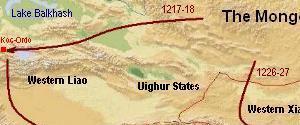 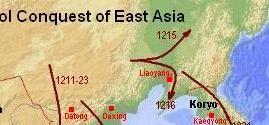
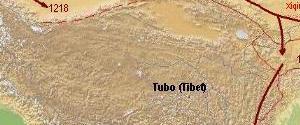 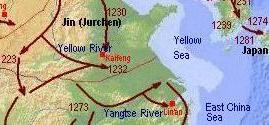
The Yuan dynasty 元 (1279-1368) was founded by Khubilai Khan, a grandson of the great Mongolian conqueror Činggis Qaɣan. The Yuan empire was one state (ulus) within the larger Mongolian unity of states. It included the three states that had formerly controlled the soil of China, namely the Tangutan Western Xia empire 西夏 (1038-1227), which was the first to be conquered by the Mongols, the Jurchen empire of Jin 金 (1115-1234), which was located in northern China, and the Southern Song empire 南宋 (1127-1279). The Yuan empire also included various Uyghurian communities in the region of modern Gansu and Xinjiang, as well as the Western Liao empire 西遼 (1124-1218) that had controlled the western parts of Xinjiang, as well as part of the steppe of Central Asia further west. The Mongols also won over control over Tibet by means of adopting Tibetan Buddhism ("Lamaism") as their religion.
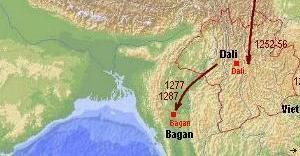
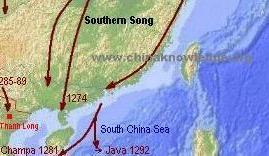
The Mongols continued to make use of their war machine and launched attacks on Korea, Japan, the kingdom of Dali in modern Yunnan, devastated the kingdom of Bagan (in today's Myanmar), invaded Vietnam, and even planned to land in what is today the centre of the Indonesian archipelago.
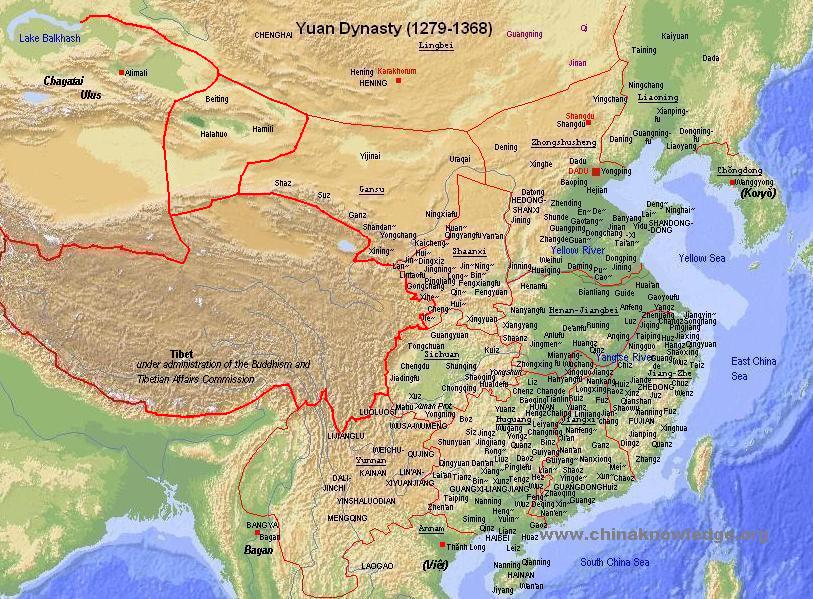
The Yuan administration followed patterns that had been created by the
Song administration, but imposed also their own structure of
improvisational government. On the local level, prefectures (zhou
州; in the map abbreviated with the sign ~; only these prefectures are
indicated that are not supersided by a route lu 路)
and superior prefectures (fu 府) were the mid-level
administration units. There were also a few military
prefectures (jun 軍) on the island of Hainan.
Capital of the Yuan empire was Dadu 大都 "Great Capital", known as
Khanbalik (Qanbaliq "City of the Khan") and today as Beijing; the secondary
capital was the Shangdu 上都 "Upper Capital" (Kaiping 開平; known as Xanadu
in the western accounts), located near modern Dolonnur 多倫, Inner Mongolia. The
old capital of the Mongols, Karakhorum (Qaraqorum, "Helin 和林"), was
located in modern Mongolia.
Khubilai Khan and his advisors adopted the institutions of the Chinese central government like the Palace Secretariat (zhongshusheng 中書省) as the core of their central government
over China, first only for the territory in the north (the former Jin empire), but in the course of the conquest of China, it became necessary to found ad-hoc secretariats by the various division of the Mongol army. These were called "en-route secretariats" (xing zhongshusheng 行中書省), a term later abbreviated as "secretariats" (sheng 省) and from the Ming period 明 (1368-1644) on used as the word for "province"). The Yuan empire was divided into eleven such "branch
secretariates" (in the map in Courier
type).
The Branch Secretariats (xingsheng 行省) of the Yuan Empire |
| branch secretariat |
modern region or province |
seat of government |
| Zhongshusheng 中書省 |
Hebei, Beijing, Tianjin, Shanxi, Shandong | Dadu 大都 (modern Beijing) |
| Liaoning 遼寧 |
Liaoning, Jilin, Heilongjiang | Liaoyang 遼陽 |
| Lingbei 岭北 |
Mongolia | Hening 和寧 (Karakhorum) |
| Gansu 甘肅 |
Gansu | Ganzhou 甘州 (modern Zhangyi 張掖) |
| Shaanxi 陜西 |
Shaanxi | Chang'an 長安 (modern Xi'an 西安) |
| Henan-Jiangbei 河南江北 |
Henan, northern Jiangsu, Hubei | Kaifeng 開封 |
| Sichuan 四川 |
western Sichuan, Chongqing | Chengdu 成都 |
| Jiang-Zhe 江浙 |
southern Jiangsu, Shanghai, Zhejiang, Fujian | Hangzhou 杭州 |
| Jiangxi 江西 |
Jiangxi, Guangdong | Longxing 龍興 (Nanchang 南昌) |
| Huguang 湖廣 |
Hunan, Guangxi, Guizhou, Hainan | Wuchang 無昌 (modern Wuhan 武漢) |
| Yunnan 雲南 |
Yunnan and parts of Myanmar and Thailand | Zhongqing 中慶 (modern Kunming 昆明) |
| Chŏngdong (Zhengdong) 征東 |
Korea | Wanggyŏng 王京 (modern Kaesŏng 開城) |
Subunits of these proto-provinces were pacification offices (xuanweisi
宣慰司, xuanwei shisi 宣慰使司 or xuanfusi
宣撫司; in the map in CAPITAL letters) that were bundled in circuits (dao
道). Most, but not all, prefectures were unified in routes (lu
路). The map gives (in black) the names of the routes. If a
sub-prefecture (zhou) is seat of a route, the "zhou"
is abbreviated with a "z" (Shaz=Shazhoulu 沙州路). In some cases, superior prefectures (fu 府)
were seat of a route (in the map, "fu" is always indicated). Some
sub-prefectures were not superseded by a route, they are indicated by
the sign ~ (De~=Dezhou 德州) in the map. This administrative system was by and large taken over from the Song empire.
Mountaineous regions and border regions were critical points that were
not administered by this regular system. Some of these prefectures or
regions were administered as (military) pacification commission (anfusi
安撫司 or junmin anfusi 軍民安撫司), military command (yuanshuaifu
元帥府), route command (zongguanfu 總管府 or zongshuaifu
總帥府), investigation commission (suzheng lianfang si
肅政廉訪司), brigades (junmin wanhufu 軍民萬戶府, guanjun wanhu fu 管軍萬戶府, or junminfu
軍民府), in one case by a branch censorate xing yushitai
行御史臺, and in Korea by a bandit suppression commission (zhaotaosi
招討司). For a short time in the 14th century, there were even two such
routes in modern Burma and Laos (Bangya 邦牙, Laogao 老告). The Uyghurian communities in Turkestan (modern Xinjiang) were not headed by a branch secretariate but were administered independently.
The highest nobility of the Mongols, i.e. the princes, were given
princedoms (wangguo 王國) in the grassland region of
Mongolia, but whose names were taken from traditional Chinese names:
Guangning 廣寧, Jinan 濟南, Qi 齊 (in the map in violet letters).
The relations the the southeast Asian countries were that of a tribute
system. As long as Bagan, Pegu (Burma), Sukhotai (Thailand), Chanla,
Champa and Vietnam ("Annam" 安南) paid tributes, they were left
unchallenged. Vietnam was still ruled by the Trần Dynasty 陳
and was not administered by a branch secretariate. Korea (Koryŏ 高麗)
only became an own state again after the downfall of the Mongols. Tibet
was ruled by the Yuan Dynasty through the Commission for Buddhist and
Tibetian affairs (Xuanzhengyuan 宣政院).
In the west of the Yuan empire was the
khanate ("ulus") of the descendants of Chagatai, a son of Činggis Qaɣan. The homeland of the Mongols ("Mongolia") was also part of the Yuan empire.
2000 ff. © Ulrich Theobald · Mail
|
|
|


