ChinaKnowledge.de -
An Encyclopaedia on Chinese History, Literature and Art
In every culture, bronze was the first alloyed metal to be used for every kind of article necessary for daily life like ploughshares, yokes, kettles, knifes, bracelets, earrings, chariot axles and so on. The melting point of unalloyed copper is a bit lower than that of bronze but it is not able to sustain hard requirements. Only alloying it with at least 5 percent of tin, the metal has the needed durability. In China the oldest bronze findings are 3200 years old.
In the west of the Eurasian continent, bronze items were in most cases used for agriculture and warfare. In China, the greatest part of discovered and preserved bronze items was not forged to ploughs or swords but cast to sacrificial vessels. Even a great part of weapons had a sacrificial meaning like daggers and axes that symbolized the heavenly power of the ruler. The strong religious sense of bronze objects brought up a great number of vessel types and shapes which became so typically that they should be copied as archaic style receptacles with other materials like wood, jade, ivory or even gold until the 20th century. The first researches about Shang 商 and Zhou 周 vessels were made in Song times 宋 when every type got a scientific name. Until then, some types did not even have a fixed name or were alloted to different categories, like ding 鼎 and li 鬲. The different types were used for three purposes: as vessels containing millet wine, vessels containing food or vessels containing water. Some vessels with their long feet made it possible to cook the food inside, making a fire of charcoal under the vessel. Some types were standing in a charcoal basin, especially wine containers. The ritual books of old China minutely describe who was allowed to use what kinds of sacrificial vessels and how much. The king of Zhou was favoured to use 9 dings and 8 gui 簋 vessels, a duke (zhuhou 諸侯: gong 公) was allowed to use 7 dings and 6 guis, a baron (daifu 大夫) could use 5 dings and 3 guis, a nobleman (shi 士) was allowed to use 3 dings and 2 guis. We can see that the vessel types were composed to sets including the most important types for offering in a sacrifice, often using the vessel types of ding, gui, dou 豆, hu 壺, pan 盤 and yi 匜 or he 盉.
 |
 |
 |
 |
 |
 |
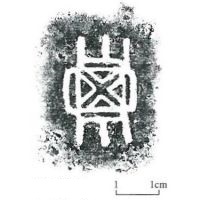 |
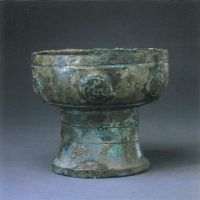
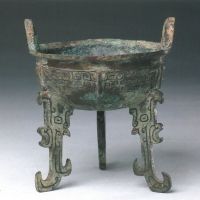
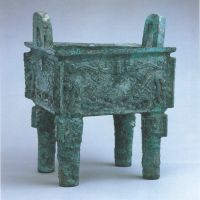
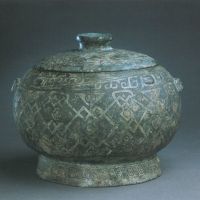
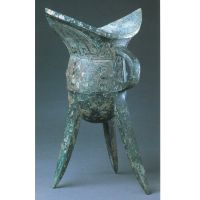
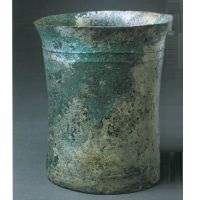
Set of six different bronze vessels (dou 豆 10.5cm high, ding 鼎 15.8cm, fangding 方鼎 23.7cm, gui 簋 (𣪘) 17.4cm, jue 角 20.8cm, zhi 觶 15cm), dated late Shang period, purchased in 1956 by the Palace Museum. All belong to one hoard and are inscribed with the insignium  . Gugong bowuyuan 故宮博物院, ed. (1999). Gugong qingtong qi 故宮青銅器 / Bronzes in the Palace Museum (Beijing: Zijicheng chubanshe), nos. 85-90. . Gugong bowuyuan 故宮博物院, ed. (1999). Gugong qingtong qi 故宮青銅器 / Bronzes in the Palace Museum (Beijing: Zijicheng chubanshe), nos. 85-90. |
|
The cultural significance of the bronze vessels is also evident through the abundance of Chinese characters used for these types. The character dou 豆 , in later Chinese meaning "bean" or "pea" originally meant a sometimes covered round one-footed vessel type. The character feng 豊 today is only used phonetically, but it depicts a vessel, that is filled with precious jade stones, later reshaped to the character feng 豐, today meaning "rich, abundant".
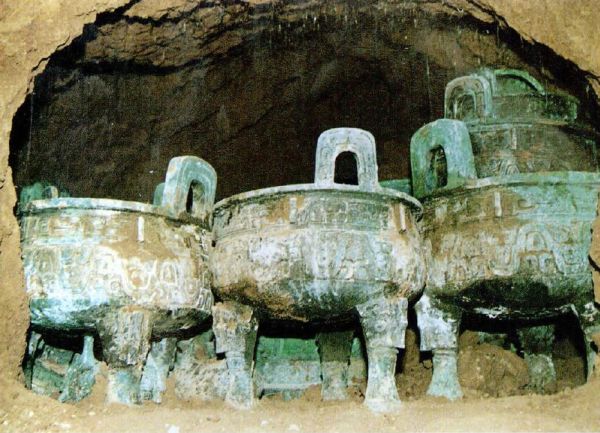 |
Hoard of ding-type tripods discovered in Yangjiacun 楊家村, Meixian 眉縣, Shaanxi. From Shaanxi Kaogu Yanjiusuo (1993). |
Already the earliest types show the typical Taotie pattern 饕餮 that is said to depict a voracious monster or dragon. The newer types of Taotie pattern make it more understandable as a forerunner of the more slim and friendly dragons (panchi 蟠螭) of chinese pictorial art. Other typical characteristics of the bronze vessels are the two button-like attachments on the rim of the vessels (zhu 柱), the nipple-nail pattern (ruding 乳錠) and the three legs.
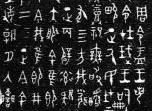
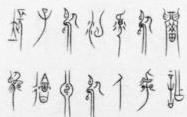
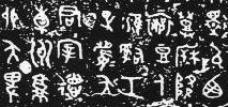
The first inscriptions of the bronze vessels are clan insignia (zuhui 族徽) or simply names of persons. From the Western Zhou time on, bronze vessels bear inscriptions of enfeoffment, memorials or instructions. See a translated example of the Mao Gong Ding 毛公鼎 kettle.
   |
 |
Ding 鼎
- one of the standard vessels for food sacrifying.
Although one can often read the ding is three
legged, there are many examples of four legged vessels,
especially in old times. This kind is called fangding
方鼎, "square ding".
Another kind of ding is a li-ding, a
vessel between li and ding,
a fourth type is the flat foot ding (pianzu
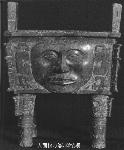
ding 扁足鼎), only used during the Shang time. Human faces are only very seldom seen on bronze vessels. This vessel has the inscription "大禾 Da He", probably the name of the owner. Height: 40 cm. The earliest ding vessels arise during the Erligang culture, deriving from stone age pottery. The character is a picture of the vessel. |
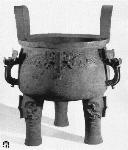 |
Ding - here a round belly three legged example from early Zhou times (height 120 cm). This is the standard shape of ding, which is still seen today in many temples as a container for incense burning. To this type belong very famous bronze kettles like the Mao Gong Ding 毛公鼎 and the Da Yu Ding 大盂鼎. The long inscriptions inside these vessels are often reports of an enfeoffment. |
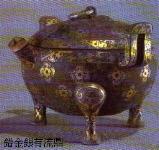 |
Ding - richly ornamented with inlaid gold and silver from late Warring States times (height: 11 cm). Refining the culture, the Zhou dynasty became more keen to small and fine handicraft instead of the former huge shapes. The ornaments of this example remind of the much later cloisonné art. Something new is the beak that makes the vessel look like a tea pot. |
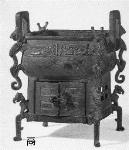 |
Ding - this specimen with the added heating oven from Western Zhou times is very precious. It has not only four legs instead of three but it shows the figure of a crippled slave who guards the door. It is therefore a witness of the "slave-holder society" at that time. |
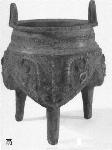 |
Li 鬲 - a round-bellied food container with three hollow legs from early Shang times to late Warring States (22 cm tall). Typical for this vessel type is the seamless, smooth transition from the legs into the body that makes the li optically more slim than the ding type. There are mixed forms called li-ding or ding-li, written with special characters that have died out since long. From the Spring and Autumn period on, the li type vessels become flatter than the earlier ones. The character is a picture of the vessel and is generally used as character for "offering vessel". |
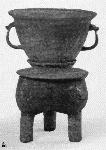 |
Yan 甗 - combination of li and a pot (zeng 甑) from early Shang to Spring and Autumn period (height 35 cm). The yan was a kind of metal steamer. The food was put in the zeng, the water in the li was heated by a fire between the three legs. The water vapor rose through holes or a grid in the bottom of the upper pot. There exist objects with one long stove-like li and three pots upon. From Western Zhou on, we also find square yan vessels. The character indicates that the vessel had a ceramic origin. |
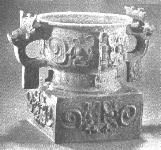 |
Gui 簋 - round, wide surface vessel with handles from early Shang to Spring and Autumn period. There exist many types of gui vessels, like the ring-foot type (quanzu gui 圈足簋), a type with four handles (sier gui 四耳簋), a type with a square base (example to the left; fangzuo gui 方座簋), and types with three legs. The character indicates that this vessel had a part of bamboo. |
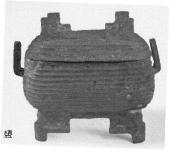 |
Xu 盨 - a long food container from late Western Zhou to Warring States (20 cm tall), deriving from a covered type of gui. On the inner side of this piece, a text about the southern conquest is engraved. |
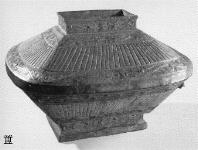 |
Fu 簠 - a food container from early Zhou to Warring States deriving from a square gui type with a large, slightly flattened corpus. The left example is one of the few still existing pieces (height 36 cm). The character indicates that in old times this vessel had a bamboo part, but especially for this vessel type exist many different characters. |
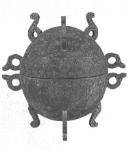 |
Dui 敦 (a character normally pronounced dun) - a globe-like food container from late Spring and Autumn times to Qin dynasty (height 25 cm). It is said to be a combination of ding and gui. The two parts are entirely symmetrical. |
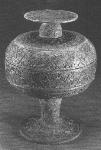 |
Dou 豆 - a food container late Shang times to Warring States period (height 20 cm). The later examples (the one on the left dates from Warring States times) of the dou have a cover that is almost symmetrical to the lower part, and the is much shorter handle than in old times. From Spring and Autumn time on we also find square dou types. The character is a picture of the vessel. |
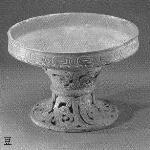 |
Fu 鋪 - a kind of dou with a short, perforated handle and a flat bowl, from Western Zhou to Spring and Autumn period. |
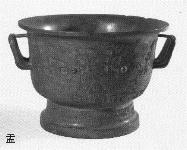 |
Yu 盂 - a bowl-shaped vessel with handles from late Shang to Spring and Autumn period (24 cm tall). It was intended to contain food or water. |
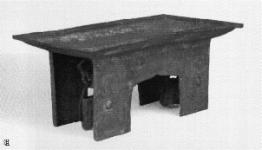 |
Zu 俎 - this kind of table was in use from Shang to Western Zhou dynasties. It had the main purpose to offer meat during a sacrifice. Some types have two large legs, some four legs, and the plate is concavely bended. |
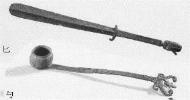 |
Bi 匕 und Shao 勺 - a flat spoon and a ladle from Shang times to Warring States period. Many bi objects are very short-handled and have a sharp tip at the front. Another kind of spoon is the dou 枓. |
| Vessels containing millet wine | |
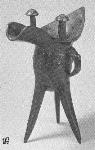 |
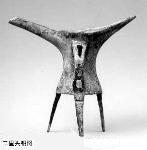 Jue 爵
- one of the oldest wine mugs, the earliest found dates
from the Erlitou culture (right picture). The jue's typical
features are the long, canal-like beak (liu 流)
and the shorter counterpart on the other side (wei
尾). On both sides, small handles (pan 鋬) are fitted. From
the Shang dynasty on, jue beaks are crowned by
one or two zhu 柱 buttons.
This vessel type has been very popular and was copied
oftenly. It has been in use until the upcoming of bowls
and cups during Song dynasty. Jue 爵
- one of the oldest wine mugs, the earliest found dates
from the Erlitou culture (right picture). The jue's typical
features are the long, canal-like beak (liu 流)
and the shorter counterpart on the other side (wei
尾). On both sides, small handles (pan 鋬) are fitted. From
the Shang dynasty on, jue beaks are crowned by
one or two zhu 柱 buttons.
This vessel type has been very popular and was copied
oftenly. It has been in use until the upcoming of bowls
and cups during Song dynasty. |
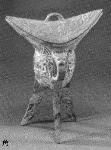 |
Jue 角 - (a character normally pronounced jiao) a wine mug very similar to the jue from Erlitou to Western Zhou times, but with a cover. The character originally means a kind of volume measure. |
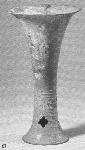 |
Gu 觚 - tall, slim wine mug with wide opening and rare ornaments from early Shang to Western Zhou. This simplicity of the gu has been handed down for centuries. There are also quadrangular pieces, called fanggu 方觚. The character originally means a kind of volume measure. |
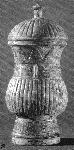 |
Zhi 觶 - a rare type of covered wine vessel from late Shang to Spring and Autumn period. There are flat and round types. The character originally means a kind of volume measure. |
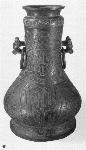 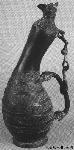 |
Hu 壺 - a kind of tall pot with cover, but without beak and carrying handle from late Shang to Warring States (50 cm tall). In most cases this type is not much decorated. On the left, two pieces from the Western Zhou resp. the Warring States period. The character for hu is a picture of the vessel. |
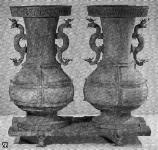 |
Hu - a beautiful specimen upon a stand called jin 禁 from early Warring States Period, found in the tomb of Marquis Zeng 曾侯. |
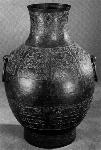
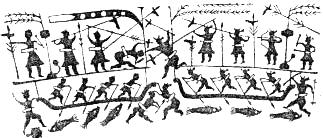 Hu - typically for the Warring States period
pots are the depictings of the aristocracy's daily life
activities like hunting and war scenes. There are many
different types of hu vessels, called with
different names like yinhu 飲壺 "drinking
pot" or jihu 汲壺 "libation pot".
The hu types are round, oval, square, long
necked, drum bellied, or gourd shaped. To the right is a rubbing from a detail of the vessel. Hu - typically for the Warring States period
pots are the depictings of the aristocracy's daily life
activities like hunting and war scenes. There are many
different types of hu vessels, called with
different names like yinhu 飲壺 "drinking
pot" or jihu 汲壺 "libation pot".
The hu types are round, oval, square, long
necked, drum bellied, or gourd shaped. To the right is a rubbing from a detail of the vessel. |
|
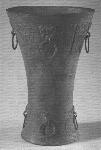 |
Bei 杯 - a water mug from the Warring States period (20 cm tall). Today, the word bei means "bottle". The eight rings that can be seen at many bronze vessels are in most cases only for decoration. |
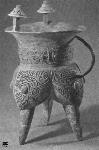 |
Jia 斝 - three legged wine pot from the early Shang. The jia has the typical two big button-like attachments that in some cases have animal shape. They are also attached to jue mugs, but smaller. The character is a picture of the vessel. |
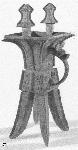 |
Jia - usually with a round shape, there are sometimes quadrangular jia pieces (fangjia 方斝). This type was copied later as an archaically shaped vessel. |
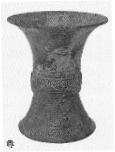 |
Zun 尊 - a multi shaped wine vessel with wide opening and flat bottom. After coming up in early Shang times this vessel developed forms with a wide belly. The zun was a standard type vessel and was copied until Qing times. The character is a picture of the vessel and is taken in verbal sense with the meaning of "to rever, to venerate, to honor". |
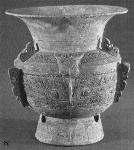 |
Zun - this type of zun from early Shang (30 cm tall) has much room for ornaments with its wide corpus. Sometimes there are even quadrangular pieces. |
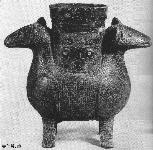 |
Zun - in late Shang times, the zun became a popular test object for bronze casters and artists. This piece with two sheep-shaped heads has still the large surface of the old types, but the legs are something new. Attention was drawn away from the ornaments to the whole shape of the vessel. The typical shapes of animals are elephants, rhinos, oxen, sheep, tigers, qilin unicorns, pigs, horses, and birds (especially owls). |
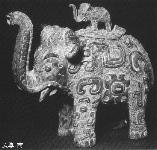 |
Zun - the nameless casters of Zhou times made much experiments with old vessel types. From now on, the zun had a typically small opening with a cover. This artful elephant is still decorated with the old taotie 饕餮 pattern. |
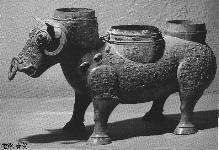 |
Zun - a vessel with the shape of a sacrificial animal. Seeing this wonderful ox from the Spring and Autumn period, one thinks of the victim ox that King Hui of Liang felt sorry for in the book of Mengzi. |
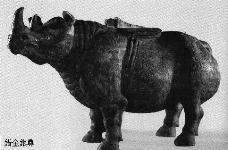 |
Zun - with simple beauty and lifelike, this rhinoceros from the Warring States period must have been in original in front of the artists. The climate 2500 years ago was much warmer than today, so that elephants and rhinos could make life at least south of the Yangtze. |
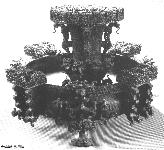 |
Zun - a perfection of Chinese bronze casting is this very richly ornamented zun, standing upon a dish. The dish was filled with hot water to heat the wine in the jar. This precious piece was a tomb offering of tomb B of Marquis Zeng 曾侯乙墓 in Suixian/Hubei (early Warring States). The filigree ornaments in dragon shape (panchi 蟠螭) was first shaped with wax, then coated with soft clay. Heating it, the melting wax came out, and the bronze could be casted in the hollow ductus. This so-called lost wax technic was also used in the Western part of the Eurasian continent, but to cast such filigee shapes can not be copied today. |
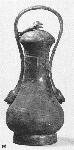 |
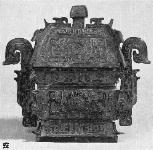
You 卣 - a tall, slim but sometimes even fat wine jar with carrying handle and cover from early Shang to Western Zhou (height 50 cm). There exist tall or small, round, flat and bucket shaped types. Later types have even shapes of animals, especially birds and monsters. The character is a picture of the vessel. |
 |
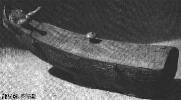
Yi 彝 - a richly ornamented rectangular wine vessel from late Shang to Western Zhou. The whole shape looks like a house or a sarcophagus (height 50 cm). The name yi or fangyi 方彝 is not original but was attributed to this vessel type by Song scholars. |
 |
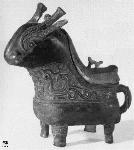
Gong 觥 - an always animal shaped vessel type from late Shang, out of the Middle Yangtze area. The cover of this wine mug is stretched over the whole length of the vessel. If the rim line is curved the type is called aogong 凹觥, "concave gong". The character originally means a kind of volume measure. |
 |
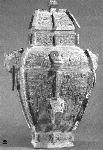
Gong - here a piece from early Zhou times (20 cm tall). The gong has been one kind of large volume vessel that was not exclusively used for sacrificial purposes. It is said that a person who did offend against the etiquette had to drink to the health of his host until he was drunk. |
 |
Lei 罍 - normally the lei was quadrangular (called fanglei 方罍), tall and vase-like, but sometimes also round. It served as a wine storing vessel. |
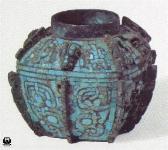 |
Lei - a quadrangular, tall vessel with rich ornaments and a cover from late Shang times. This precious piece is inlaid with turquois stones that are arranged in the shape of a Taotie monster. |
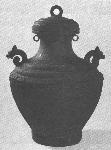 |
Ling 櫺 - a wide-bellied jar-like vessel from the Western Zhou (44 cm tall). The missing of ornaments draws the attention to the two handles and the rings at the neck of the covered vessel. |
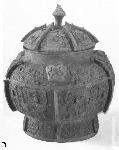 |
Bu 瓿 - (also called weng 瓮) a wide-bellied sacrificial vessel for millet wine from late Shang times. In spite of its huge character (40 cm tall) it is richly decorated with Taotie patterns and formed after the shape of Stone Age ceramics. |
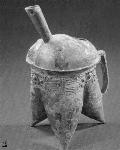 |
He 盉 - three legged wine pot from early Shang. This simple piece with the three teat-like feet is based upon Neolithic shapes. With the long beak, some Chinese authors compare this vessel type with an animal, but one could think of more cultic parts of the body. |
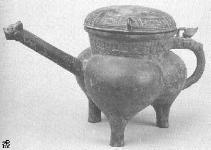 |
 He -
especially this piece with the extreme long beak whose
end is thickened and with the swollen upper part of the
legs could symbolize a phallus. There are also taller
pieces which look more like modern coffee pots. On the
right side, a similar vessel type called ying 鎣. He -
especially this piece with the extreme long beak whose
end is thickened and with the swollen upper part of the
legs could symbolize a phallus. There are also taller
pieces which look more like modern coffee pots. On the
right side, a similar vessel type called ying 鎣. |
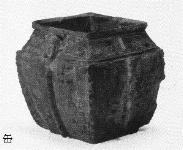 |
Fou 缶 - a quadrangular multi-purpose vessel with Stone Age forerunners. This piece dates from late Shang. The character is a picture of the vessel. |
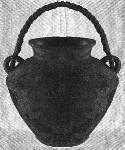 |
Guan 罐 - a jar-like vessel with a carrying handle from late Shang (16 cm tall). This shape is very simple and has Stone Age forerunners. Today the word guan means "tin" or "can". |
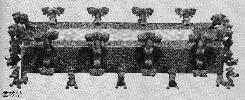 |
Jin 禁 - a stand for wine mugs or jars from the Spring and Autumn period. This specimen is very richly decorated with dragons (panchi 蟠螭). |
| Vessels containing water to wash hands | |
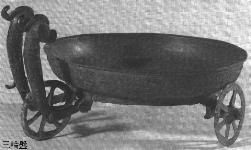 |
Pan 盤 - flat basin for washing hands or to serve dishes from Shang to Spring and Autumn period. This piece has even wheels and a bird-shaped prow. There are also rectangular examples. Today, the word pan means "dish". |
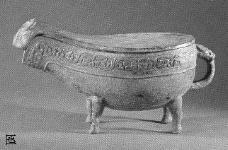 |
Yi 匜 - a huge footed ladle for water from middle Western Zhou (30 cm long). This piece has a cover that bears an inscription with juristic content. |
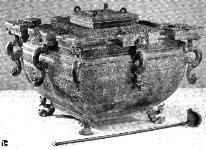 |
Jian 鑑 or 鑒 - a water basin from the Spring and Autum period. The richly ornamented piece to the left is from the Warring States period. Older examples are often round, not rectangular. The Chinese character for this vessel type is later being used with the meaning of mirror, meaning the reflection of the water. |
| Other Vessels | |
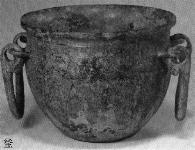 |
Fu 釜 - a kind of kettle with almost no ornaments. This rare specimen dates from late Shang. |
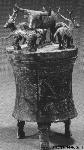 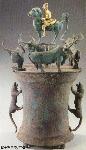 |
Coin container (beizhu 貝貯) - the mystical Taotie faces and the sacrificial ritus are part of Shang art and culture. The late Zhou time had a more practical approach to religion and art. The bronze vessels were much more decorated with scenes of daily life instead of the Shang and early Zhou vessels whose main purpose was to sacrify wine and food to the ancestors. The right coin container is from Western Han times. |
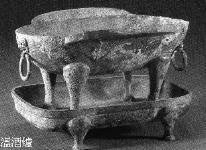 |
Wine heater - a rare example of an ear bowl (erbei 耳杯) with legs that is standing in a coal basin to heat the wine inside the bowl, a piece from the Qin dynasty. |
| Patterns | |
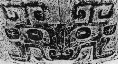 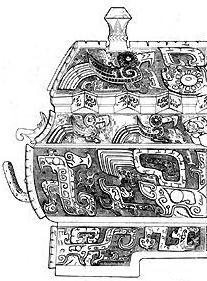  The Taotie 饕餮
pattern came up already in the Erlitou culture when jade
objects like daggers, axes, disks and scepters were
decorated with fabulous animals with fierce teeth and
claws, sharp horns, tails and legs. The name taotie
is not original but was given in Song times when scholars
made first researches of Chinese art. It is said the taotie
monsters were very voracious, and therefore the Chinese
caracters for "Taotie" contain the character
for "eat". During Zhou times, the fierce
looking animals became dragons with button-like staring
eyes. Until the Han dynasty, the former compact monsters
transformed into slim and friendly dragons. Sometimes the
intertwined bodies of the Taotie remind of the lion
patterns of Nordic art (see an
example of Jellinge art) or the Maya glyphic art (see the face of the raingod Chac). The Taotie 饕餮
pattern came up already in the Erlitou culture when jade
objects like daggers, axes, disks and scepters were
decorated with fabulous animals with fierce teeth and
claws, sharp horns, tails and legs. The name taotie
is not original but was given in Song times when scholars
made first researches of Chinese art. It is said the taotie
monsters were very voracious, and therefore the Chinese
caracters for "Taotie" contain the character
for "eat". During Zhou times, the fierce
looking animals became dragons with button-like staring
eyes. Until the Han dynasty, the former compact monsters
transformed into slim and friendly dragons. Sometimes the
intertwined bodies of the Taotie remind of the lion
patterns of Nordic art (see an
example of Jellinge art) or the Maya glyphic art (see the face of the raingod Chac). |
|
 < The Maya raingod Chac, detail from a Maya temple < The Maya raingod Chac, detail from a Maya templeCopy of a Chinese bronze vessel design with taotie pattern > | 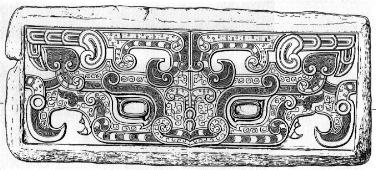 |
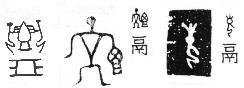 |
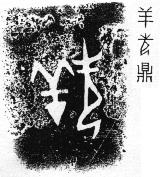
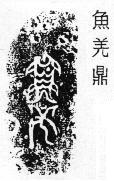
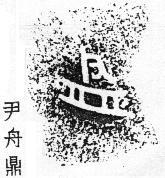
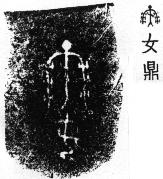
Clan insignia (zuhui 族徽) are among the first inscriptions of bronze vessels. Except simple symbols for a family or clan, we find names of persons, like the name of the owner of the vessel or that of the person that casted the vessel, other inscriptions declare the name of the person sacrifying the goods inside the vessel of the name of the venerated person. |
    | |