ChinaKnowledge.de -
An Encyclopaedia on Chinese History and Literature
The beginning of the Three Empires period 三國 (220-280) is officially fixed as the year 220, when Cao Pi 曹丕 (Emperor Wen 魏文帝, r. 220-226) proclaimed himself emperor of the Wei dynasty 魏 (220-265; often called Cao-Wei 曹魏 in order to avoid confusion with the Northern Wei empire 北魏, 386-534). Yet the end of the Han dynasty 漢 (206 BCE-220 CE) was heralded as early as 189, when an alliance of functionaries massacred the influential eunuch clique at the court. General Dong Zhuo 董卓 (d. 192) entered the capital Luoyang 洛陽 (today in Henan) and kidnapped Emperor Liu Bian 劉辯 (r. 189, later known as one of several under-age emperor, Shaodi 少帝) and his brother Liu Xie 劉協 (181-234) and brought them to Chang'an 長安 (Xi'an 西安, Shaanxi). A few days later, Dong Zhuo enthroned Liu Xie, who is known as Emperor Xian 漢獻帝 (r. 189-220). The sovereign remained in the custody of several warlords over the next decades, only to be dethroned in 220 CE.
Dong Zhuo's abduction of the emperor was only possible because the central government of the Han was destabilized by severe conflicts between the court officials, court eunuchs, kinsmen of empresses like Dou Wu 竇武 (d. 168 CE) and He Jin 何進 (d. 189), eminent families, in addition to outbreaks of plague and the rebellion of the Yellow Turbans (Huangjin 黃巾) initiated in 184 by the Daoist leader Zhang Jiao 張角 (d. 184 CE) in the Hanzhong region 漢中. Last, but not least, the northern frontier saw the rise of a new steppe federation, the Xianbei 鮮卑.
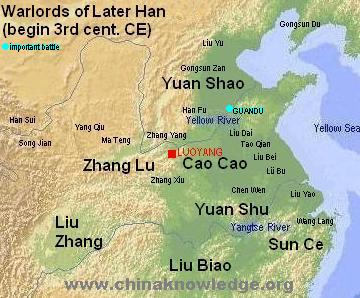 |
An alliance of local governors under the leadership of Yuan Shao 袁紹 (d. 202) tried to overthrow the tyrant Dong Zhuo. After Dong' death in 192, the empire was left in a political vacuum that was filled by a dozen of warlords and religious sects like the Daoist Five-Peck-of-Grains Sect (Wudoumi dao 五斗米道) and the Yellow Turbans.
On the side of Yuan Shao stood his cousin Yuan Shu (d. 199). In 191, a general of the latter, Sun Jian 孫堅 (c. 155-191) occupied the capital Luoyang, which thereafter fell into ruins. In 193, Gongsun Zan 公孫瓚 (d. 199) took over the province of Youzhou 幽州 (today's Hebei) from Liu Yu 劉虞 (d. 193). Gongsun Du 公孫度 (d. 204 CE) controlled Liaodong 遼東 (today's Liaoning). The middle Yangtze valley – the province of Jingzhou 荊州 – was in the hands of Liu Biao 劉表 (142-208), and the western province of Yizhou 益州 (Sichuan) was the domain of Liu Yan 劉焉 (d. 194). All these warlords commanded troops with great loyalty to their leaders, all the more as many of the men were volunteers who hoped to gain back land and welfare they had lost. Yet all loyalty could not compensate missing fighting experience. Only in the course of time, the warlord armies transformed into professional military units. The misery of the days was widespread, and pure survival was the core question for many families.
In the early 190s, Cao Cao 曹操 (155-220) rose to prominence as the strong man of the Central Plain. He had been successful in fighting local rebels, usurped the governorship of the province of Yanzhou 兗州 (today's Henan), and pacified the last Yellow Turban gangs of Qingzhou 青州 (Shandong). He then pushed back Yuan Shu to the southeast and aimed at occupying the province of Xuzhou 徐州 that was controlled by Tao Qian 陶謙 (132-194). However, it took him hard contests with Yuan Shu, Lü Bu 呂布 (d. 198), and Liu Bei 劉備 (161-223) for the area south of the Yellow River. Lü Bu had assassinated the warlord Dong Zhuo, while Liu Bei claimed membership of the imperial family. Yuan Shu was finally defeated in 199 after having adopted the title of emperor.
In 196, Cao Cao received Emperor Xian and took him to his own residence in Xu 許 (today's Xuchang 許昌, Henan), where Cao began to build his own state. Four years later, Yuan Shao attempted to destroy Cao Cao' base, and the two parties met in the battle of Guandu 官渡 (today's Zhongmou 中牟, Henan), where Cao defeated Yuan Shao and began to conquer step by step the northern parts of the Central Plain and of the province of Bingzhou 並州 (Shanxi) until 207. Cao Cao also defeated the northeastern federation of the Wuhuan 烏桓. He adopted the title of Counsellor-in-chief of the Han empire. Apart from being an excellent military leader, Cao Cao was famous as the author of a commentary on the famous military treatise Sunzi 孫子 (see Sunzi shijia zhu 孫子十家注), and as a man of refined manners.
Cao Cao's embryonic government had to make good for the defects of the Later Han administration, like a dysfunctional taxation system by which eminent families occupied large tracts of land and starved the government treasury, or the breakdown of currency. Cao Cao lowered the land tax to one thirtieth of the harvest (de Crespigny 2019: 34) plus a certain amount of cloth and nourished his armies by creating military agro-colonies (tuntian 屯田) in the heartland of his quasi-state. He also began to introduce a household tax (hudiao 戶調) aimed at replacing the land tax. Monetary reforms were not successful, with the consequence that barter trade prevailed in many regions.
The most important administrative reform of Cao Cao was the introduction of the nine-rank system (jiupin zhongzheng zhi 九品中正制). The overall turmoil made the traditional system of provincial recommendees (zheng-bi zhi 征辟制) unfeasible. Cao therefore decided to keep to practical circumstances, accepted the dominance and influence of the distinguished families, and classified all families into one of nine ranks, according to which access to state offices was allowed. The measures of Cao Cao were the result of a general tendency of late Han-period thinkers like Wang Fu 王符 (83-170) and Cui Shi 崔寔 (a. 120–170) who had advocated legalist measures to re-strengthen the state, and to put off the stress on Confucian values.
Cao Cao also shifted the seat of his parallel state to Ye 鄴 (today's Linzhang 臨漳, Hebei), leaving the puppet emperor and his entourage at Xu. In 213, Cao Cao was bestowed the title of Duke of Wei, and was three years later invested as King of Wei. Three of his daughters were made court ladies of Emperor Xian, making him father-in-law of the sovereign. He was allowed to use his own banners and insignia, and granted the nine privileges. In 217, Cao made his oldest son Cao Pi heir of his title of king, even if there was some competition with Cao Zhi 曹植 (192-232) and Cao Zhang 曹彰 (189–223).
When Liu Biao died in 208, Cao Cao saw his chance to conquer the middle Yangtze valley. Liu's son Liu Cong 劉琮 (b. c. 190) surrendered, but Liu Bei and Liu Qi 劉琦 (191-209) offered resistance to Cao's invasion, and were supported by Sun Quan 孫權 (182-252), who controlled the southeast of China. Sun sent general Zhou Yu 周瑜 (175-210) in support, and their unified army defeated Cao Cao in the river battle at the Red Cliff (Chibi 赤壁, near modern Puqi 蒲圻, Hubei) in 208. Yet just as the southern frontier of Cao Cao's domain was determined by this defeat, Sun Quan could not profit from his victory. He could neither break through to the north in the Huai River 淮河 valley, nor could he gain a foothold in the province of Jingzhou. Liu Bei won control over this region or what is today Jiangxi and Hunan. The last military success of Cao Cao was the defeat of the Daoist master Zhang Lu 張魯 (d. 216 CE) in 215 which gave into Cao's hands the region of the Han River 漢水 valley (Hanzhong).
In Sichuan, the local warlord Liu Zhang 劉璋 (194-219) called for support by Liu Bei, who took this chance and simply usurped the Sichuan Basin. In 219, Liu Bei advanced further to the north and occupied the Hanzhong region. With Liu Bei having left the middle Yangtze region, Sun Quan sent out general Lü Meng 呂蒙 (178-219), who occupied that area. Sun's domain substantially grew, while Liu Bei was restricted to Sichuan.
From then on, the division of China was decided. It was finally executed in the years between 220 and 229. On 11 Dec 220 Cao Pi, then successor of his father, the King of Wei, urged Emperor Xian to abdicate (see shanrang 禪讓) and lay the Heavenly Mandate into the hands of the Cao family. Liu Bei had decided in 219 to adopt the title of King of Han 漢, just as 400 years earlier Liu Bang 劉邦 (256 or 247-195 BCE) had done, the founder of the Han dynasty. On 6 Apr 221, Liu Bei proclaimed himself emperor of Han, expressing that he was the justified successor of Emperor Xian. In order to ensure Sun Quan's loyalty, the court of Wei granted him the title of King of Wu, but in late 222, Sun cancelled his allegiance to the empire of Wei. On 23 May 229, he also adopted the imperial title. Chinese historians describe this situation as "the feet of a tripod erected against each other" (dingzu duishi 鼎足對峙), or "three empires standing like the feet of an [actually united] tripod" (san guo ding li 三國鼎立). These were the empires of Wei 魏 (220-265) in the north, Wu 吳 (229-280) in the south, and Shu 蜀 (221-263) in Sichuan.
Chinese historiographers did not have a calendar with a fix date like the putative date of the birth of Jesus Christ in the Western calendar. During the Warring States period 戰國 (5th cent.-221 BCE), when China was controlled by regional rulers, the year of rule of the kings of Zhou 周 (11th cent.-221 BCE) was the scale of counting time. Yet for the Three Empires, many historians were not able to decide the rule of which emperor should be the orientation scale. The official dynastic history of the Three Empires is compounded of three autonomous books for every empire: Weishu 魏書, Wushu 吳書 and Shushu 蜀書 (together called Sanguozhi 三國志, compiled by Chen Shou 陳壽). Historians from the Jin period 晉 (265-420) counted Cao Cao's rule as the justified because the Jin dynasty had replaced that of the Wei. For the Tang period 唐 (618-907) historian Ouyang Xiu 歐陽修 (1007-1072), the Heavenly mandate was cut off during that time. Sima Guang 司馬光 (1019-1086), author of the univeral history Zizhi tongjian 資治通鑒, used the Wei calendar because the other lords had accepted Cao Pi's rule. Yet the Neo-Confucian demigod Zhu Xi 朱熹 (1130-1200) chose the calendar of Liu Bei as the justified one.
History is never told objectively, but every age has its own interpretation of events and actors. Discussion about who was the right emperor is not ended yet. In the imagination of the common people, popular tales are to be found and stories about the battles, intrigues and strategies of the Three Empires. The book that mostly formed popular thinking about this period of history is the romance Sanguo yanyi 三國演義 "The Three Empires" by Luo Guanzhong 羅貫中 (c. 1330-c.1400). This book depicts Cao Cao as a decisive person who ended the tyranny of Dong Zhuo, but who dared to make himself the regent for a weak and young emperor. His counterpart Liu Bei is described as the justified successor and defender of the Han dynasty. Cao's failure to unify the empire, along with his origin from a eunuch family, determined the negative image of him, while Liu Bei, a person of humble origins supported by a magician like Zhuge Liang 諸葛亮 (181-234) and a hero like Guan Yu 關羽 (d. 219), had much more positive appeals. Contemporary historians were quite objective in their judgement about who was a "good" and who was a "bad" actor, but later novelists and writers of theatre plays made a villain out of Cao Cao and a hero of Liu Bei and his followers. Among the latter, Guan Zhong was even elevated to the status of God of War (Guan Gong 關公), and Zhuge Liang is likewise highly venerated as a semi-deity of loyalty and wisdom.