ChinaKnowledge.de -
An Encyclopaedia on Chinese History, Literature and Art
For a very long time, the accounts about the Shang dynasty 商 (17th-11th cent. BCE) as found in historiographical accounts like the universal history Shiji 史記 or the "Bamboo Annals" (Zhushu jinian 竹書紀年) were believed to be pure inventions.
Only the discovery of oracle bone inscriptions (jiaguwen 甲骨文) in the northern parts of the province of Henan made clear that the purported rulers of the Shang dynasty had really existed, and that the chronological sequence of rulers as presented in the Shiji was relatively accurate. In the 19th century, locals used to sell bone fragments to apothecaries which used them as "dragon bone" medicine. In 1899, scholars became aware that the bones were of ancient origin. The first regular excavations in search for more oracle bones took place in 1928, and in the 1950, a huge amount of fragments was stored in private and public collections in many countries all over the world.
The inscriptions on oxen scapulae or tortoise plastrons (jiagu 甲骨) record processes and results of divinations made by the Shang kings and their "shamans" (wu 巫). The inscribed bones were stored in archival pits close to the compounds of the royal palace and ancestral temple (see Shang arcitecture). The oracle bone inscriptions are not only witnesses of Shang belief and religion, but also of their system of ancestor veneration, their political, economical, and military activities, and Shang society at large.
The political centre of the high and late Shang period was the city (guo 國) of Yin 殷, whose "ruins" (Yinxu 殷墟) were discovered at Xiaotun 小屯 close to the city of Anyang 安陽, Henan. This capital was the Shang residence since the reign of King Pan Geng 盤庚 (trad. r. 1401-1374 BCE, probably around 1300). The Shang at that time dominated smaller cities and states in the Yellow River Plain (the Central Plain, Zhongyuan 中原). From there, the power of the Shang kings extended to the Shandong Peninsula in the east and and Wei River 渭水 valley in Shaanxi the west. Enemies of the Shang state were called fang 方 "regions", like the Tufang 土方, which roamed the northern region of Shanxi, the Guifang 鬼方 and Gongfang 𢀛方 in the northwest, the Qiangfang 羌方, Suifang 繐方, Yuefang 戉方, Xuanfang 亘方 and Zhoufang 周方 in the west, as well as the Yifang 夷方 and Renfang 人方 in the southeast.
Although the culture of the Shang kingdom quite probably differed from the cultures in the semitropical area of the Yangtze River valley and Sichuan (for instance, the Sanxingdui Culture 三星堆文化), and also from the steppe cultures in the north, economic activities and the exchange of goods led to the spread of common features ("metropolitan tradition", Campbell 2014) in all cultures of Shang-period China. Such can be seen in the custom to cast ritual bronze vessels.
Yin as a politically dominating centre of the "Chinese world" obtained tributes (gong 貢) from the "many states" (bangguo 邦國, duofang 多方) of the Yellow River plain and beyond. The Shang kingdom was thus not a sovereign dynasty that dominated over a large territory, but rather one strong state among many dozens of smaller states (wanguo 萬國 "ten thousand states"). The heads of these states were called "earls" (bo 伯, perhaps related to the word ba 霸 "lord, hegemon"). Apart from tributes, the Shang kings required from their allies or vassals taxes in grain and military assistance during warfare.
Particularly during the reign of King Wu Ding 武丁 (trad. r. 1324-1266 BCE, in fact probably 1238-1180), the Shang demonstrated their military superiority over their neighbours and even over states that were a thousand miles away from the royal residence. During the last century or so of the Shang period, control over the western regions (Shaanxi) was lost.
From the 1950s on, excavations brought to light earlier Shang residences, namely Erligang 二里岡 and Yanshi 偃師 close to Zhengzhou 鄭州, Henan, and Huanbei 洹北 somewhat north of Anyang. The Shang period is thus usually divided into the early or Erligang phase (1600-1400), the middle or transitional Huanbei phase (1400-1300), and the late or Anyang phase (1300-1050).
According to legend, Jian Di 簡狄, the mother of the Shang's first ancestor Xie 契 (Jian Di was a daughter of a noble called You Song 有娀 and secondary wife of Emperor Di Ku 帝嚳), is said to have conceived when she ate the egg of a black bird (xuanniao 玄鳥) that had dropped from the sky. Xie is also believed to have been a descendant of the Yellow Emperor 黃帝. The black bird seemed to have been a kind of heraldic symbol or totemic animal of the Shang people (see Shang religion).
Traditional historical sources explain that the Shang dynasty was founded by Tang the Perfect (Cheng Tang) 成湯, who defeated the depraved king Jie 桀, ruler of the Xia dynasty 夏 (17th - 15th cent. BCE). The defeated king Jie was banished to Nanchao 南巢 in the Yangtze River region. Before this event, the pre-dynastic Shang chieftains had changed eight times the location of their seat (historiographical sources mention the place names Bo 亳, Ao 隞, Xiang 相, Xing 邢, Bi 庇, Yan 奄, Yin 殷, and Mei 沬), and after the foundation of the dynasty, five more times. Scholars suppose that the Shang people were either nomadic, and retained the custom of temporarily changing residence, or that they were forced to move their dwelling places because of inundations or droughts. It might also be that the Shang had to remove their seat to evade stronger neighbour polities or intra-family quarrels.
The second ruler of the Shang, king Wai Bing 外丙 (trad. r. 1759-1758 BCE) appointed Yi Yin 伊尹 to the office of chief minister (qingshi 卿士, zhongzai 冢宰). Yi Yin served three subsequent kings, but finally attempted to depose King Tai Jia 太甲 (trad. r. 1753-1721) and to usurp the throne. Seven years later, the demoted king was able to kill Yi Yin, but he allowed the usurper's sons Yi She 伊陟 and Yi Fen 伊奮 to inherited their late father's position of chief minister.
Other accounts tell that King Tai Jia "forgot about the [virtuous] way of Tang the Perfect" and was therefore detained by Yi Yin in the Tong Palace 桐宮. Yi Yin thus acted as regent for the depraved ruler. King Tai Jia later repented his faults and was welcomed back to the court. The king's temple name was Taizong 太宗 "Grand Ancestor". Yi She was also the first minister who initiated relationships with the western nomad tribes (Xirong 西戎) and the "nine" southeastern barbarians (Jiuyi 九夷). Yi Yin's successor as chief minister was Jiu Dan 咎單.
King Yong Ji 雍己 (trad. r. 1649-1638 BCE) was the first of the Shang rulers who showed signs of decadence. Yi Yin's son Yi She, serving as chief minister of King Tai Wu 太戊 (trad. r. 1637-1563 BCE, temple name Zhongzong 中宗), was able to ensure the continuance of the power of the Shang kings over their neighbours, a success that was by traditional historians expressed with the words "the regional rulers turned towards them [i.e. the Shang]" (zhuhou gui zhi 諸侯歸之).
Yin She's successor in office was Wu Xian 巫咸 (also written 巫賢). Under King Hedan Jia 河亶甲 (trad. r. 1534-1526 BCE), the Shang kingdom again lost its prevalent position among the many states.
King Pan Geng is said to have moved several times the residence of Shang but finally decided to move the capital to Yin. His long rule is again seen as an age of strength and prevalence for the Shang rulers. King Wu Ding's chief minister was Fu Yue 傅說. The king once dreamt of Yue as an excellent advisor, had sought for him and found him as a hermit in the wildnerness. With Fu Yue's advice, the king's army defeated the nomad warriors of the Guifang in the north. The western tribes of the Di 氐 and Qiang 羌 declared their vassalship to the Shang.
King Wu Ding is in traditional sources seen as an extremely virtuous ruler, and was therefore given the temple name Gaozong 高宗 "High Ancestor". Wu Ding is also the first Shang king who is historically documented.
King Wu Yi 武乙 (trad. r. 1198-1195, rather 1129-1095 BCE) made Dan Fu, Duke of Gu, 古公亶父, ancestor of the house of Zhou 周 (11th cent.-221 BCE), ruler over the statelet of Qi 岐 in the Zhou Plain (Zhouyuan 周原) of the Wei River valley. The lords of Zhou were militarily very active and fought against the western nomad warrior tribes. As loyal vassals of the Shang, their rulers regularly visited the royal court at Yin. Ji Li 季歷, the earl of Zhou, obviously became a political threat for the Shang and was killed by King Wen Ding 文丁 (trad. r. 1194-1192, rather 1094-1084 BCE). Shortly later, "phoenixes assembled in Qi", the seat of the Zhou, an occurrence interpreted as a portent of political significance.
King Di Xin 帝辛 (better known as King Zhou 紂, trad. r. 1154-1123, rather 1060/1050-1027 BCE) was the last ruler of the Shang. It is said that he was rude and licentious, enticed by his consort Da Ji 妲己, daughter of the nobleman You Su 有蘇, and in later novels (Fengshen yanyi 封神演義) believed to be a fox spirit. King Zhou imprisoned Ji Chang 姬昌, the Viscount or Earl of the West (Xi Bo 西伯) and chieftain of the Zhou people, and only relieved him six years later (compare the case of Ji Li some decades before).
Ji Chang, posthumously called King Wen of Zhou 周文王, founder of the Zhou Dynasty, assembled other counts and marquesses with him and won over Lü Shang 呂尚 (known as Jiang Ziya 姜子牙 or Qi Taigong 齊太公) to be his general-in-chief. The armies of the Zhou crossed the Yellow River ford at Mengjin 孟津 (today in Henan) and began to attack King Zhou of Shang.
This happened as a final decision to destroy the Shang after King Zhou had incarcerated his uncle, Prince Jizi 箕子, killed another uncle, Bi Gan 比干, and driven away his half-brother Prince Weizi 微子. At the battle of Muye 牧野 (today in Henan) in c. 1046 BCE, the Zhou armies defeated the last troops of the Shang. King Zhou of Shang burned himself on his Deer Terrace (Lutai 鹿臺). The rulers of the Zhou took over control of the Central Plain. Prince Weizi was made ruler of the regional state of Song 宋.
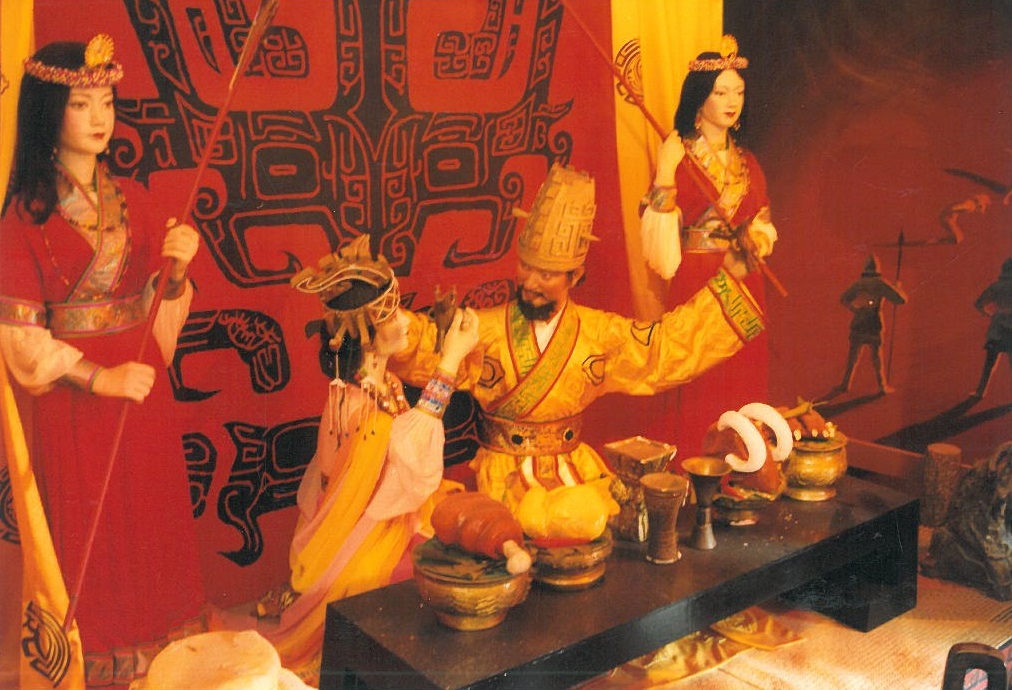 |
Diorama in Ocean Park, Hong Kong, 1997. Foto: Ulrich Theobald. |
The Shang prince Wu Geng 武庚 (posthumous title Lu Fu Yin 祿父殷) rebelled against the new master of "China", Ji Fa 姬發, King Wu of Zhou 周武王, but was defeated.
In their self-interpretation, the chieftains of the Zhou received the Heavenly Mandate (tianming 天命) and thereby the duty to replace, as "Sons of Heaven" (tianzi 天子), the Shang dynasty. King Zhou of Shang was reinterpreted as a brutal tyrant who disobeyed the Heavenly way, killed his relatives, murdered his loyal ministers by cruel punishments (like the "roasting pillar", baoge zhi fa 炮格之法, see judicial system) and followed the licentious wishes of his scheeming concubine Da Ji.
The Shang dynasty was thus by Chinese historians defined as one ruling house that experienced the usual cycle of dynastic succession: The first ruler, Tang the Perfect, was a kind and virtuous sovereign. This "royal way" (wangdao 王道) declined and was finally lost by the last ruler, who was in turn replaced by someone who displayed an original mode of virtue, namely the Earl of the West. This cycle was even projected back to the earlier Xia dynasty, and historical accounts on that dynasty in many points resemble the story of the Shang.
Together with the Western Zhou dynasty 西周 (11th cent.-770 BCE), the Xia and Shang constitue the so-called Three (Golden) Ages (sandai 三代).
Although the oracle bone inscriptions proved that traditional Chinese "historians" living during the Zhou period had certain knowledge of the Shang dynasty and the order of the dynastic succession of their kings, they did not report much about the political events that took place during the several hundred years of the Shang rule. Such details and information about Shang society, economy, culture and religion can only be reconstructed from archaeological discoverings.
In 1910, Luo Zhenyu 羅振玉 (1866-1940) found the source of "dragon bones" in the village of Xiaotun near Anyang, Henan. This event was followed by vivid activities in archaeology, resulting in the discovery of the "Peking Man" at Zhoukoudian 周口店 near Beijing in the early 1920s, and the Yangshao 仰韶文化 (5000-3000 BCE) and Longshan 龍山文化 (3200–1850 BCE) cultures in 1921 and 1928, respectively. At the same time, the scholar Gu Jiegang 顧頡剛 (1892-1980) established a scholarly line doubting the narrative of traditional writings (yigupai 疑古派) speaking of the Five Emperors and the Xia dynasty – and explained that these were but mythology, not history. After nearly a century of archaeological discoveries, the republic of letters has turned toward a trend accepting, after critical assessment, the content of mythology as based on historical facts. The most important scholar supporting this change in perception is Li Xueqin 李學勤 (b. 1933), author of Zouchu yigu shidai 走出疑古時代.
Luo Zhenyu, Fu Sinian 傅斯年 (1896-1950) and Dong Zuobin 董作賓 (1895-1963) were the most important early archaeologists, members of the Academia Sinica (Zhongyang Yanjiuyuan 中央研究院), which carried out excavation seasons in Anyang between 1928 and 1937. Excavations in Erligang, part of the city of Zhengzhou, Henan, brought to light in 1950 a vast Shang-period site. Many other Shang-period sites were discovered thereafter and demonstrated that the influence of the Shang culture reached from the Liao River 遼河 basin in the north to the banks of the Yangtze River and beyond to Xingan 新淦 (新干), central Jiangxi.
Finds of a tomb in Chengjia Village 程家 in Dayangzhou 大洋洲 in the district of Xingan yielded a huge amount of bronze artifacts, jades, and pottery wares. The material cultures unveiled in Wucheng 吳城, Jiangxi, and Panlongcheng 盤龍城, Hubei, was markedly identical to that of Erligang, and scholars therefore interpreted the Hubei and Jiangxi sites as a military outpost of the Shang, the latter being a single civilized centre (Zhang 2006: 54). It is assumed that Wucheng and Panlongcheng provided Erligang with local materials, while the Shang manufactures bronze items and shipped them to the south (Zhang 2006: 55). Yet the validity of such a core-periphery model must be tested. The absence of clay moulds does not necessarily mean that the bronzes were made in the Central Plain.
The discovery at Sanxingdui, district of Guanghan 廣漢, Sichuan, of a hoard of bronze items like masks, statues and "sacred or spirit trees" in a style totally different from what was known from Shang sites, further contributed to the abandoning of the idea that the Shang state dominated all predominant cultures of archaic China.
The establishing of a chronology is possible when counting back the reign periods as listed in traditional sources like Shiji or Zhushu jinian from the earliest known year, which is 851 BCE. For dating the Chinese dynasties, the year of the Zhou conquest of the Shang is of particular importance. The reign dates given in traditional ruler lists result in the year 1122 as the year of the fall of the Shang, while other evidence, mainly based on astronomical statements (supernovae or else), leads to the year 1045 or 1046 BCE. This timeframe is backed by archaeological evidence like radiocarbon dates (Zhang 2006). The intention to fix exact dates, as seen in the Xia–Shang–Zhou Chronology Project (Xia-Shang-Zhou duandai gongcheng 夏商周断代工程) carried out between 1996 and 2000, was motivated by a kind of "dataism" (Chang 1980: 60; Zhang 2002).
Archaeological discoveries make clear that about 1500 BCE, a major state had taken shape in the Yellow River Plain and probably ruled over large territories occupied by smaller and weaker states and communities. The power of this state shrank about 1300 BCE, and the Yellow River plain became a network of various interacting states that culturally had about the same level. Only the dynasty ruling the city that later was called Yin (the name of Yin is not mentioned in oracle bone inscriptions) made use of a script, and was therefore the only state about which historiographical information has survived, for instance, in the Shiji.
Although the oldest discoveries of cast ritual bronze vessels were unearthed in the province of Gansu from the Qijia Culture 齊家文化 (2200-1600 BCE, finds in Qijiaping 齊家坪, close to Guanghexian 廣河縣, and Huoshaogou 火燒溝, close to Yumen 玉門), the Erlitou Culture 二里頭 (1900-1350 BCE) which centered around Luoyang 洛陽, Henan and discovered in 1959, was the first culture which knew industrial casting of bronze vessels. This craft was not evidently imported from the west: In the Near East, where the bronze age began about the same time as in East Asia, metalwork was made by hammering, while in China the abundance of metal ores and labour force made it possible to rely extensively on casting techniques.
There are not many traces left of the palaces and the burial sites of the ruling class of Erlitou. The findings within the Erlitou tombs like jades, turquoise and cowry shells give evidence of a widespread trade system that enabled the ruling class of the Erlitou people to acquire such objects. The pounding of earth (hangtu 夯土) for the base of "palace-temples" and for sealing tombs, and the casting of bronze vessels required a sophisticated labour organization and social stratification.
Archaelogists divide the Erlitou period in four phases. The site of Erlitou included in its early phase a cluster of settlements covering an area of 100ha, which grew to about 300ha in the second and third phase (Campbell 2014: 24-25). The palace of phase III with its rammed-earth walls covered an area of no less than 11ha. This was also the time when piece-mould casting came into use. After this expansionary age, Erlitou shrank again to a size of 30ha. During Erlitou phase IV, the city of Erligang began to rise.
The city of Erlitou emerged from Yangshao and early Longshan settlements and became a large urban site as the result of migration of population from elsewhere (Liu and Chen 2003: 57). The urbanization of the city peaked in phase III (1700-1600) and declined in phase IV (1600-1500). The Population in phase III was perhaps as large as 18,000-30,000 (Liu and Chen 2003: 64).
The city of Erlitou was perhaps a political capital, a ceremonial centre, and an elite centre and hub of a resource extraction network (Liu and Chen 2003). The metropolis controlled the surrounding and its natural reserves, like pebbles for building foundations, kaolin clay for white pottery, timber, charcoal, the rivers Yi 伊河 and Luo 洛河 for transport, stone tools in Huizui 灰嘴, and of course food. It controlled the periphery in southern Shanxi, like Dongxiafeng 東下馮 and Yuanqu 垣曲 (Nanguan 南關) with their salt and copper deposits, Donglongshan 東龍山 (Shangluo 商洛) in eastern Shaanxi, where also copper was found, as well as jade deposits, and the Middle Yangtze Valley, with the copper deposits in Panlongcheng.
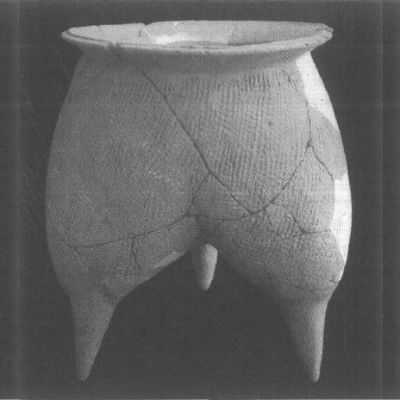
The oldest bronze vessels were simple transformations of traditional pottery shapes (like ding 鼎, li 鬲, or jue 爵) into a new material, but later vessel types show that artisans invented new forms and shapes especially convening with the novel material bronze (qingtong 青銅). The Erlitou culture shows the transgression from the Neolithic age to the Bronze Age. In tombs, archaeologists discovered clay and bronze vessels, jade and bronze daggers (ge 戈), lacquered wooden coffins, animal bones for divination (without inscriptions), and traces of the custom of placing into a tomb persons accompanying their master to the netherworld (renxun 人殉).
The palace-temples of Erlitou showed the model for imperial palatial architecture of China. Quite surprising is that the whole structure was planned to be short-lived: Palaces and temples were made of earth, wood, thatch, and mud, with timber pillars, but wattle-and-daub walls, and thus more functional than impressive.
 |
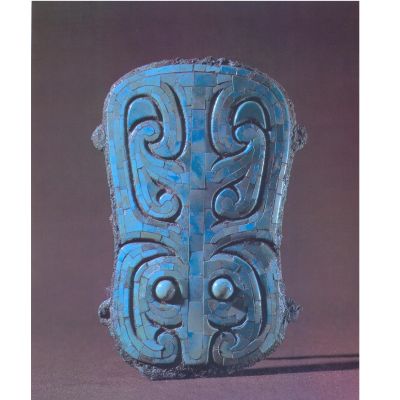 |
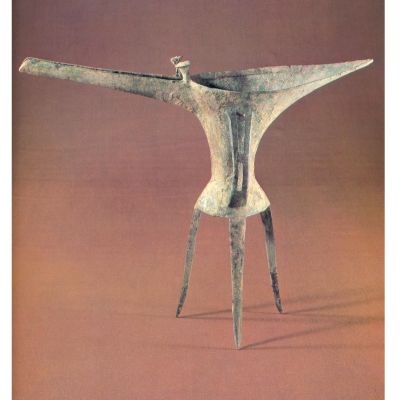
Left: Jue 爵-type tripod beaker unearthed in 1975 in Yanshi 偃師, Henan. Height: 22.5cm. Right: Decorative object with turquois (lüsongshi 綠松石) inlay in the shape of a taotie 饕餮 pattern. Size: 14.2×9.8cm Unearthed in 1981 in Yanshi. From Zhongguo meishu quanji bianji weiyuanhui/Li (1985), nos. 2 and 3. |
|
Although the Erlitou city itself did not have a city wall, there were pounded earth walls found in contemporary sites like Chengziya 城子崖 near Jinan 濟南, Shandong. The palace compound of Erlitou, with the main hall in the north, is very similar to Neolithic finds. The same is true for the deep tomb shafts with a shelf around the shaft base (a construction called ercengtai 二層臺 "two-layer terrace") on which burial objects or accompanying persons (renxun) were laid down. This structure is the continuation of a traditional neolithic pattern. Beneath the coffin of the tomb owner was a sacrificial pit (called yaokeng 腰坑 "hip pit" because it was usually located below that part of the body) filled with burial objects. The bronze vessels in the tombs probably contained food and wine for the posthumous life of the buried person. The jades discovered in Erlitou tombs likewise imitate the shapes of the traditional neolithic daggers, tubes (cong 琮) and disks (bi 璧). Stone tools were produced in Huizui not far away from Erlitou.
An important difference to later sites is that in Erlitou no central cemetery with large elite tombs and smaller ones of subordinates and commoners was found, even if some irregular tombs were discovered. The reasons for the lack of a burial area are still under discussion.
Archaeologists discern five regional patterns of the Erlitou Culture which show different styles and decorations in pottery. Not all of these cultures, ranging from Hebei to Hubei, and from Sichuan to Shandong, were derivates of the Erlitou culture. Sanxingdui in Sichuan, for instance, emerged from the earlier Baodun Culture 寶墩文化 (2500-1700 BCE), while the Qijia Culture shows traces of Central Asian and Siberian influence.
The Erlitou culture was very widespread and it is therefore difficult to describe the political status of the Erlitou polity in prehistoric China. Items found in the tombs that are not available in the Central Plain must have been traded from outside. Erlitou was nevertheless the first political entity of archaic China that meets the criteria for a state-level society (Liu and Chen 2003: 79). All regional centres were small compared with the metropolis of Erlitou, so one might see the rise of Erlitou as an "urban revolution".
The elite of Erlitou seems to have monopolized the most sophisticated metallurgy technology of the time and dominated the production of bronze vessels, and so also the most sacred ritual power, and thus the legitimacy to rule (Liu and Chen 2003: 80). The culture of Erlitou also contributed to a standardization of vessel types and of objects used in rituals and for the demonstration of secular power. It was able to determine similar issues in peripheral cultures and thus caused a break to earlier traditions. The Erlitou state expanded driven by the need to get a better grip on key resources like copper ore.
Yet there is no knowledge about ethnic or linguistic affiliation of the communities in the early 2nd millennium, nor is anything known about the political dependency from Erlitou of local centres like Xiaqiyuan 下七垣 close to Handan 邯鄲, Hebei, or Yueshi 岳石 close to Pingdu 平度, Shandong.
Recently historians have begun to identify the Erlitou Culture with the Xia dynasty, but unless there is written evidence, such assumptions are no more than speculation. There remains a "notable lack of corroborating evidence that a Xia state, or people, or culture even existed" (Thorp 2006: 61). If it had existed, it may have started as a chiefdom society and evolved into a territorial state only in its later stages (Liu and Chen 2003: 84).
It can be concluded that Erlitou is a site reflecting the interconnection of traditions, practices, and styles over large areas and "multiple overlapping networks of material cultural interaction" (Campbell 2014: 60). While bronze casting was influenced from northwestern cultures, the styles of jades originate in the Longshan Culture of the western part of the Central Plain. The coagulation of various cultures created an "elite material cultural horizon" (Campbell 2014: 60). Yet Erlitou was certainly not the political centre of the whole cultural network of the early 2nd millennium BCE, even if it might have been a major player. About the social elite of the Erlitou phase, virtually nothing is known.
The decline of Erlitou coincided with the rise of towns not far away, in Yanshi and Erligang.
In the fifteenth century BCE, the Erligang Culture near Zhengzhou, Henan, transformed into an outstanding culture that exerted superiority over neighbouring cultures. The political power of this "metropolitan tradition" (Campbell 2014: 69) was expressed by a walled city and ceremonies during which ritual bronze vessels played an important role. The wide geographical distribution of the findings of bronze vessels shows that Erligang was a centre of a considerably large cultural sphere and also that of a network of polities. The rapid expansion of the Erligang state contributed to the spread of technical knowledge and political instruments to other communities in and far beyond the Yellow River. Yet all of these polities developed their own styles and adapted them to their own cultural needs and tastes.
The Erligang period, often called "early Shang period", is restricted to two centuries (15th-13th cent. BCE) that saw the rapid expansion and sudden decline of political influence. The site at Erligang is assumed to be identical with the Shang capital city of Ao 隞 mentioned in the traditional accounts. Alternatively, Erligang might have been a secondary capital like Xiang 相, or the first Shang capital Bo 亳 (Chang 1980: 270-271). The Erligang period is by archaeologists divided into the lower and upper period, with two phases each. Radiocarbonic dates prove that Erligang was an early Shang-period site (Chang 1980: 272).
Unfortunately a great part of the Erligang site (discovered in 1950) is buried under the modern city of Zhengzhou and cannot systematically been excavated. The city and its suburbs were of unprecedented size (encompassing c. 13km2), a tenth of which consisted of a palace-temple area with buildings constructed on rammed earth (hangtu), while others included cemeteries and bronze foundries or other workshops producing ceramics, bone tools, jades and weapons (also as symbols of power). Bronze and pottery workshops were located outside of the city. The settlement pattern discovered so far shows differences in social strata and profession.
Some finds of hoards might suggest that the "capital" Erligang was abandoned rapidly and unprepared. The small size of all sites of the Erligang Culture are perhaps an indication that movement of residence was still common during that age.
Remnants of the early Erligang phase show the influence of the Erlitou culture, but the later phases show a diversification in the shape and types of bronze vessels (in addition to the old li 鬲 tripods, the new jue 爵- and jia 斝-type beakers). The earthenware of Erlitou was mainly gray pottery, often in the shape of li-type tripods, but there was also hard pottery and yellow-greenish glazed pottery, constituting a kind of proto-porcelain (Chang 1980: 264, see Shang technology and Shang economy). Pottery was decorated with basket impressions. Erligang craftsmen worked many types of stones and bone-antlers. The products of the Erligang bronze industry were all very similar to Anyang.
The "capital" of the Erligang Culture was protected by an outer wall made from stamped earth and a large trench. It was 6km-long (1700×1840m) and perhaps 20m tall (Campbell 2014: 72; Chang 1980: 269). The inner city had an area of 170-300ha and was protected by a 20-30m-thick wall; the outer city was 1,300-ha large (Liu and Chen 2003: 93; Campbell 2018: 69). Eleven buildings were completely excavated. Their pillars were standing on stone bases to prevent them from rotting (see construction). The city was rectangular and oriented south-north, yet with a 10 to 20-degree inclination to the northeast. This is also true for other cities and for tombs of the Shang period.
The elite apparently lived in the inner city, while commoners were banned to the outer city (Liu and Chen 2003: 97, 101). Storage facilities found in the city show that Erligang was in fact a kind of metropolis with administrative functions.
Only a few modest tombs could be excavated, all with very few bronze vessels, jade objects and human sacrifices at tomb offerings, the richest being a grave at Baijiazhuang 白家莊. All these tombs stand in sharp contrast to the richly furnished large royal tombs of the Anyang site.
 |
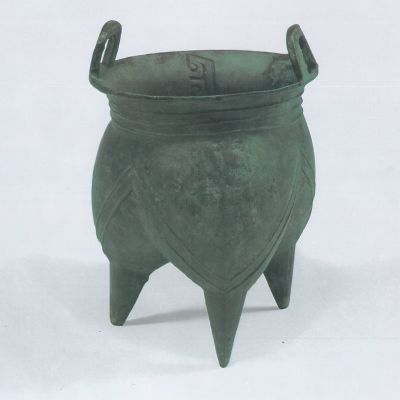 |
Left: Ceramic li 鬲-type tripod unearthed in 1999 in Yanshi, Henan, tomb M68, height 21.7cm, from Zhongguo Shehui Kexue Yuan Kaogu Yanjiu Suo Henan Di Er Gongzuodui (2006). Plate 7, no. 1. Right: Bronze li 鬲-type tripd, height 15.4cm. From Zhongguo meishu quanji bianji weiyuanhui/Li (1985), no. 23. |
|
 |
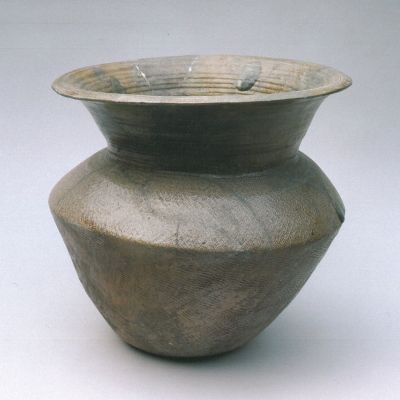 |
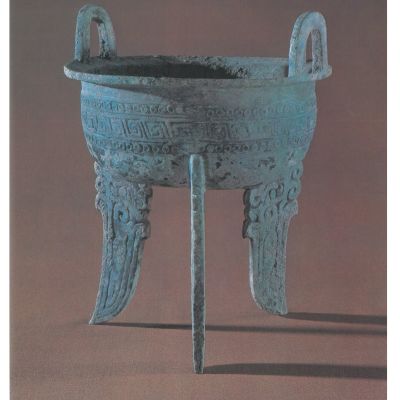
Left: Flat-legged tripod (pianzu ding 扁足鼎), unearthed in 1982 in Zhengzhou, Henan. Height 31.7cm. From Zhongguo meishu quanji bianji weiyuanhui/Li (1985), no. 7. Right: Brown-glazed zun- 尊 type vessel made of proto-porcelain, height 28cm, width of opening 27cm, from Zhongguo meishu quanji bianji weiyuanhui/Xia (1988), no. 72. |
|
Remains on fragments of bones show traces of an oracle inscription, but not with readable texts (Chang 1980: 269).
Another important site of the Erligang culture was Shixianggou 屍鄉溝 (called Shangcheng 商城) close to Yanshi 偃師, Henan. It was built roughly at the same place of earlier settlements of the Yangshao and Longshan cultures and an Erlitou village. Archaeologists divide the Shang phase of Yanshan into seven periods. The city of Yanshi, with an area covering 200ha (Campbell 2018: 69), included a 4.5ha-large palace area surrounded by a wall with a thickness of 16m at the base. In its apogee during phase III, the city covered an area of 200ha and was surrounded by a wall with five gates (Liu and Chen 2003: 91).
Part of the settlements were were semi-subterranean, others were surface dwellings, and most resembled the typical square constructions traditionally known as siheyuan 四合院, where a central courtyard is surrounded by a main hall in the background, side buildings to the left and right, and a wall with an entrance gate in the front. This structure formed the base of imperial Chinese architecture.
Workshops were also found in Yanshi, and modestly furnished tombs. It cannot be said whether the mode of burial in the early Shang period was just modest, or if archaeology has missed to find larger tombs of the nobility.
Large numbers of arrowheads and dismembered human skeletons prove that Yanshi and perhaps Erligang were flourishing in a time when war was quite frequent (Liu and Chen 2003: 91-92).
The expansion of the Erligang culture is reflected in the spread of ceramics with typical patterns and shapes that replace the Erlitou types. Erligang pottery is found from southern Shaanxi to the Shandong Peninsula, and from southern Hebei to Hubei.
Settlements in Taixicun 臺西村 close to Gaocheng 藁城, Hebei, Liujiahe 劉家河 close to Pinggu 平谷, Beijing, Shangqiu 商丘, eastern Henan, and Panlongcheng and Lijiazui 李家嘴 (Hubei) were "almost exact duplica[s] of Erligang" (Chang 1980: 303). Yet there were some local variants of the "metropolitan" style of Erligang and Yanshi, the most important of which is the Panlongcheng variant.
Panlongcheng, Hubei, is hundreds of kilometers south of Erliang, and thus shows how widespread the culture and influence of Erligang was. Panlongcheng must have been something like a fortified colony to assure the transport of ores from the Tongling 銅岭 copper mines to the political center at Erligang, where the ores were used to cast ritual bronze vessels and objects. Findings of bronze vessels and burial customs in Palongcheng are nearly identical to the findings in Erligang and the north (Campbell 2014: 85-86).
Furthermore, the tombs at Panlongcheng and Lijiazui are furnished with many more burial offerings than in the "capital city" Erligang. Bronzes were cast locally outside the city walls in the workshops by craftsmen that probably came from the north. The spread of Erligang bronzes to such a distant area makes it plausible that the rulers of Erligang conquered quite a large territory or at least made the local rulers subservient. Yet in spite of all points in which the remains of Panlongcheng resemble that of Erligang, there were many local characteristics. How the Eligang rulers controlled Panlongcheng is not known. Perhaps it was a military conquest, but in the long run domination might have been realized by alliance or kinship.
Panlongcheng was abandoned in the Anyang phase (Campbell 2014: 116, 161).
Farther more to the south, at Xingan, Jiangxi, the traces of the Wucheng Culture can be found, whose relicts are in style partially identical to the northern relicts but on the other hand show clear evidence of a local genuine style in vessel types as well as in decoration. The local lords in the Yangtze valley thus can not have been simple vassals of the northern rulers. In Wucheng, archaeologists discovered pots made from a primitive kind of porcelain. Some of these sherds were inscribed with signs that are interpreted as forerunners of Chinese characters. A tomb discovered at Xingan is the second-richest of the early bronze age, and is only surpassed by the tomb of Fu Hao 婦好, consort of King Wu Ding, in Anyang. The bronzes of Xingan are characterized by a richer decoration with new types of patterns that are not used in Erligang bronzes. Furthermore, this southern tomb was furnished with many more pieces of pottery than in northern tombs, and bronze vessels of the types ding and li are prevalent. Among the tomb furnishings were also types of bells (nao 鐃 and bo 鎛) unkown in the north.
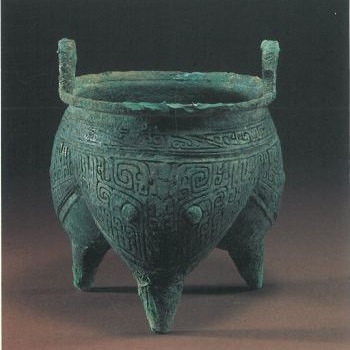 |
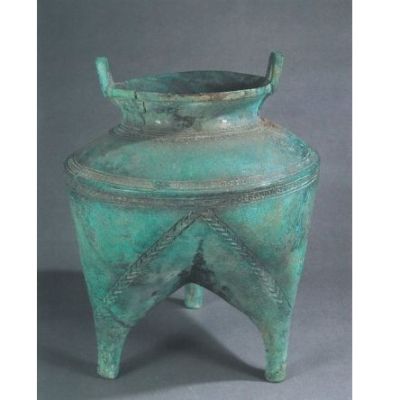 |
Anyang-style li 鬲 tripod, height 16cm. |
Local-style li tripod, height 39cm. |
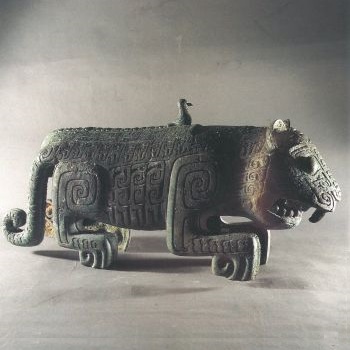 |
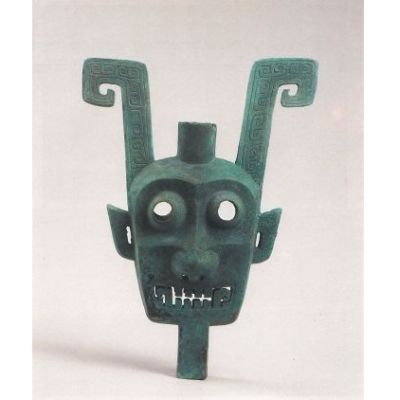 |
Bronze tiger similar to jade tiger found in Anyang. Length 53.5cm, height 25.5cm, width 13cm. |
Local-style bronze mask. Height 53cm, distance between horns 38.5cm. All images from Jiangxi sheng Wenwu Kaogu Yanjiuyuan (1997). |
The Huai River 淮水 region (northern Anhui, northern Jiangsu) was inhabited by people, whose traces can be seen in the bronze vessels unearthed in Funan 阜南 and Feixi 肥西, Anhui.
Near present-day Beijing, tombs were unearthed at Pinggu and Taixicun. They show no great diversity in the shape and decoration of bronze vessels, but pottery with features that were distinctive from the Central Plain. In southern Shaanxi, at Chenggu 城固, vessels of an extremely high quality have been unearthed. Some bronze vessel and weapon types might derive from Xingan types in the south.
The expansion of the Erligang state into southern Shanxi, for instance, to Dongxiafeng and Yuanqu (Nanguan), had the intention to secure the supply of copper and of salt, which was locally produced. The need for copper also drove Erligang to advance farther westwards to Chenggu, Donglongshan and Laoniupo 老牛坡, Shaanxi. Yet the "western" mines were then exhausted, and in the late Erligang phase, the state withdrew from the west and expanded to the southeast for copper, and eastwards to Daxinzhuang 大辛莊 close to Linqing 臨清, Shandong, for new access to salt (Liu and Chen 2003: 105, 127).
The centralized state of Erligang declined around 1500 and was replaced by a model in which local polities dominated the distribution of wealth. Members of the of the royal lineage were sent to act as supervisors ("feudal lords") of local resources (Liu and Chen 2003: 141-142). David Keightley (2000) calls this political system "segmentary state".
After the collapse of Erligang and Yanshan, a new centre emerged in Xiaoshuangqiao 小雙橋 not far away from Zhengzhou. The city there was not walled, and the whole archaeological situation suggests that around 1400 the Shang dynasty experienced political instability. Medium-sized urban centres were found in Shaochai 稍柴 and Fucheng 府城 close by.
Findings in Anhui and some sites in Shaanxi from the end of the Erligang period are witnesses of a diversification in styles and types, and thus of the multi-centered character of this historical period. After the end of the expansive Erligang period, and before the beginning of the Anyang Culture (late Shang), there was a phase that is by archaeologists called a transition period. Although various cultural centres existed, all these city states had intensive contacts with each other.
The Erligang period was around 1400 BCE overlapped by and began to be replaced by another cultural complex which is represented by the finds of Xiaoshuangqiao (close to Zhengzhou, Henan) and Huanbei 洹北 (close to Anyang, Henan). The most salient features of these archaeological sites are the richly furnished tombs and bronze hoards. These tombs with their "royal proportions" might have belonged to lords of Shang. Yet the political landscape of this phase is wholly unknown. Economic and perhaps political interaction between all parts of "China" existed during that time.
The Xiaoshuangqiao complex, discovered in 1989, revealed an architecural component, which is the first testimony of building structures which might have been inhabited by the elite. Huanbei, discovered in 1999, was enclosed by a large wall. The 470ha-large area included a building of considerable size (Campbell 2014: 109). The residential patterns and sacrificial remains of Huanbei strongly resemble those of Anyang.
Further discoveries might bring more light into this "transitional" phase of the Shang period.
Around 1250 BCE begins the historical period of Anyang 安陽 (by older archaeologists called Yinxu 殷墟, "Wastes of Yin"), the "capital" of the Shang dynasty in its later phase. The site was for many centuries looted by grave robbers, so only a fraction of the original wealth buried underground has survived. The only untouched tomb was that of Fu Hao 婦好, the consort of King Wu Ding 武丁 (trad. r. 1324-1266 BCE) which was discovered in 1976. Excavations in Anyang began in 1928 and went through a whole decade until the beginning of the Sino-Japanese War in 1937. The work was only resumed in the 1950s and continued until today.
The whole site covers an area of no less than 30km2 and is located in a plain crossed by the meanders of River Huan 洹河. Cemeteries, workshops, and residential areas were found in places like Xiaotuncun 小屯村, Hougang 後崗, Dasikongcun 大司空村, Guojiazhuang 郭家莊, Xibeigang 西北岡 Houjiazhuang 侯家莊, or Wuguancun 五官村. The "palace-temple" structures and tombs were larger and richer than in any of the preceding sites. Even if these features emerged from the Erligang Culture and its network, the Anyang phase added two distinct new features to the world of culture, namely writing, and the chariot - the latter being of foreign origin. The comparison of written sources on the oracle bones with such transmitted in historiographical writings make it much easier to establish an exact chronology of the Anyang period.
The Anyang phase began with a settlement with a size of 12km2 to the east protected by the River and in the west by a series of ponds. Bronze workshops as well as such for bones and jades were found close to the residential area. The palace-temple area included sacrificial (north, south) as well as administrative (centre) buildings. Oracle bone inscriptions reveal that there were gates in the royal compound, ritual halls (ancestral or lineage), officiating halls, sleeping rooms (private chambers), and earthen platform or altars. The one or other building might have corresponded to the Zhongwu Hall 重屋, a precursor of the Mingtang Hall 明堂 of the Zhou dynasty 周 (11th cent.-221 BCE) (Chang 1980: 134).
The residential area, albeit still imperfectly investigated, shows residential and mortuary clusters in which lineage settlements were associated with burials. Accidentally, roads and cart tracks were discovered. Most settlements were of the surfacial type, but there were also semi-subterranean dwellings. Most houses are small and have one or two rooms, but some include courtyard structures.
There seem to have been two tiers of workshops, namely highly centralized ones for royal production and more decentralized workshops which produced for the members of the various lineages. The workshops are scattered over a large area and might perhaps not have been under direct supervision of the kings, as would be necessary if the kings had a kind of monopoly over the production of ritual bronze vessels. Quite typically, the king presented his ministers and subjects with cowries which the donees bought bronze with to have vessels cast.
The royal cemetry of Anyang is located in Xibeigang. It consists of seven large tombs in the western section (M 1001, 1002, 1003, 1004, 1217, 1500, 1550), and the eastern section three (M 1129, 1400, 1443), all with north-south orientation, but slightly inclined to the east. The nine tombs correspond to the number of kings said to have ruled in Yin (Anyang). A rough chronology can be established, with M1500 as the oldest, and M1400 as the youngest tomb (Chang 1980: 117). The owners cannot be identified because inscriptions are missing, as all tombs were repeatedly robbed of their contents (which might have included inscribed vessels). Because of similarity with the Fu Hao tomb, it might be guessed that M1001 was the tomb of King Wu Ding (Chang 1980: 118).
Most tombs had four ramps leading down to the tomb chamber, giving the whole construction the shape of a cross. A fewer tombs had just two ramps, leading town to the central pit, where the coffin was placed in a wooden chamber. Additional pits were created to hold human sacrifice. The tomb chamber itself was cross-shaped or rectangular (Chang 1980: 114), perhaps with a door on the southern side. After finishing the 2- or 3-meters high chamber, sacrificial victims and burial objects (chariot fittings, weapons, bronze cauldrons) were placed outside the chamber. The ramps were also furnished with sacrificial victims, some of which were beheaded.
The site also includes second-rank tombs and several thousand sacrifical pits filled with human and animal remains. The latter demonstrate that the "cemetry" also served as a site of the cult of ancestral veneration. Over 15,000 tombs (Campbell 2014: 141) have been excavated in the Anyang site, among which those of various royal lineages were located in different parts of the area.
 |
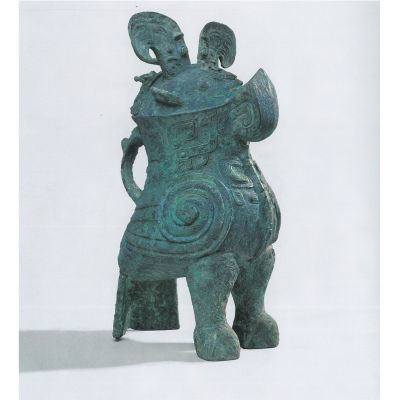 |
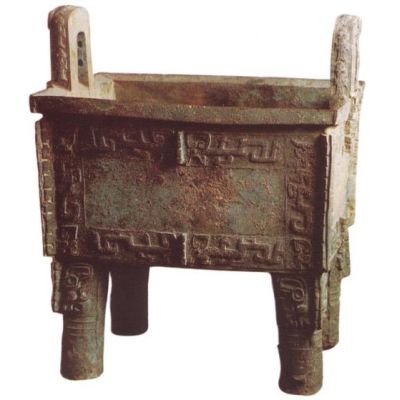
Left: Square bronze vessel (fangding 方鼎) with the inscription Si (=Hou) mu wu 司(=后)母戊, cast for King Wu Yi's 武乙 consort Fu Jing 婦妌. Height 133cm, weight 832.84kg, unearthed in 1932 in Wuguancun 武官村 close to Anyang, Henan. From Han (2005), Vol. 1, 54. Right: Bronze zun vessel in the shape of an owl, from the tomb of Queen Fu Hao, unearthed in 1976, height 45.9cm. From Zhongguo meishu quanji bianji weiyuanhui/Li (1985), no. 36. |
|
 |
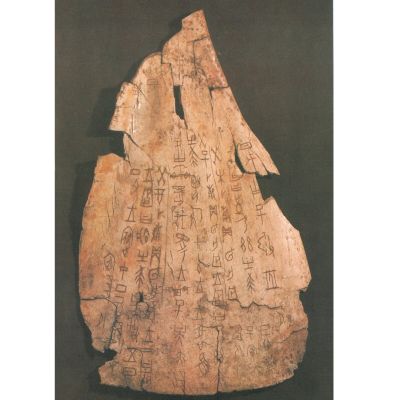 |
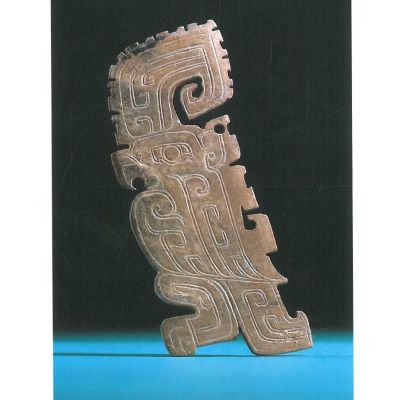
Left: Jade bird, by Chinese scholars identified as a "parrot" (yingwu 鸚鵡), length 11.2cm, discovered in 1976 in the tomb of Queen Fu Hao. From Zhongguo meishu quanji bianji weiyuanhui/Yang (1986), no. 69. Right: Oracle bone made of a bovine scapula, with several inscriptions, length 32,2, width 19,8cm. From Guo/Zhongguo Shehui Kexue Yuan Lishi Yanjiu Suo (1982), Vol. 1, fig. 5 |
|
From the oracle bone inscriptions it can be observed that in the last few decades of the Yin period the Shang state enjoyed a quite peaceful time. While during the reign of King Wu Ding there were frequent military campaigns against the Tufang and Gongfang, the kings of Yin might have lost their influence on communities in modern Shanxi and Shaanxi. Interference into the politics of the peoples and states living in this area was beyond the Yin king's sphere. Surprisingly, the last kings of Yin did not rely on friendly lords as their allies in wartime. One former ally, Zhou, had become an enemy and suddenly took over the control of the Central Plain in the mid of the 11th century BC.
Although the area where ritual bronze vessels were cast during the Anyang period is much larger than before, the types and decorations of the various regions show a great diversity. The vessels of the Yangtze region are the first who were given the shape of elephants or rhinoceroses (no more fabulous stylized "dragons" or taotie 饕餮 masks of voracious monsters), a pattern adopted later by the Zhou artisans. Nao bells from Ningxiang 寧鄉, Hunan, are extremely huge compared with the Anyang bells of Fu Hao's tomb. Unknown to the north are also the large bronze drums like that found in Chongyang 崇陽, Hubei.
The apogee of Wucheng was the transitional period in the 14th and early 13th centuries. The site was 60ha in size and was surrounded by an irregular earthen wall of non-stamped earth. Wucheng included workshops for bronze casting, stonewares and proto-porcelain. The local culture thus might be the source of the stamped and glazed stoneware and proto-porcelain found in Central Plains sites like Erligang and Yuanqu, Shanxi. During the Anyang period, Wuchang pottery showed increasingly local characteristics, for instance, in the widespread use of yan 甗-type vessels. Moreover, artifacts are incribed with what appears to be an unkown script (Campbell 2014: 92-93, 104n22, 120).
Wucheng was the place of a copper mine in Tongling, Ruichang District 瑞昌. It was in operation from the Anyang period on (Campbell 2014: 160). The most spectacular find of the Wucheng culture was the tomb of Niutoucheng 牛頭城 in the district of Xingan. The assemblage of bronzes found in the tomb encompasses pieces from the Erligang to the Anyang phase. The mix of styles gives evidence of a large network embracing the lower and middle Yangtze regions and extending to the Central Plain (Campbell 2014: 115, 164).
In Shandong in Subutun 蘇埠屯, the largest tomb outside of Anyang was discovered, abundantly supplied with human sacrifices. Subutun had close relationships with Anyang or was perhaps a kind of colony. Some of the tombs resemble the royal tombs of Anyang. Scholars interpret these tombs as those political rivals to the Shang or as those of high and privileged dignitaries (Campbell 2014: 144). Nearby in Daxinzhuang, a few inscribed oracle bones were discovered. Nearly all sites in that region and from the late Anyang period include bronze vessels inscribed with clan insignia, part of them known from Anyang.
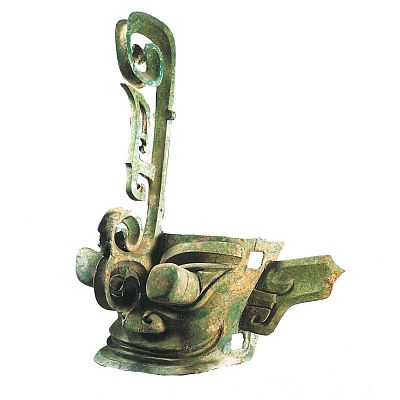
The site of Sanxingdui in the district of Guanghan north of Chengdu 成都, Sichuan, was discovered in the late 1920s. Local persons discovered several stone and jade tools and pottery dating from the Neolithic age. Scholarly excavations began in 1933 and were resumed after the war, in 1953. During the early 1980s, a city wall was discovered, and in 1986 two sacrificial pits (jisikeng 祭祀坑) that included spectacular objects with features very different from the culture of the Central Plain.
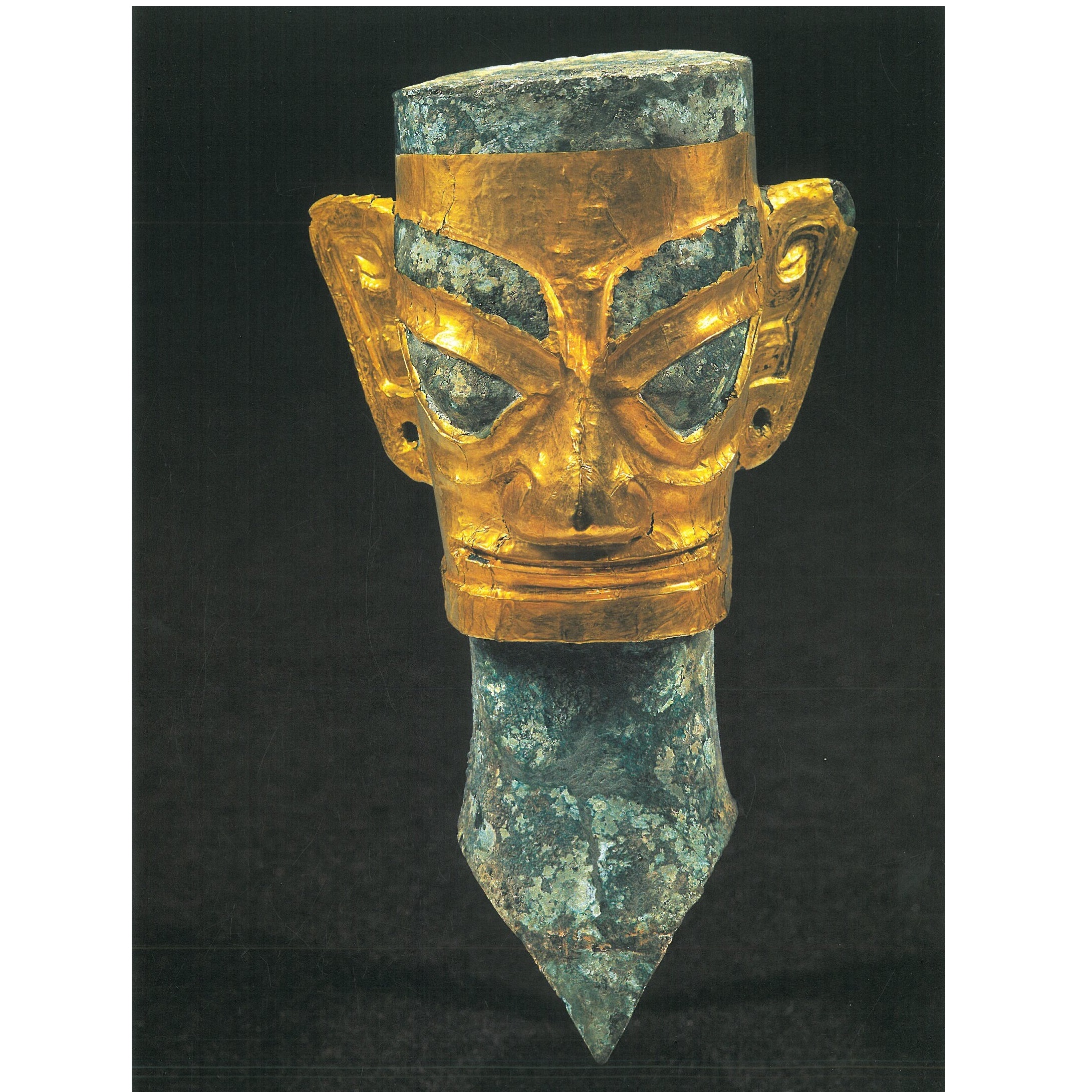
The cultural difference was seen in motifs and decorations, utensils, and the intensive use of gold. Whereas the cultural world of Erligang and Anyang made sparely use of human figures or human faces as motifs, masks and statues, or depictions of persons on jade and stone objects made out a substantial part of the bronze items found in Sanxingdui. Even if Anyang-style spiral patterns were found on some bronze vessels, they were only part of a much wider range of large bronze objects. Moreover, the shape of bronze vessels of Sanxingdui differed somewhat from those of Anyang. Several of the masks found in Sanxingdui were covered by gold leaves. Gold foil was also cut into the shape of dragons or long slips. A wooden staff was covered with gold and decorated with fish patterns.
 |
 |
Giant bronze mask, height 82.5cm, width 78cm. Xiao (2001): 73. |
Human head plated with gold foil, height 42.5cm. Sanxingdui bowuguan (2005). |
 |
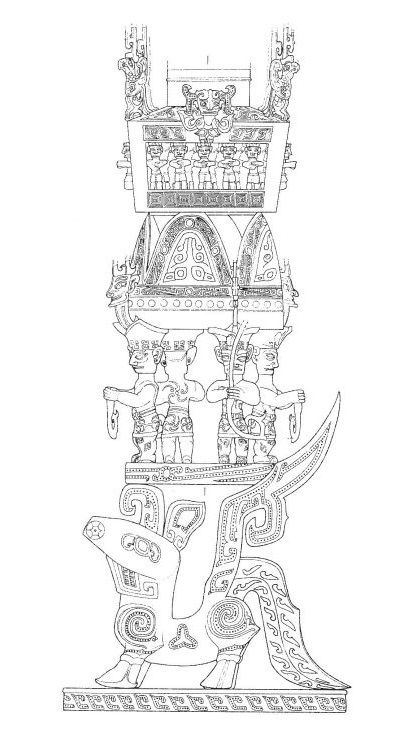 |
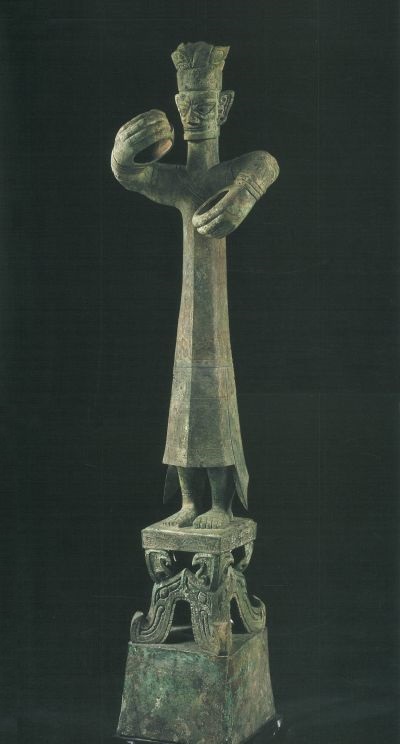
Figure of a standing human, with hands formed to hold a staff. Height 180cm, with base 260.8cm. Sanxingdui bowuguan (2005), plate between 16-17. |
Drawing of the original appearance of a "spirit altar" (shentan 神墰) consisting of three storeys, with beasts symbolizing the underworld, a group of humans symbolizing the human world, and a chest Heaven. Sanxingdui bowuguan (2005): 65. Total height with top decoration perhaps up to 4 or even 5m (Sun 2010: 53). |
 |
 |
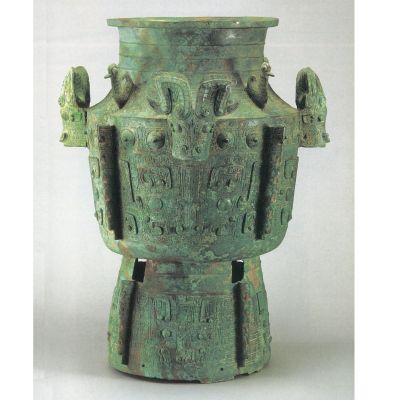
Local-style bronze zun 尊 with long base, height 53,4cm. Xiao (2001): 83. |
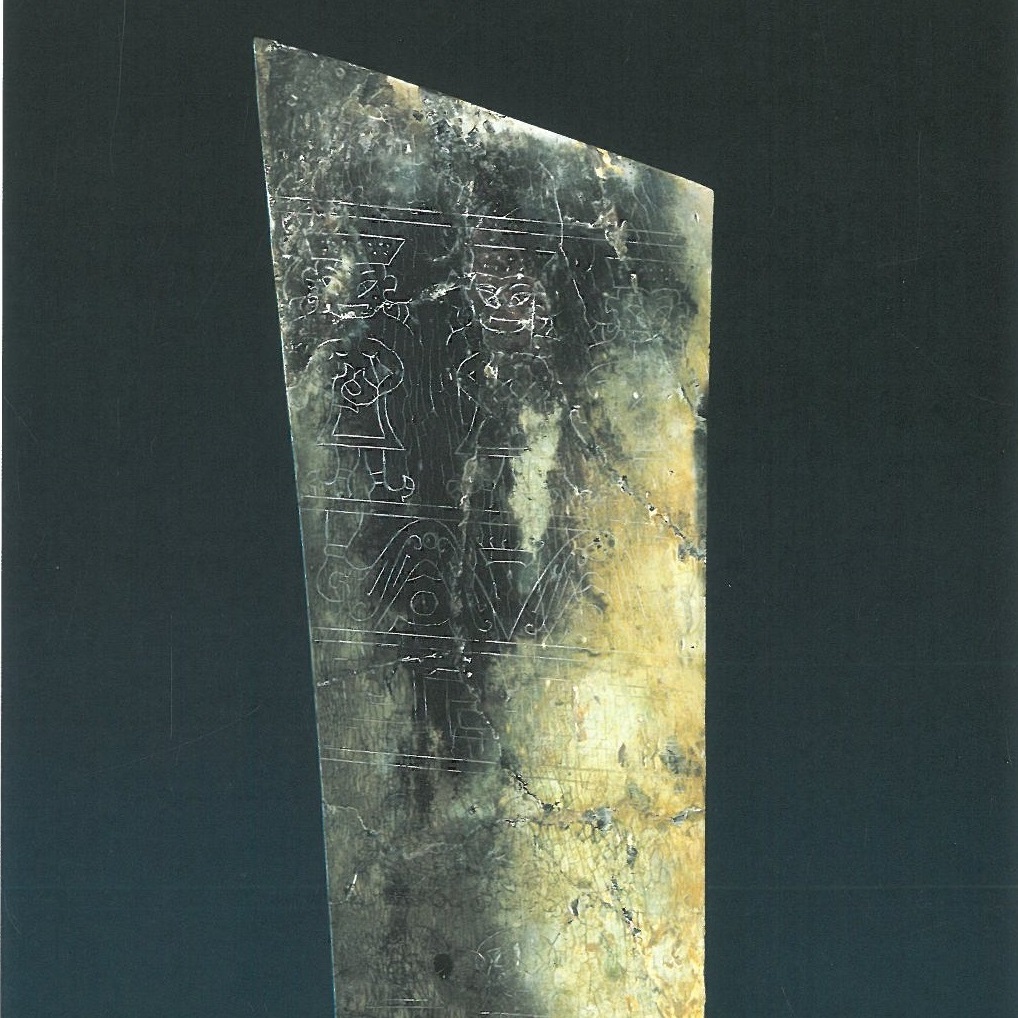
Zhang 璋 "sceptre" of jade, incised with human figures (detail). Total height 54.2cm, width at top 8.8cm. Sanxingdui bowuguan (2005): 103. |
Bronze masks were either used separately, like the huge mask with a size of 82*78cm, another one with a dimension of 138×66 cm, or to serve as head covers of wooden beams. The figures of cocks or other birds were likewise used to crown ceremonial (?) staffs. Another type of object not known in the Central Plain was a so-called "spirit tree" (shenshu 神樹) totally made of bronze. Birds were sitting on the branches of the tree. The construction of a so-called "spirit altar" (shentan 神壇) consisted of an assemblage of three different sets, the base consisting of a beast, the second storey of a group of persons, and the highest of a decorated bronze chest. The object was damaged by fire, yet there are several attempts at reconstruction (Sun 2012), and explanation. Laoban Salong (2012) uses religious objects used by the Yi nationality to interpret these sacral objects: The beast at the bottom signifies the underworld, the group of persons the human world, and the chest at the top the world of spirits.
One pit included a rich collection of elephant tusks.
Quite outstanding is the large number of objects made of green jade, used for bi disks and as beads or tubes for necklaces. More yellowish or whitish jade was used for zhang-type 璋 "scepters". Some of the zhang scepters were decorated with carved scenes of standing persons.
The Sanxingdui site also included cowries that must have been traded from the Indian Ocean via Yunnan, and perhaps on to the Central Plain.
Weapons are scarce, and look different from those of the Central Plain, particularly the ge 戈-style dagger axes that had sharply toothed blades.
The history of Sanxingdui is usually divided into four periods, the first corresponding to the Baodun Culture of the late Neolithic age, the second and third to the early Shang or Erligang period, while the long fourth Sanxingdui period ranges from the late Shang or Anyang period to the Spring and Autumn period 春秋 (770-5th cent. BCE).
The art of bronze casting as seen in the finds of Sanxingdui is considerably high and leads to the conclusion that it was directly imported from the northwest, and spread from Sichuan to the Yangtze River region, where it influenced local cultures (Jiang 2006).
Even if the bronzes vessels of Sanxingdui show contact with the cultural sphere of Erligang or Anyang, they take form of ritual or status artifacts rather than those of daily use (Campbell 2014: 56). Other scholars claim that bronzes at Sanxingdui show no Erligang influences, but similarity to vessels from the Middle Yangtze Region (Campbell 2014: 96, 121). Sanxingdui tombs do not contain human sacrifices like in the Central Plain. Of great interest is the function of polities in the Sichuan Basin for the trade of cowry shells from the Indian Ocean via Yunnan to the Central Plain. Chinese scholars found out that lead used for Central Plain bronze vessels originated in Yunnan (Campbell 2014: 167). Also for the trade of metal, thus, Sichuan seems to have been a trade pivot.
The Wei River valley, the region of the Zhou conquestors, shows no sophisticated culture but instead seems to be an eager recipient of Erligang, Anyang, southern and northern-Siberian cultures. Although archaeologists tried to find a trace of a proto-Zhou culture this task seems not to be solvable because of the abundancy of archaeological relics of different cultures. The Zhou people thus might have been a mixture of different cultural cradles, including nomad warriors from the west. Like the state of Qin 秦 later, the Zhou rulers might have obtained an excellent training in military techniques by the permanent challenge of nomad raiders within their territory.
In China's north that was inhabited by nomad tribes, casting of ritual bronze vessels was not as important as that of weapons and other tools for daily use. There seems to be no deep influence of Erligang bronze casting techniques, and some historians assume the arrival of foreign populations at the end of the Erligang period that made use of gold rather than bronze. Around 1200, the chariot came in use in the Anyang region, perhaps brought to the Shang by such immigrants.
The archaeological discoveries make evident that pre-Zhou China was not ruled by a single state or a Shang Dynasty as supposed by the traditional historiographic sources. Early bronze-age China instead was inhabited by numerous communities with different cultural traditions several of which proved to be politically superior and were able to dominate a larger territory for a certain time, like the Erligang Culture and the Anyang Culture.
There must have been a partial parallel development and considerable overlap between the Xia and Shang, and the Shang and Zhou dynasties, respectively, and not a sequential succession, as suggested in the Shiji and other written sources (Chang 1980: 350-351). This is also the reason that historiography speaks of chieftains or pre-dynastic rulers (xianwang 先王) in all three cases. Geographically, the Xia (2400-1200 BCE) dominated the centre of the Yellow River Plain, the Shang (1800-1050) more the east, and later the Zhou (1400-770) its western fringes, yet all three were regional modes of the Neolithic Longshan Culture. They shared the same culture and differed only in detail and designations for rituals in particular. All were similarly ruled by dynastic lineages, fundamental similarities in succession (like the binary system of ancestral veneraton, by the Zhou called zhaomu 昭穆), appointing (feng 封) lineage members as regional rulers, and all of them built walled towns.
Archaeological finds also contradict a state-sponsored project called Xia–Shang–Zhou Chronology Project, which tried to establish a sequential chronology of the rulers of the Xia, Shang, and Zhou dynasties in order to verify traditional historiographical accounts.
Finds all over China demonstrate that the "Shang" culture of the Central Plain was dominant in its time, but experienced an admixture of local influence in many places. When the Zhou conquered ancient China from the west, they inherited parts of the political and cultural institutions of the Shang rulers in Yin, like calendar, script, and the religion of ancestor veneration. It was the Zhou historiography and tradition that blinded out all other cultures of the late 2nd millenium BCE and purported that a single universal dynasty, the Shang, ruled over the Central Plain. The Zhou took over their territory and claimed thus the political legitimacy over "all under Heaven" (tianxia 天下).